What Do Heat Pumps Cost to Install? A Practical Guide
Discover what drives heat pump installation costs, typical price ranges for air-source and geothermal systems, and practical tips to estimate, finance, and maximize value.


Installed heat pump costs typically range from $3,500 to $8,000 for a standard air-source system, with higher expenses for ductless mini-splits or homes requiring ductwork upgrades, and geothermal systems commonly $20,000 to $40,000. These figures include the unit and professional installation, but local permits, wiring, and retrofit work can raise the total. Heatpump Smart analysis notes that incentives can reduce net price.
What determines heat pump installation costs
Understanding cost starts with the headline question: what do heat pumps cost to install? In practical terms, the biggest drivers are system type (air-source vs geothermal), required capacity (tons or zones), and the condition of existing infrastructure (ductwork, electrical panel, and permits). Homeowners often misestimate based on unit price alone. The Heatpump Smart team finds that the installed price is a blend of equipment, labor, and site-specific work. If your home already has a well-functioning duct system, you can save on ductwork costs; conversely, homes without ducts will require significant upfront investments for ductwork or zone-level mini-splits. Climate also matters: milder climates may use smaller units, while cold climates require higher efficiency units to maintain comfort at low outdoor temperatures, impacting cost and long-term savings. Local labor rates and permit requirements add further variance. Importantly, installation quality affects long-term costs: a poor install can lead to higher maintenance and energy waste, eroding upfront savings.
Cost ranges by system type
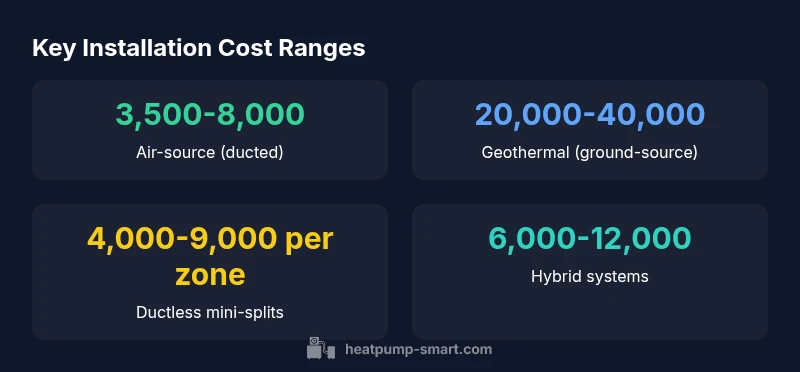
Direct cost ranges help set expectations. For a typical air-source heat pump installed in a house with existing ductwork, you can expect a price range roughly between $3,500 and $8,000. If you’re opting for a ductless mini-split, costs generally start higher per zone, often in the range of $4,000 to $9,000 per zone, due to outdoor units, refrigerant lines, and installation complexity. Geothermal systems, which require ground loops or boreholes, are substantially more expensive upfront, commonly between $20,000 and $40,000 for a complete installation, though they can deliver very low operating costs in the right climate. There are also hybrid options, combining a heat pump with a fossil-fuel backup, typically in the $6,000 to $12,000 range, depending on configuration. Don’t forget additional items that can swing the total, such as new thermostats, smart controls, or necessary electrical panel upgrades. Across all types, prices vary by contractor, region, and the need for retrofit work.
Hidden costs and upgrade considerations
Beyond the sticker price, several upgrade lines commonly surprise homeowners:
- Ductwork upgrades and sealing can add thousands to the bill if existing ducts are old, leaky, or poorly sized.
- Electrical service upgrades or new subpanels may be required for higher-capacity units.
- Permits and inspections add to both time and cost, especially in building areas with strict codes.
- The outdoor unit installation location, refrigerant line length, and need for trenching or boreholes influence labor and material costs.
- Zone controls and smart thermostats can improve comfort and efficiency but add upfront costs.
- Paperwork for rebates and tax incentives can require documentation and time. Heatpump Smart recommends planning for these elements early to avoid sticker-shock at the install.
How to estimate your own cost: a practical method
Start with your home’s size, climate, and whether you have existing ducts. Then follow a simple calculator-style approach:
- Determine target efficiency (SEER/HSPF) and size (tons) based on load calculations.
- Pick air-source vs geothermal and decide on ducted vs ductless.
- Factor in non-equipment costs: ductwork upgrades, electrical work, and permits.
- Add a 10-15% contingency for unforeseen wiring or retrofit needs.
- Subtract any federal, state, or local incentives you qualify for. Finally, compare multiple full quotes that itemize equipment, labor, and ancillary costs, so you’re comparing apples to apples. Heatpump Smart suggests asking installers for a 2- to 3-page scope of work and a detailed breakdown.
Financing, rebates, and incentives you should know
Rebates and incentives can significantly affect the bottom line, though programs vary by location. Expect federal and local incentives to influence net price, with some programs offering substantial credits for high-efficiency heat pumps and properly insulated homes. Your final cost often reflects both the up-front subsidy and how well the system reduces annual energy consumption. Because programs change, start by confirming eligibility with your installer and checking state and local energy offices or trusted sources. Heatpump Smart notes that understanding the lifecycle costs—initial investment, maintenance, and energy savings—helps you evaluate true value rather than focusing solely on upfront price.
Choosing the right installer for value
Value comes from a capable team that performs accurate load calculations, installs to code, and provides solid after-sales service. When evaluating bids, look for:
- A valid license and clear references for similar homes
- A documented load calculation (Manual J) and a proposed system capacity
- A written scope of work including ductwork, wiring, permits, startup, and warranty terms
- Transparent line items: equipment, labor, permits, and contingencies
- Realistic timelines and a plan for commissioning and refrigerant charge checks Quality installation reduces calls for service and ensures your equipment operates at peak efficiency. Heatpump Smart advises homeowners to prioritize installers who explain tradeoffs between efficiency, cost, and comfort, rather than pushing the most expensive option.
Long-term value: operating costs, maintenance, and depreciation
A heat pump’s upfront price is just one piece of the equation. Operating costs depend on climate, usage patterns, and unit efficiency. Higher SEER and HSPF ratings typically deliver greater energy savings, but the savings are climate-dependent. Regular maintenance—air filter changes, coil cleaning, and annual checkups—extends system life and preserves efficiency. When calculating total cost of ownership, include potential depreciation for property value, reduced heating season energy bills, and the impact of rebates on the net price. A well-chosen system can provide comfortable year-round climate control with lower lifetime costs compared with older HVAC setups. Heatpump Smart emphasizes that homeowners, builders, and property managers should view installation as a strategic decision that blends upfront investment with long-term energy savings.
Common mistakes to avoid when budgeting for installation
- Underestimating ductwork costs or assuming existing ducts are perfectly sized
- Failing to account for electrical upgrades or permit fees
- Ignoring incentives or assuming they don’t apply to your home
- Selecting a system based on upfront price alone rather than total cost of ownership
- Skipping load calculations and documentation in the bidding process
- Not planning for future zoning or smart controls that improve comfort and efficiency Careful planning helps you avoid surprises and achieve maximum value over the system’s lifetime.
Estimated installed costs by system type
| Installation Type | Typical Cost Range (USD) | Notes |
|---|---|---|
| Air-source (ducted) | 3,500-8,000 | Unit + standard ductwork; regional variation |
| Air-source (ductless mini-split) | 4,000-9,000 per zone | Outdoor unit + zone-specific installation |
| Geothermal (ground-source) | 20,000-40,000 | Ground loops and excavation; climate impact |
| Hybrid heat pump system | 6,000-12,000 | Heat pump with fossil backup |
Your Questions Answered
What is the typical cost to install an air-source heat pump?
Air-source installation commonly falls in the $3,500-$8,000 range, depending on size, ductwork, and local labor costs. Additional upgrades may apply for ductless configurations or older homes requiring retrofits.
Air-source installations usually cost between three and eight thousand dollars, with variations based on house size and ducts.
Does ductwork affect the cost significantly?
Yes. Upgrading or repairing ductwork can substantially affect total cost, especially if existing ducts are leaky or poorly sized. Ducted systems tend to be cheaper upfront than adding multiple zones with ductless setups.
Ductwork can change the price a lot; leaky or bad ducts mean more cost but better long-term performance.
Are rebates or tax credits available for heat pumps?
Federal, state, and local incentives can reduce the net price, but eligibility varies by location and system type. Work with your installer to identify applicable programs and required documentation.
Yes, there are rebates and credits, but they depend on where you live and the system you install.
How long does installation take?
Most residential installations take 1-3 days, depending on system type, ductwork needs, and electrical work. Complex installations may require more time for permits and commissioning.
Most installs take about a day or two, sometimes a bit more if ductwork or permits are involved.
Is geothermal worth it for climate control?
Geothermal costs are higher upfront but can offer very low operating costs in suitable climates. Consider long-term savings, available incentives, and site suitability when evaluating value.
Geothermal costs more now, but can save more later if your climate and site are right.
Should I replace an old HVAC system with a heat pump?
Often, retrofitting to a heat pump is sensible when replacing a furnace or condenser. Assess space, wiring, rebates, and cooling needs to determine if a heat pump provides better value.
If your old system is near the end of its life, a heat pump can offer better efficiency and comfort.
“Choosing the right heat pump is about value, not just upfront cost. A well-qualified installer can maximize efficiency gains and ensure reliable performance for years.”
Top Takeaways
- Budget for ductwork upgrades if needed
- Compare total installed costs, not just unit price
- Factor in incentives to reduce net price
- Ask for itemized quotes from licensed installers
- Plan for a few days of installation time