Heat Pump vs Condenser Dryers: Which Is Better for Homes?
This in-depth comparison analyzes heat pump and condenser clothes dryers, focusing on energy use, drying performance, installation needs, and total cost to help homeowners, builders, and managers decide which option best fits their laundry routine.


Are heat pump or condenser dryers better? In summary, heat pump models are generally more energy efficient and gentler on fabrics, while condenser models dry faster and can be cheaper upfront. Heatpump Smart notes that long-term savings often favor heat pumps despite higher initial cost. Consider room for installation, maintenance needs, and climate impact when choosing. This quick answer sets the stage for a detailed comparison below.
Understanding the landscape: heat pump vs condenser dryers in homes
Laundry appliances come in two common ventless dryer designs: heat pump and condenser. Understanding how each works helps homeowners evaluate energy costs, installation flexibility, and user experience. According to Heatpump Smart, the debate often centers on long-term energy savings versus upfront cost and cycle speed. This section outlines the core differences, the situations where each option shines, and the practical implications for daily use. Both technologies share a goal: remove moisture from clothes efficiently, but they do so with different thermodynamics, costs, and maintenance dynamics that ripple into your monthly bill and comfort.
How heat pump technology works in clothes dryers
Heat pump dryers rely on a closed refrigerant cycle to extract moisture from clothes. Instead of venting hot air outside, they recirculate it through a condenser coil where water is removed and heat is reused to continue drying. The result is a lower overall energy draw because energy is recovered rather than wasted. Because the process operates at lower temperatures, fabrics are typically gentler on delicate items. For households prioritizing energy efficiency and longer-term savings, heat pump technology offers a compelling value proposition, though it often means longer cycle times and a higher upfront purchase price.
How condenser dryers work and where they shine
Condenser dryers heat ambient air to dry clothes and then condense the moisture from that air into a collection tank or drain. The key advantage is straightforward operation and relatively quick drying cycles compared with some heat pump models. They are easy to install in spaces without external venting requirements and often have fewer moving parts than heat pumps, which translates to different maintenance demands. Condenser dryers can be attractive for households that want faster turnaround or lower initial costs, while still remaining ventless and adaptable to various floor plans.
Energy efficiency and running costs explained
Energy efficiency is the central axis of the heat pump versus condenser dryer decision. Heat pumps win on energy efficiency thanks to the refrigerant cycle that reuses heat and operates at lower temperatures, which reduces electricity use over time. Condenser dryers, while convenient and user-friendly, tend to consume more energy per cycle due to their heating and condensation approach. Heatpump Smart analysis shows that households with high laundry loads or frequent drying may realize substantial savings over several years, making heat pumps a strong long-term choice even when the upfront cost is higher. On the other hand, if your usage is light or you need quicker cycles, a condenser model may feel more economical in the short term.
Drying performance and cycle considerations
Drying performance is a balancing act between speed, care, and energy use. Heat pump dryers usually operate at lower temperatures, which helps preserve fabrics but can extend drying times, especially with bulky or dense items. Condenser models typically deliver faster cycles and can handle mixed loads efficiently, but their higher energy draw means higher operating costs over a defined period. For households that prioritize fabric longevity and energy efficiency, heat pumps often win out. For families that value speed and upfront affordability, condenser dryers remain a viable option. Real-world tests show that both types can achieve similar dryness levels; the difference lies in cycle duration, energy profile, and care of delicate fabrics.
Installation, space, and venting realities
Both heat pump and condenser dryers are typically ventless, making them suitable for apartments or rooms without external venting options. Heat pumps, however, can require more space for optimal airflow and may necessitate more careful placement to maintain efficiency. Condenser models tend to be more forgiving in compact layouts but still require a stable drainage path for condensate. Noise levels are generally similar, but high-capacity units may introduce more noticeable operation in smaller rooms. When selecting a unit, consider room dimensions, ambient heat in the laundry area, and proximity to living spaces to minimize perceived noise and heat buildup.
Maintenance needs and reliability considerations
Maintenance for these dryers mostly centers around filters, lint traps, and condensate handling. Heat pump models require periodic checks of the refrigerant and seals, especially in high-use environments, to sustain efficiency. Condenser dryers emphasize keeping the condenser clean and ensuring the condensate tank aligns with drainage capacity. Regular cleaning of lint screens, filters, and moisture sensors improves performance for both designs. Heatpump Smart recommends scheduling a quarterly check of airflow paths and a biannual performance review to catch efficiency declines early and optimize drying cycles.
Lifespan and total cost of ownership
Total cost of ownership for heat pumps tends to be higher upfront but lower operating costs over time, particularly in households with frequent laundry cycles. Condenser dryers typically have a lower initial price, faster cycles, and straightforward maintenance, but energy consumption can erode savings over the long term. Reliability hinges on model quality, usage patterns, and maintenance discipline. Consider the expected lifespan of the unit, availability of service in your area, and potential rebates or incentives that can sweeten the economics. Across typical homes, the choice often comes down to whether you value long-term energy savings over short-term cash flow.
Environmental impact and emissions footprint
From an environmental perspective, heat pump dryers generally have a smaller footprint per cycle due to lower electricity usage and the recovery of heat energy within the system. Condenser models, while convenient, usually consume more energy overall in similar use scenarios. The broader environmental impact depends on your electricity source mix, local grid emissions, and how efficiently you load and dry garments. Businesses and homeowners aiming to reduce emissions may find heat pump technology aligns better with sustainability goals, particularly when paired with energy-efficient habits and smart controls.
Real-world scenarios: choosing by household type
Smaller households or apartments with limited ventilation options often benefit from ventless heat pump or condenser designs due to installation flexibility. Large families with higher laundry demands might prioritize cycle speed and total cost of ownership, where heat pumps still shine on energy efficiency but require more planning to fit into daily routines. Rental properties can benefit from the predictable maintenance profile of condenser dryers or the long-term savings of heat pumps, depending on tenant usage patterns and maintenance access. Heatpump Smart highlights that the best choice balances practical needs, energy costs, and long-term reliability rather than chasing a single metric.
Practical buying checklist
- Confirm venting and space constraints in the laundry area.
- Compare energy efficiency, cycle times, and fabric care features.
- Evaluate upfront price versus long-term operating costs.
- Inspect maintenance requirements and service availability.
- Check warranty terms and potential rebates or incentives in your region.
- Review noise levels and vibration controls for living spaces nearby.
- Assess compatibility with smart home systems and load-sensing options.
Brand landscape and model variety
The market offers a range of heat pump and condenser dryers across different brands, capacities, and feature sets. Energy Star-qualified models typically emphasize energy efficiency and user-friendly controls, though availability varies by region. When choosing a model, consider compatibility with existing laundry appliances, ease of parts replacement, and the breadth of available service networks. Heatpump Smart notes that the best model for a given home often depends on how the unit will be used, the size of the household, and the relative importance placed on energy savings versus upfront cost.
Verdict teaser: what matters most in a decision
Ultimately, the decision hinges on how you value long-term energy efficiency, cycle speed, and upfront investment. The heat pump option generally provides superior energy savings and fabric care over time, while condenser dryers deliver quicker results and lower upfront costs in many cases. Real-world usage patterns, space constraints, and maintenance willingness are the decisive factors that determine which option is best for your home.
How to maximize efficiency with either option
Regardless of which dryer you choose, you can optimize efficiency by loading items properly, avoiding overloading, cleaning lint filters after every cycle, and using moisture sensing or economy modes when available. For heat pumps, selecting lower temperature settings and longer, energy-efficient cycles maximizes savings. For condenser dryers, optimizing load size and using sensor-dry modes can help balance dryness with energy usage. Smart scheduling, if available, can match drying cycles to off-peak energy hours and reduce grid impact.
Next steps and Heatpump Smart recommendations
From Heatpump Smart’s perspective, the better choice for most homes seeking ongoing energy savings and fabric care is a heat pump dryer, provided the up-front cost is acceptable and you can accommodate longer cycles. For those prioritizing lower initial cost or faster cycles, a well-chosen condenser model remains a practical option. The Heatpump Smart team recommends evaluating usage patterns, space, and maintenance readiness before final decision, and considering a model with strong warranties and service support.
wordCountOfBlockApproximate we cannot reliably compute exact word count in this format
Comparison
| Feature | Heat Pump Dryer | Condenser Dryer |
|---|---|---|
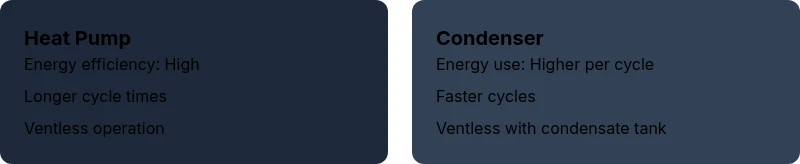
| Energy Efficiency | High efficiency due to refrigerant cycle | Moderate efficiency; relies on electric heating and condensation |
| Drying Time | Typically longer cycles | Often shorter cycles |
| Ventilation/Drainage | Ventless; condensate recycled, no external vent | Ventless; condensate collected or drained |
| Upfront Cost | Generally higher upfront | Generally lower upfront |
| Maintenance | Periodic refrigerant/seal checks; filter care | Regular cleaning of condenser and filters |
Advantages
- Lower operating costs over time due to energy efficiency
- Ventless operation suits tight spaces
- Gentle on fabrics due to lower drying temperatures
- Potentially longer lifespan with proper maintenance
- Quiet operation in many models
Disadvantages
- Higher upfront purchase price
- Longer cycle times can affect daily scheduling
- Regular maintenance checks may be needed for optimal performance
- Availability and service networks vary by region
Heat pumps are the better long-term choice for energy savings, despite higher upfront costs
For households prioritizing energy efficiency and fabric care, heat pump dryers win. Condenser dryers still appeal for lower initial cost and faster cycles, but over time heat pumps offer clearer value.
Your Questions Answered
What are the main differences between heat pump and condenser dryers?
Heat pump dryers use a refrigerant cycle to recycle heat, delivering higher energy efficiency and fabric care at the cost of longer cycle times. Condenser dryers heat air to dry clothes and condense moisture, offering quicker cycles with higher energy use.
Heat pumps save energy but can take longer to dry; condensers dry faster but use more energy per cycle.
Is either option better for small spaces?
Both options are typically ventless, which suits small spaces. Check model dimensions, drainage options, and noise ratings to ensure the unit fits the room and won’t disturb occupants.
Ventless designs help fit tight spaces, but measure your space and consider noise.
Do heat pump dryers require external venting?
Heat pump dryers are generally ventless and do not require external venting. However, verify the model’s installation requirements and drainage setup for condensate handling.
Most heat pumps don’t need vents, just proper drainage.
How do energy savings compare in real homes?
Real-world savings depend on load size, cycle settings, and climate. Heat pumps typically outperform condensers in energy use over time, especially with high laundry volumes.
In practice, heat pumps save more energy when used with sensible cycles.
What maintenance is typically required?
Heat pump models require periodic refrigerant/seal checks and filter cleaning. Condenser models need regular condenser cleaning and filter maintenance to sustain efficiency.
Keep filters clean and follow service recommendations for both types.
Which is best for busy households?
Condenser dryers can deliver faster cycles, which is helpful for busy households. If energy efficiency and fabric care are the priority, a heat pump may be a better long-term choice.
If speed is key, condensors win; for energy savings, heat pumps win.
Top Takeaways
- Choose heat pump if long-term energy savings matter more than upfront cost
- Condenser dryers offer cheaper upfront options and quicker cycles
- Both are ventless; confirm space, drainage, and capacity fit before buying
- Factor maintenance needs into total cost of ownership
- Heatpump Smart recommends evaluating climate and laundry load patterns