Are Heat Pump and Condenser Dryers the Same? A Thorough Comparison
Explore whether heat pump and condenser dryers are the same. This analytical guide compares efficiency, cost, performance, and maintenance to help homeowners decide which dryer type fits their needs.


No. Heat pump and condenser dryers are not the same. A heat pump dryer recycles heat using a refrigerant loop, delivering top energy efficiency, while a condenser dryer uses a simple heated air cycle and condenses moisture in a reservoir or drain. Heat pumps cost more upfront but save on running costs; condenser dryers are cheaper upfront but less efficient.
Are heat pump and condenser dryers the same? What homeowners should know
The question "are heat pump and condenser dryers the same" is common, but the answer is nuanced. In short, these two technologies are different in how they generate and handle heat, how they remove moisture, and how this affects long-term costs. According to Heatpump Smart, the best path to clarity is to compare energy efficiency, total cost of ownership, and practical usage scenarios rather than upfront sticker price alone. By unpacking the core principles side by side, you can map these dryers to your space, laundry habits, and budget.
How heat pump dryers work
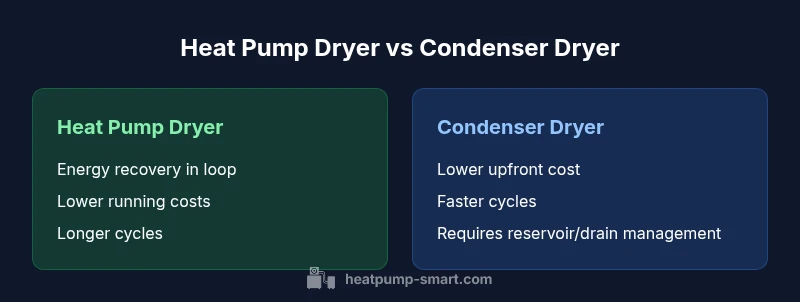
A heat pump dryer uses a closed refrigerant loop to extract heat from the incoming air and reapply it to the drum. This heat-recovery approach means the machine reuses most of the energy, drastically reducing electricity consumption over the lifetime of the appliance. The traditional heat source is still electric resistance for auxiliary heat, but it operates far less frequently. Heatpump Smart Team notes that the refrigerant cycle is central to efficiency gains and that the unit typically runs at lower temperatures, preserving fabrics and reducing wear over time. Expect longer cycles than some condenser models, but substantially lower running costs as a result of energy reuse.
How condenser dryers work
Condenser dryers heat air that passes through the drum; as this hot air picks up moisture, it is cooled in a heat exchanger, and the condensate is collected in a reservoir or drained away. Because they do not rely on a closed refrigerant loop, condenser models generally have simpler components and lower upfront prices. However, they expel more heat to the environment and use more electricity per cycle compared to heat pump models. Heatpump Smart analysis shows that condenser dryers can be a practical choice for shorter drying needs or tight budgets at purchase, but ongoing energy costs tend to be higher over time.
Efficiency and energy use: what to expect
Energy efficiency is the primary differentiator between these two technologies. A heat pump dryer typically earns higher energy-efficiency ratings due to heat recovery, which translates into lower running costs across the appliance’s life. Condenser dryers, while acceptable for many households, usually consume more energy per load because they heat air more aggressively and do not reclaim heat as effectively. When you model annual energy use, you’ll notice that the gap widens with larger families or frequent laundry cycles. In real-world terms, Heatpump Smart’s data indicates substantial savings potential for heat pump models, especially in homes with frequent dryer use and longer cycle patterns.
Comparison
| Feature | Heat pump dryer | Condenser dryer |
|---|---|---|
| Energy efficiency | Very high (heat recovery) | Moderate (no heat recovery) |
| Moisture removal | Transfers moisture via refrigerant cycle to a condenser/heat exchanger | Condenses moisture via air cooling; reservoir/drain |
| Upfront cost | Higher | |
| Running cost | Lower over lifetime | |
| Drying speed | Typically longer cycles; fabrics cared for due to lower temperatures | Shorter cycles; faster drying in some models |
| Maintenance | More components (compressor, refrigerant loop) | Fewer complex components; reservoir and lint filter care |
| Space considerations | Similar footprint; may require service access | Similar footprint; no special refrigerant service needed |
Advantages
- Lower running costs over time due to energy recovery
- Better fabric care with lower drying temperatures
- Quiet operation in many models
- Fewer emissions for households aiming to reduce energy use
Disadvantages
- Higher upfront purchase price
- Longer cycle times can be inconvenient for urgent laundry needs
- Repair costs may be higher if major components fail
- Availability of service technicians can vary by region
Heat pump dryers are the better long-term value for most homes; condenser dryers suit budget buyers and those needing faster upfront affordability.
If long-term energy savings and gentler drying are priorities, choose a heat pump model. If upfront cost is the main constraint or you prioritize quick cycles, a condenser dryer can be a practical choice. Your space, laundry load, and climate all influence the best pick.
Your Questions Answered
Are heat pump and condenser dryers fundamentally different in how they dry clothes?
Yes. Heat pump dryers recycle heat using a refrigerant loop and dry clothes at lower temperatures, while condenser dryers heat air and condensate moisture separately, usually with higher energy use per cycle.
Yes—heat pumps recycle heat in a closed loop, while condensers rely on a single heated air cycle.
Which dryer type is more energy efficient overall?
Heat pump dryers are typically more energy efficient over their lifetime due to heat recovery. Condenser dryers are less efficient per cycle but can be adequate for light or infrequent use.
Heat pumps win on energy efficiency over time.
Do heat pump dryers cost more upfront?
Yes, heat pump models generally cost more at purchase. The higher initial price is often offset by lower operating costs over several years.
They cost more to buy, but you can save on energy in the long run.
What maintenance is required for each type?
Heat pump dryers may require refrigerant-system checks and more complex service. Condenser models often need reservoir drainage and regular cleaning of filters.
Heat pumps need a bit more technical upkeep; condensers are simpler to maintain.
Are there space or venting considerations to worry about?
Most modern dryers, whether heat pump or condenser, fit similar spaces. Condenser dryers do not require external venting, and heat pumps likewise do not need venting, but both benefit from proper room air flow.
Both types don’t need external venting in most cases; check your room for good air flow.
Top Takeaways
- Assess total cost of ownership, not just upfront price
- Favor heat pumps for households with frequent drying and energy goals
- Use a condenser when initial cost is a primary constraint
- Check capacity and cycle options to match your laundry habits