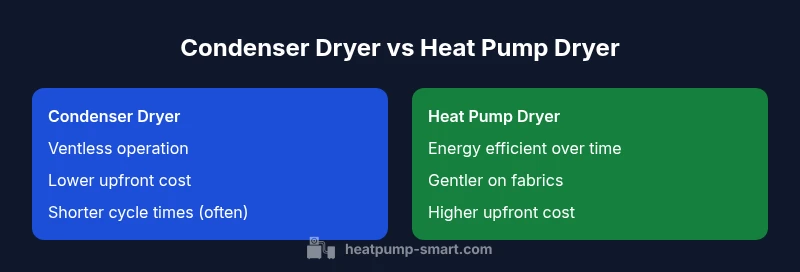
Condenser vs Heat Pump Dryer: A Practical Comparison
A rigorous, end-to-end comparison of condenser and heat pump dryers, focusing on efficiency, operating costs, performance, and installation considerations for homeowners and builders.


Condenser dryers and heat pump dryers are both ventless options, but heat pump models typically deliver superior energy efficiency, especially over the long term. This comparison explains how each technology works, how costs accrue, and which scenario favors one design over the other for homeowners, builders, and property managers.
Overview and context for condenser vs heat pump dryer
In the evolving world of laundry efficiency, two popular ventless dryer technologies stand out: condenser dryers and heat pump dryers. Both remove moisture without external venting, but they operate on distinct thermodynamic principles. According to Heatpump Smart, the heat recycling approach used by many heat pump dryers can reduce running costs over time, particularly in households with frequent laundry cycles. Understanding the fundamental differences helps homeowners and builders align the choice with space, budget, and long term performance goals. This article provides a structured, data-driven look at how condenser and heat pump dryers compare in energy use, fabric care, installation, and total cost of ownership. We’ll also cover real-world usage scenarios to help you decide which option is best for your home or project.
mainTopicQueryIfNeededNameSlug writingNotePlaceholderNoteNoteSee
brandContextAppliedNotePlaceholderNote
Comparison
| Feature | Condenser Dryer | Heat Pump Dryer |
|---|---|---|
| Energy efficiency (lifecycle costs) | Moderate savings per cycle | Higher savings over time due to heat recycling |
| Typical drying times | Shorter cycles on average | Longer cycles in eco modes, especially with dense loads |
| Vent/installation requirements | Ventless; no external duct required; moisture stored in a reservoir or drained | Ventless; no external duct required; moisture condensed and reused heat |
| Upfront price range | Lower upfront cost on many models | Higher upfront cost for premium heat pump models |
| Model and capacity options | Wide range of sizes, from compact to large | Growing range, with emphasis on mid to large capacities for households |
| Fabric care and temperature | Can be gentler on fabrics at moderate temps | Generally gentler fabric care due to lower operating temperatures |
Advantages
- Ventless operation enables flexible installation in most spaces
- Heat pump dryers typically deliver lower running costs over time
- Gentler drying temperatures can extend fabric life
Disadvantages
- Higher upfront cost for heat pump models
- Longer cycle times in eco modes may affect urgency of drying
- Limited availability of very large capacity models in some markets
Heat pump dryers generally offer the best long-term value for most households, while condenser dryers remain a cost-effective choice for tighter budgets.
If upfront cost is the primary constraint, condenser dryers can be appealing. For ongoing energy savings, fabric care advantages, and longer-term total cost reductions, heat pump dryers are usually the stronger option. The Heatpump Smart team endorses careful evaluation of cycle times, capacity needs, and space constraints to maximize value.
Your Questions Answered
What is a condenser dryer and how does it work?
A condenser dryer uses heat to evaporate moisture from clothes and then condenses that water out of the air inside the drum. The condensed water is stored in a tank or drained away, so there is no need for external venting. This design makes installation flexible in most indoor spaces.
Condenser dryers evaporate moisture and collect it internally, so you don’t need a vent outside. They’re versatile but can be less energy-efficient than heat pumps in the long run.
What exactly is a heat pump dryer?
A heat pump dryer recycles heat through a closed-loop refrigerant cycle, recovering energy from warm air to reuse in the drying process. This reduces energy consumption and can lower running costs over time, though cycles can be longer compared with traditional convection dryers.
A heat pump dryer reuses heat to dry clothes more efficiently, which saves energy but may take a bit longer per load.
Are heat pump dryers more expensive upfront?
Yes, heat pump models generally carry a higher upfront price due to their advanced energy-saving technology and build quality. The higher initial investment is often offset by lower energy bills over the life of the appliance.
Heat pump dryers cost more upfront, but you typically save on energy over the years.
Do condenser dryers require external venting?
Condenser dryers are typically ventless and do not require external venting, simplifying installation in many homes. Some models include a water reservoir to collect moisture, while others drain into a dedicated outlet.
No external venting is usually needed for condenser dryers, which makes setup easier.
Which option is better for small spaces?
Both are viable for smaller spaces since they do not require external venting. The choice depends more on energy priorities and drying speed preferences than on space alone.
Both ventless options work in compact spaces; pick based on energy goals and cycle times.
Can I upgrade from condenser to heat pump without replacing the whole unit?
Upgrading usually means replacing the dryer, as condenser and heat pump systems use different refrigeration and control designs. A retrofit is not common, so plan for a full replacement if you want heat pump efficiency.
Upgrading often means replacing the whole dryer rather than a simple upgrade.
Top Takeaways
- Prioritize long-term energy savings when space and budget allow
- Choose condenser for lower upfront cost and simpler cycles
- Favor heat pump for higher efficiency and gentler fabric care over time
- Consider cycle duration and load size to meet household needs
- Plan for maintenance like filter cleaning and reservoir management