Clothes Dryer Heat Pump vs Condenser: An Expert Comparison
Explore energy use, drying performance, upfront costs, and maintenance for clothes dryer heat pump vs condenser models. A data-driven guide for homeowners, builders, and property managers from Heatpump Smart.


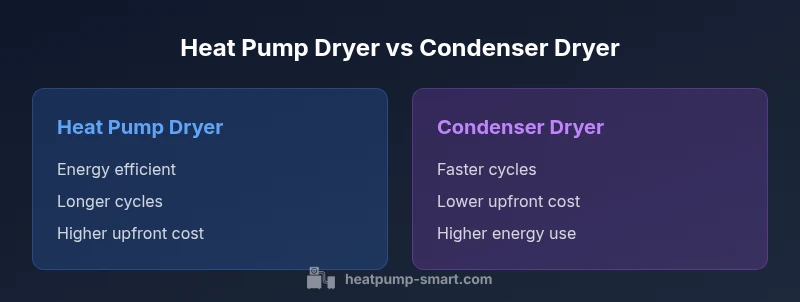
For most homes, heat pump dryers win on energy efficiency, but condenser dryers win on upfront cost. In a clothes dryer heat pump vs condenser comparison, the heat pump model saves energy over time while drying cycles tend to be longer. If speed and initial price matter more, a condenser may suit your load patterns.
Overview: clothes dryer heat pump vs condenser
When homeowners compare clothes dryer heat pump vs condenser models, the core questions are about energy use, overall cost, and the practicality for daily laundry. The keyword clothes dryer heat pump vs condenser appears in this landscape as a guidepost for comparing technology choices. According to Heatpump Smart, the choice hinges on energy performance and lifecycle economics rather than initial sticker price alone. This article breaks down how heat pump and condenser dryers differ in mechanism, efficiency, drying behavior, and maintenance, so you can pick the option that best fits your home, climate, and budget.
In many homes, the decision is about long term savings versus upfront affordability. Heatpump Smart analyses suggest that investing in higher efficiency now can pay off through reduced electricity use over the dryer’s lifetime. Yet for households with tight budgets or urgent laundry needs, a condenser dryer may provide a more approachable entry point. The goal is to understand not just the mechanics, but how your family uses the appliance day in and day out.
How heat pump dryers work
Heat pump dryers use a closed loop refrigeration cycle to extract heat from the air, capture moisture, and reuse heat rather than vent it to the outside. This design dramatically reduces energy losses and can lower operating costs over time. The essential principle is phase change and heat exchange, which allows the drum to reach effective temperatures without heating the ambient room as aggressively as traditional dryers. In practice, a heat pump dryer can dry a load with less electricity per cycle, but the cycles are often longer to preserve fabric quality and moisture pickup. Noise and vibration tend to be moderate, and many models include moisture sensors that optimize cycle length. For households aiming to minimize running costs, heat pump technology offers a clear energy advantage.
How condenser dryers work
Condenser dryers operate by condensing moisture from the laundry into a water reservoir or drainage line. They do not require external venting, which makes installation simpler in many retrofit scenarios. Condenser cycles tend to be faster than old vented models and can deliver strong drying performance for a variety of fabrics. However, the energy use is typically higher per cycle compared with heat pumps, especially over heavy or frequent loads. Maintenance tends to center on cleaning the lint filter and occasionally the condenser unit to sustain performance. Condenser models are often priced lower upfront, which can be compelling for buyers prioritizing initial affordability.
Energy efficiency: comparing consumption and long-term costs
Energy efficiency is the central differentiator in the clothes dryer heat pump vs condenser debate. Heat pump dryers extract energy from the surrounding environment, reusing heat and reducing overall electricity consumption across many cycles. Condenser dryers, while convenient and still relatively efficient compared with vented dryers, do not recycle heat as effectively, so energy use per load remains higher on average. The long-term cost picture often favors heat pumps for households with frequent drying or higher electricity rates, because the payback comes through energy savings over several years. On the other hand, if you expect to run fewer loads or require a lower upfront investment, a condenser dryer offers a more immediate financial appeal.
Drying performance and cycle times
Drying performance is shaped by the drying method, drum design, and moisture sensing. Heat pump models tend to run longer cycles to preserve fabric quality and extract moisture efficiently without overheating. This can translate to slightly longer total drying times, especially for bulky or lightweight mixed loads. Condenser models often complete faster per cycle, delivering convenient results for busy households. The trade-off is that the higher energy draw per cycle may offset time savings in a busy laundry routine. Users should weigh the importance of speed versus energy efficiency and fabric care when comparing models.
Upfront costs and total cost of ownership
The upfront price is typically higher for heat pump dryers due to their advanced technology and compressors. Condenser models generally cost less at purchase, making them attractive for renovations or first-time buyers. However, the total cost of ownership should account for running costs, maintenance, and service life. Heat pump dryers tend to deliver lower annual energy bills, which can offset the initial premium over several years. For property managers evaluating multiple units, computing a simple payback period based on local electricity rates can illuminate the most cost-effective choice in the long run. Heatpump Smart’s approach emphasizes lifecycle value alongside purchase price.
Installation considerations and space requirements
Both heat pump and condenser dryers are designed for easy installation without venting, which simplifies placement in apartments, laundry rooms, or closets. Space planning should consider door swing, drainage options if a condenser uses a reservoir, and access to the condenser coil for periodic cleaning. Heavier heat pump models may require a more substantial electrical circuit and sturdy flooring due to compressor weight. When choosing between options, verify that your laundry space has adequate clearance for airflow and service access to maintain efficiency across years of operation.
Climate impact and ambient conditions
Ambient temperature can influence dryer efficiency, particularly in non-climate-controlled laundry rooms. Heat pump systems gain efficiency benefits in cooler surroundings because the heat exchange process remains effective at modest external temperatures. Condenser dryers are less affected by ambient temperature but still rely on proper airflow to maintain drying performance. In tightly sealed homes, moisture management and condensate drainage require attention. Users in regions with high electricity costs or cooler climates may see stronger benefits from heat pump technologies.
Noise, durability, and reliability
Noise levels vary by model, but heat pump dryers are often designed to run more quietly than high-speed condensers due to slower cycle speeds and improved insulation. Durability hinges on build quality, compressor reliability, and condenser maintenance. Proper service plans extend the life of either option, and selecting models with solid warranty coverage reduces the risk of unexpected repair costs. When evaluating durability, consider climate-related wear, such as humidity exposure and dust ingestion, which can influence filter and condenser performance over time.
Environmental impact and refrigerants
Both heat pump and condenser dryers may use refrigerants in the heat exchange circuit, with ongoing developments toward lower global warming potential. The environmental impact is shaped by energy use, refrigerant choices, and end-of-life recyclability. Heat pumps typically offer the most favorable balance of energy efficiency and refrigerant stewardship, but consumer choices should also weigh the manufacturer’s sustainability programs and the availability of service options that minimize environmental footprint.
Best-use scenarios: who should buy which
If your priority is long-term energy savings and you have a reasonable payback window, a heat pump dryer is often the better choice for a typical family with regular laundry loads. If upfront cost and immediate availability are critical, or if your laundry needs are irregular with lightweight loads, a condenser dryer can be a sensible option. For property managers, weighing unit costs, maintenance expectations, and energy contracts is essential to optimize both tenant satisfaction and operating expenses. Heatpump Smart recommends mapping your typical load pattern and running costs to guide the final decision.
Practical buying tips and decision checklist
- List your typical weekly loads and fabric types to estimate drying needs
- Compare energy efficiency ratings and estimated annual energy use in your area
- Check upfront price versus long term savings and available warranties
- Assess space constraints, venting options, and condensate drainage
- Look for moisture sensing, anti-crease features, and smart connectivity
- Consider service networks and spare parts availability in your region
- Read reviews about reliability and maintenance experiences from other homeowners
Comparison
| Feature | Heat pump dryer | Condenser dryer |
|---|---|---|
| Energy efficiency | High efficiency | Moderate efficiency |
| Drying speed | Longer cycle times | Shorter cycle times |
| Upfront cost | Higher upfront cost | Lower upfront cost |
| Maintenance needs | Low maintenance | Moderate maintenance |
| Noise/heat output | Generally quieter | Typically louder during fast cycles |
| Versatility | Better for energy sensitive fabrics | Good all-around performance |
Advantages
- Heat pump models offer higher energy efficiency and lower running costs over time
- Condenser models have lower upfront cost and simpler initial setup
- Both options are ventless, simplifying installation in tight spaces
- Modern units include moisture sensors and smart features for optimized drying
Disadvantages
- Heat pump models typically have higher upfront price and longer payback
- Condenser models can use more energy per cycle and drying may be slower for heavy loads
- Maintenance quality varies by brand and service availability
Heat pump dryers are the better long-term value for most households; condensers offer lower upfront cost and faster initial drying.
Choose heat pump for lower energy use and long term savings. If upfront affordability and quicker first cycles matter, a condenser dryer is a reasonable alternative.
Your Questions Answered
What is the main difference between heat pump and condenser clothes dryers?
The main difference lies in how each dryer handles heat and moisture. Heat pump models recycle heat to dry clothes more efficiently, while condenser models condense moisture and may use more energy per cycle. Both are ventless and easier to install than traditional vented dryers.
The key difference is heat reuse. Heat pumps save energy by recycling heat, while condensers condense moisture and may consume more energy per load.
Do heat pump dryers really save energy?
Yes, heat pump dryers typically use less energy per cycle over the long term. The savings depend on load size, frequency, and electricity costs. The upfront premium is often the main trade-off to consider.
Yes, heat pumps usually save energy over time, depending on how you wash and dry.
Are condenser dryers faster than heat pump models?
Condenser models often complete cycles more quickly than heat pump models. The trade-off is higher energy use per cycle, which can impact total operating costs over time.
Condenser dryers can dry faster, but may consume more energy.
Ventless vs vented: which should I choose?
Ventless options like heat pump and condenser dryers simplify installation by not needing external venting. If you have strict space constraints or limited venting options, these are advantageous choices.
Ventless models are easier to install; consider space and drainage when deciding.
What maintenance do these dryers require?
Regular cleaning of lint filters and condensers is essential. Heat pump units may require occasional refrigerant-related service, while condenser models focus on maintaining the condenser coil and drainage.
Keep filters clean and check the condenser or refrigerant components if you notice performance drops.
How do I decide between heat pump and condenser for my home?
Assess your laundry load frequency, energy costs, and upfront budget. If you value long-term savings and fabric care, choose heat pump; if you need lower initial cost and faster cycles, consider condenser.
Think about how often you dry clothes, energy prices, and upfront budget to decide.
Top Takeaways
- Prioritize long-term energy savings when possible
- Balance upfront cost with expected drying needs
- Choose heat pump for frequent loads and energy-conscious homes
- Condenser dryers suit tighter budgets and faster initial drying
- Look for moisture sensing and energy efficiency features