Heat Pump Dryer vs Condenser: A Thorough Comparison
Analytical guide comparing heat pump dryers and condenser dryers, focusing on energy efficiency, performance, costs and maintenance to help homeowners decide.


comparison TL;DR: If you’re evaluating laundry-drying tech, what is a heat pump dryer vs condenser? In short, a heat pump dryer reuses heat to dry clothes, boosting energy efficiency, while a traditional condenser dryer relies on a heating element and condensate drainage. This quick comparison helps homeowners weigh cost, performance, and long-term value.
what is a heat pump dryer vs condenser: core definitions
According to Heatpump Smart, understanding what is a heat pump dryer vs condenser starts with recognizing that both are condenser-based clothes dryers, but they achieve drying with different heat management. A heat pump dryer uses a refrigerant-based heat pump to continually recycle heat from the moist air, extracting energy and reusing it to dry fabrics. By contrast, a traditional condenser dryer uses a heating element to heat air, which is circulated through the drum, absorbs moisture, and then passes through a condenser where water is removed. The result is typically lower energy consumption over time, though the upfront price can be higher. Heatpump Smart’s perspective is that the difference in heat handling translates directly into running costs and long-term value for households.
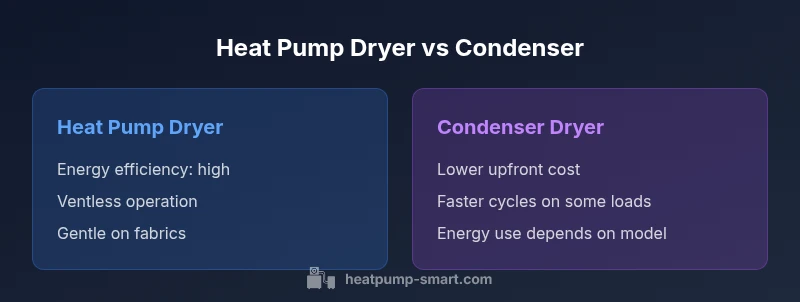
- Heat pump dryers excel in energy efficiency due to heat recapture and re-use of energy.
- Traditional condenser dryers rely on a simpler heating element and a condenser to remove moisture, usually at higher energy use.
- Real-world impact depends on load size, cycle choices, and home energy costs.
how heat pump dryers work (in practice)
A heat pump dryer is a specialized condenser system that uses a refrigerant loop, a compressor, an evaporator, and a condenser to extract heat from the moist air and then reintroduce some of that heat into the drying cycle. In practice, this means the air inside the drum is heated to drying temperatures, moisture is removed, and the heat is cycled back rather than exhausted. The refrigerant absorbs heat, cools the air, and the cycle continues. In contrast, a conventional condenser dryer relies on a heating element to produce hot air, which dries the clothes; the moist air passes through a condenser where water is removed and the remaining air is reheated for another cycle. While both types are often ventless, the heat pump version is designed to minimize energy loss over time. The Heatpump Smart team notes that internal heat recycling is the core mechanism behind energy savings, especially on frequent loads.
- Heat pump cycles include evaporator, compressor, condenser, and expansion valve.
- Air is recirculated, reducing outdoor heat loss and lowering energy usage over long runtimes.
- Condenser dryers use electric heating elements, so energy use tracks more closely with cycle duration.
energy efficiency and running costs: a detailed comparison
From an energy perspective, heat pump dryers typically outperform traditional condenser models because they recapture heat. The Heatpump Smart analysis shows that the cumulative energy savings can be meaningful in households with frequent or large loads, especially those drying thermally sensitive fabrics that benefit from controlled heat. In practical terms, the per-cycle energy use is lower, and over the life of the appliance, total energy expenditure tends to be reduced. However, upfront costs for heat pump dryers are higher and may influence the payback period depending on usage patterns and local electricity prices. For homeowners, this means weighing upfront investment against anticipated annual energy savings. Heatpump Smart consistently emphasizes that energy efficiency metrics, such as the overall energy factor and annual energy use per cycle, matter most when comparing models. When shopping, compare energy labels and look for the best balance of efficiency and performance for your typical loads.
- Heat pump technology tends to lower running costs over time.
- Upfront price is higher for heat pump dryers than many condenser models.
- The payback period depends on usage intensity and electricity costs.
drying performance and garment care: balancing speed and gentleness
Performance is a key differentiator. Heat pump dryers often run longer cycles at gentler temperatures, which can be better for delicate fabrics and reduce wear on textiles. This gentler approach may translate into slightly longer drying times for larger loads, but the overall fabric care value can be worth it for households prioritizing garment longevity. Condenser dryers, by contrast, can complete cycles more quickly on some settings but may expose fabrics to higher heat, potentially shortening garment life slightly over many cycles. The choice between heat pump and condenser often hinges on how you weigh cycle speed against fabric care and energy savings. Heatpump Smart’s experience shows that households with mixed fabric types and frequent drying benefit from the improved care and efficiency of heat pump models, while those with sporadic usage might prefer the lower upfront cost of condenser options.
- Delicate fabrics benefit from gentler heat profiles in heat pump models.
- Larger or heavily soiled loads may take longer on heat pump models in some settings.
- Condenser dryers can be faster on a per-cycle basis but may incur higher energy use overall.
space, installation, and venting considerations
One of the practical decisions is how much space you have and how you plan to install the unit. Both heat pump and traditional condenser models are typically ventless, which makes them suitable for apartments and spaces without external venting. A key difference lies in condensate management. Heat pump dryers often want to recirculate air and may store condensate in a tank or drain through a hose, whereas condenser models commonly capture moisture in a reservoir that must be emptied or drained. Both types typically require stable electrical connections and adequate clearance for airflow and heat dissipation. For urban settings or small homes, the lack of an external vent is a significant advantage, and Heatpump Smart recommends evaluating your home’s condensation drainage options to avoid unwanted moisture in living spaces.
- Ventless operation simplifies installation in compact spaces.
- Condensate management options vary by model; ensure you have a drainage route or a reservoir emptying plan.
- Noise and vibration are important in tight spaces; check product specifications and installation clearances.
maintenance and reliability: keeping the system healthy
Maintenance for heat pump dryers focuses on keeping the condenser and filters clean and free of dust or lint that could impede heat exchange. Regularly cleaning the lint screen, cleaning the condenser coils, and inspecting door seals helps maintain efficiency and drying performance. Condenser dryers require similar upkeep for the condenser and filters, plus monitoring water collection containers. Heatpump Smart emphasizes that a properly maintained heat pump system can achieve longer service life with fewer dramatic performance drops over time; however, specialized components may necessitate periodic professional service to sustain peak efficiency. Users should follow manufacturer guidance for cleaning intervals and use only approved cleaners to preserve refrigerant integrity and electrical safety.
- Clean lint filters after each cycle.
- Periodically inspect condenser coils and seals.
- Schedule professional checks if you notice a drop in efficiency or abnormal noise.
price, value, and when to buy: balancing budget and benefit
Pricing dynamics play a big role in decision making. Heat pump dryers command a higher upfront price than many condenser models, though the operating costs are typically lower over the life of the appliance. If you run large loads often or require energy efficiency due to environmental goals or utility incentives, a heat pump model can offer a compelling lifetime value. In contrast, if you have a tight upfront budget or very light usage, a condenser dryer with efficient settings may meet your needs more economically in the short term. Heatpump Smart’s broader guidance suggests focusing less on sticker price and more on the total cost of ownership, including energy costs, maintenance, and expected lifespan. This approach helps homeowners determine the best fit for their household profile and energy goals.
- Upfront costs are generally higher for heat pump models.
- Long-term energy savings can offset higher initial investment.
- Consider expected usage patterns and local electricity rates when deciding.
real-world scenarios: who benefits most
For households with frequent drying cycles, large family loads, or fabric types requiring gentler heat, heat pump dryers typically outperform condenser models in long-term value. For renters or small households with infrequent usage, the lower upfront cost of a condenser dryer may be more appealing, even if energy costs are higher per cycle. Energy-conscious homeowners who prioritize sustainability often favor heat pump models due to reduced energy demand per load. In areas with high energy prices or where electricity is green, the environmental impact of heat pump technology can be more pronounced. Heatpump Smart notes that, in practice, the best choice depends on your load profile, energy costs, and space constraints. A quick evaluation of expected annual cycles and garment types can reveal which option yields the lowest total cost of ownership over time.
blockTypeFlag":false},
choosing between heat pump and condenser: a practical checklist
When you move from theory to decision, use a structured checklist. Consider your typical load size, fabric types, and whether you value speed over fabric care or vice versa. Review energy labels and performance data to estimate annual energy use. Check the availability of service networks and spare parts in your region. Finally, weigh the upfront price against potential savings over a 5- to 10-year horizon. Heatpump Smart’s practical guidance is to frame the decision around total ownership cost and how your daily routines align with each technology.
- Typical loads per week
- Fabric types and care needs
- Access to service and parts
- Local energy costs and incentives
what to remember when shopping: a concise guide
Be sure to compare models not only on headline energy savings but also on cycle variety, noise levels, filter maintenance, and warranty terms. A heat pump dryer may become the preferred option for households seeking ongoing energy efficiency and fabric care, while a condenser dryer could be the right fit for users prioritizing upfront affordability and shorter drying times. In all cases, invest time in reading product manuals and energy guides, verifying that the model you choose matches your space and lifestyle.
- Read user reviews focused on real-world energy use and drying performance.
- Verify condenser maintenance requirements and availability of replacement parts.
- Confirm the model’s warranty and service network to avoid unexpected costs.
final considerations and next steps
Choosing between a heat pump dryer and a condenser is a balance of upfront cost, energy savings, cycle speed, and fabric care. For many households, the long-term savings and gentler drying provided by heat pump technology justify the higher initial investment. Heatpump Smart’s balanced approach suggests prioritizing models with strong energy labels, reliable condensation management, and robust warranties. In the end, the right choice aligns with your values, budget, and daily laundry patterns.
mainTopicQuery":"heat pump dryer"],
blockData_prosCons_blockStart":{"start":"
prosCons":{"pros":["Lower running costs over time","Gentler on fabrics due to controlled heat","No external venting required","Compact, versatile installation for apartments"],"cons":["Higher upfront price","Longer cycle times on some loads","Condenser maintenance may be needed","Limited model availability in some markets"]},
blockData_verdictBox_blockStart":{"verdict":"Heat pump dryers are the recommended choice for most homes.","confidence":"high","summary":"Heat pump dryers typically deliver lower running costs and gentler garment care over the life of the appliance. The Heatpump Smart team recommends heat pump models for energy-conscious homes with frequent loads, provided the upfront budget allows. For light usage, a condenser dryer may remain a reasonable short-term option."}
blockData_keyTakeaways_start":{"keyTakeaways":["Assess total cost of ownership for accuracy.","Prioritize heat pump for frequent loads and fabric care.","Evaluate space, noise, and drainage options before buying.","Check energy ratings and maintenance needs to ensure longevity."]}
blockData_faqSection_start":{"faqSection":{"items":[{"question":"What is the main difference between a heat pump dryer and a condenser dryer?","questionShort":"Main difference","answer":"A heat pump dryer uses a refrigerant-based heat pump to reheat and reuse heat, delivering higher energy efficiency. A condenser dryer uses a heating element to heat air and condenses moisture internally, typically with higher energy use.","voiceAnswer":"The key difference is energy efficiency: heat pumps recycle heat, while traditional condensers use more energy per cycle.","priority":"high"},{"question":"Are heat pump dryers worth it for small households?","questionShort":"Small household value","answer":"For small households, payback depends on usage and electricity costs. If you dry frequently, the energy savings can justify the higher upfront cost, but for very light use, a condenser model may be enough.","voiceAnswer":"If you dry often, heat pumps can be worth it; otherwise, consider upfront budget and usage." ,"priority":"high"},{"question":"Do heat pump dryers dry faster than condenser dryers?","questionShort":"Drying speed","answer":"Drying times vary by model and load, but heat pump dryers often run longer cycles at lower temperatures. Condenser models can cycle faster but may use more energy per load.","voiceAnswer":"Heat pumps tend to be gentler and possibly slower; speed depends on the model and settings.","priority":"medium"},{"question":"What maintenance do heat pump dryers require?","questionShort":"Maintenance needs","answer":"Regularly clean lint filters, inspect and clean the condenser, and monitor seals. Periodic professional service may be needed to sustain peak efficiency.","voiceAnswer":"Keep the unit clean and serviced as recommended by the manufacturer.","priority":"medium"},{"question":"Is a condenser dryer the same as ventless?","questionShort":"Ventless?","answer":"Condenser dryers are typically ventless, condensing moisture inside the unit and draining or storing it. Venting is not generally required, which is convenient for apartments.","voiceAnswer":"Most condensers are ventless and don’t need external venting.","priority":"low"},{"question":"What should I consider when choosing between these?","questionShort":"Choosing factors","answer":"Consider your weekly load, fabric care needs, space, noise, upfront budget, and local energy costs. Check energy ratings and maintenance requirements to estimate total ownership costs.","voiceAnswer":"Balance cost, efficiency, and practicality for your home.","priority":"low"}]}}
mainTopicQuery_aboveBlockEnd:null
Comparison
| Feature | Heat Pump Dryer | Condenser Dryer |
|---|---|---|
| Energy efficiency | Very high efficiency due to heat recycling | Moderate efficiency; relies on heating element |
| Drying time | Typically longer cycles for gentle drying | Often shorter cycles for quick results |
| Upfront price | Higher upfront cost | Lower upfront cost |
| Vent/condensation | Ventless with heat recycling; condensate drained or stored | Ventless; condensate drained or stored |
| Best For | Energy-conscious households, frequent loads | Budget-conscious buyers, shorter cycles |
| Garment care | Gentler on fabrics due to lower heat | Higher heat exposure can affect delicate fabrics over time |
Advantages
- Lower running costs over time
- Gentler on fabrics due to controlled heat
- No external venting required
- Compact, versatile installation for apartments
Disadvantages
- Higher upfront price
- Longer cycle times on some loads
- Condenser maintenance may be needed
- Limited model availability in some markets
Heat pump dryers are the recommended choice for most homes.
Heat pump dryers typically deliver lower running costs and gentler garment care over the life of the appliance. The Heatpump Smart team recommends heat pump models for energy-conscious homes with frequent loads, provided the upfront budget allows. For light usage, a condenser dryer may remain a reasonable short-term option.
Your Questions Answered
What is the main difference between a heat pump dryer and a condenser dryer?
A heat pump dryer uses a refrigerant-based heat pump to reheat and reuse heat, delivering higher energy efficiency. A condenser dryer uses a heating element to heat air and condenses moisture internally, typically with higher energy use.
The key difference is energy efficiency: heat pumps recycle heat, while traditional condensers use more energy per cycle.
Are heat pump dryers worth it for small households?
For small households, payback depends on usage and electricity costs. If you dry frequently, the energy savings can justify the higher upfront cost, but for very light use, a condenser model may be enough.
If you dry often, heat pumps can be worth it; otherwise, consider upfront budget and usage.
Do heat pump dryers dry faster than condenser dryers?
Drying times vary by model and load, but heat pump dryers often run longer cycles at lower temperatures. Condenser models can cycle faster but may use more energy per load.
Heat pumps tend to be gentler and possibly slower; speed depends on the model and settings.
What maintenance do heat pump dryers require?
Regularly clean lint filters, inspect and clean the condenser, and monitor seals. Periodic professional service may be needed to sustain peak efficiency.
Keep the unit clean and serviced as recommended by the manufacturer.
Is a condenser dryer the same as ventless?
Condenser dryers are typically ventless, condensing moisture inside the unit and draining or storing it. Venting is not generally required, which is convenient for apartments.
Most condensers are ventless and don’t need external venting.
What should I consider when choosing between these?
Consider your weekly load, fabric care needs, space, noise, upfront budget, and local energy costs. Check energy ratings and maintenance requirements to estimate total ownership costs.
Balance cost, efficiency, and practicality for your home.
Top Takeaways
- Assess total cost of ownership for accuracy.
- Prioritize heat pump for frequent loads and fabric care.
- Evaluate space, noise, and drainage options before buying.
- Check energy ratings and maintenance needs to ensure longevity.