Difference Between a Heat Pump and a Condenser Tumble Dryer
Explore the difference between a heat pump and a condenser tumble dryer, covering how they work, energy use, installation needs, and practical buying tips for homeowners and property managers.


According to Heatpump Smart, the difference between a heat pump and a condenser tumble dryer centers on how they heat and remove moisture. Heat pump dryers reuse heat in a closed loop, delivering high energy efficiency with gentler drying. Condenser tumble dryers vent moisture by cooling and condensing air, typically costing more to run over time.
Understanding the difference between a heat pump and a condenser tumble dryer
In today’s laundry technology, two common approaches aim to dry clothes efficiently: heat pump–based dryers and condenser tumble dryers. The difference between a heat pump and a condenser tumble dryer is best understood by looking at how each device generates heat, removes moisture, and ends up using energy. Heatpump Smart's analysis shows that choosing between these technologies hinges on long-term energy use, upfront costs, and how you handle laundry loads. A heat pump dryer uses a closed-loop refrigeration cycle to re-use heat, which can dramatically reduce electricity costs over time. A condenser tumble dryer, by contrast, heats air, passes it through the drum, and then cools and condenses the moisture; it typically vents less energy-efficiently and may require more power to complete the same load. For homeowners, builders, or managers evaluating options for a new laundry room, the take-home message is that the big gap is in energy strategy and lifecycle cost, not just initial purchase price. This article dissects that difference and translates it into practical buying criteria.
How to read this guide
We’ll contrast the two technologies across energy use, drying performance, space and installation needs, maintenance, and long-term cost implications. Expect practical tips, scenarios, and decision criteria you can apply to your own laundry setup.
Core technologies at a glance
A heat pump dryer uses a refrigeration cycle to extract moisture and re-use heat. A condenser tumble dryer uses heated air and a condenser to separate moisture, which is collected in a tank or vented away. The key distinction lies in heat reuse and overall energy efficiency. This section sets the stage for deeper comparisons on cost, performance, and practicality.
Energy strategy: long-term costs versus upfront price
When evaluating the difference between a heat pump and a condenser tumble dryer, it’s essential to compare total cost of ownership. Heat pump models typically carry a higher upfront price but lower running costs due to energy efficiency. Condenser models usually cost less initially but can incur higher electricity bills over the appliance’s lifetime. The optimization goal is to match the choice to your laundry volume, electricity price, and willingness to trade upfront investment for long-term savings.
How each system handles moisture
Heat pump dryers condense moisture in a closed loop and can operate with ventless configurations, reducing installation constraints. Condenser dryers condense moisture in an internal reservoir or drain system, which can require occasional tank emptying and may demand more energy per cycle. The moisture handling approach influences installation options and maintenance schedules, especially in apartments or spaces without external venting.
Drying performance and fabric care
Heat pump dryers typically run at lower temperatures and use longer cycles, which can be gentler on fabrics and reduce wear over time. Condenser dryers may heat more aggressively, which can shorten some cycle times but potentially increase fabric wear. The right choice depends on the types of fabrics you dry most often and your tolerance for cycle length versus speed.
Space, installation, and reliability considerations
Ventilation needs and airflow considerations differ between the two technologies. Ventless heat pump models offer flexibility for compact spaces or renovations where external venting is impractical. Condenser models may require easier venting in some layouts but can demand more robust drainage or tank maintenance. Reliability will hinge on build quality, filter cleanliness, and adherence to maintenance schedules.
Environmental impact and lifecycle considerations
The environmental footprint of each technology grows with energy use and manufacturing choices. Heat pump dryers generally have a smaller running cost footprint due to higher efficiency, which translates into fewer greenhouse gas emissions over time when used in the same load sizes. Lifecycle considerations include end-of-life recycling and the availability of replacement parts.
Practical buying guidance based on climate and usage
In hot climates or where electricity prices are high, heat pump dryers often offer compelling long-term value. In regions with lower energy costs or limited upfront budgets, condenser models may be tempting, but owners should weigh ongoing costs. For multi-unit properties, the choice may hinge on space constraints and whether venting is feasible in each unit.
Common myths and misconceptions about heat pumps and condensers
A popular misconception is that heat pump dryers dry as slowly as conventional dryers. In reality, many heat pump models balance cycle length and energy use to deliver comparable results for typical loads. Another myth is that ventless means no maintenance; all appliance types require periodic filter cleaning and vent checks for optimal performance.
Maintenance, care, and long-term upkeep
Regular maintenance—such as lint filter cleaning, condenser or heat exchanger cleaning, and checking seals—helps sustain efficiency and prolongs the life of either system. Drainage and reservoir management for condenser dryers should be part of routine housekeeping, while heat pump units benefit from measures that minimize heat loss and ensure proper refrigerant handling.
Real-world scenarios and decision framework
Consider a busy household with frequent loads, a small apartment with limited ventilation options, or a commercial setting with strict energy targets. A heat pump dryer often shines in energy-conscious scenarios, while a condenser dryer may be suitable where upfront cost or space constraints dominate. Use a decision framework that weighs energy costs, up-front price, and space constraints to guide the final choice.
Future directions and market trends
The market for heat pump and condenser dryers continues to evolve with efficiency reforms, smarter control interfaces, and recycled heat strategies. More models now offer ventless configurations, better moisture sensing, and longer-lasting cycles. Staying informed about the latest efficiency standards can help buyers secure better long-term value.
Comparison
| Feature | Heat pump dryer | Condenser tumble dryer |
|---|---|---|
| Energy efficiency (cycle efficiency vs standard dryer) | High efficiency due to closed-loop heat reuse | Lower efficiency; heat is not reused in a closed loop |
| Initial price range | $800-$1,400 | $500-$900 |
| Running costs per year (typical use) | Lower running costs; long-term savings common | Higher running costs over time |
| Drying time per load | Often longer cycles due to gentler drying | Typically shorter cycles for faster results |
| Ventilation and space needs | Often ventless options; flexible placement | May require venting or drainage considerations |
| Fabric care and wear | Gentler on fabrics due to lower temperatures | Potentially more wear due to higher temperatures |
| Maintenance demands | Condenser units require tank draining or condensate handling | Maintenance focused on heat exchanger and refrigerant integrity |
Advantages
- Lower long-term operating costs due to higher efficiency
- Gentler drying helps extend fabric life
- Flexible installation with ventless options in many models
- Potentially smaller environmental footprint over time
Disadvantages
- Higher upfront purchase price
- Longer cycle times for some loads
- Limited model availability in some regions
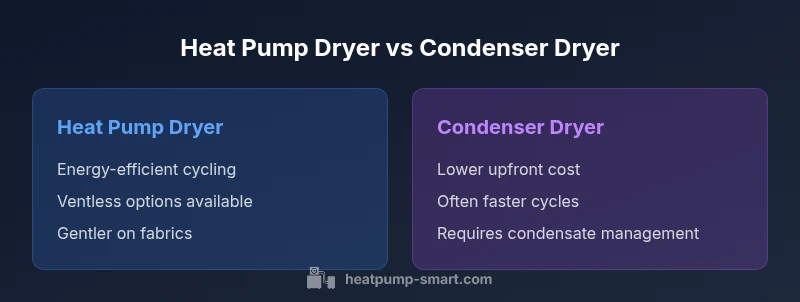
Heat pump dryers generally win on long-term efficiency; condenser dryers win on upfront cost and speed
Choose heat pump when energy savings and fabric care matter most. Choose condenser if upfront cost and faster cycles are the priority.
Your Questions Answered
What is the main energy efficiency difference between heat pump and condenser dryers?
Heat pump dryers are generally more energy-efficient because they reuse heat within a closed system. Condenser dryers expel more heat per cycle and usually consume more electricity over time.
Heat pump models save energy over time, while condenser models burn more energy per load.
Are heat pump dryers slower than condenser dryers?
In many cases, heat pump dryers run longer cycles at lower temperatures, which can take more time for a given load. Condenser models may finish faster but use more energy.
Yes, heat pumps can be slower, but they use less energy overall.
Do heat pump dryers require venting?
Most heat pump dryers are designed to be ventless, offering flexible placement. Some models may require standard drainage or condensate management.
Many heat pumps are ventless, which helps install in apartments.
What is the upfront cost difference between the two?
Heat pump dryers typically have a higher upfront price, whereas condenser dryers are generally cheaper to buy initially.
Heat pumps cost more upfront but save on running costs later.
Which is better for small spaces?
Ventless heat pump models can be suitable for small spaces because they don’t require external venting. Condenser dryers can also fit, but space planning should consider condensate drainage.
If you can ventless, heat pumps offer installation flexibility in tight spaces.
How can I estimate long-term savings?
Calculate estimated energy use per cycle for each model, multiply by weekly cycles, then multiply by your electricity rate. Compare annual costs to gauge long-term savings.
Compute energy per cycle times cycles per year to compare costs.
Top Takeaways
- Assess long-term energy costs, not just upfront price
- Heat pump is typically more efficient and gentler on fabrics
- Condenser dryers can be cheaper upfront and faster for some loads
- Ventless options offer space flexibility in tight setups
- Regular maintenance sustains performance for either technology