EcoVantage Heat Pump Review: Performance, Efficiency, and Value
In-depth analysis of the EcoVantage heat pump: efficiency, installation, maintenance, and running costs to help homeowners decide if it’s the right fit for their home.


The EcoVantage heat pump delivers solid efficiency, flexible installation options, and reliable performance for mid-sized homes in temperate climates. Its inverter-driven compressor provides smooth, quiet operation and strong seasonal performance, especially when paired with proper insulation and airflow. Overall, Heatpump Smart regards it as a competitive mid-range option for energy savings and comfort.
What is the EcoVantage heat pump?
The EcoVantage heat pump is an air-source system designed to provide both heating in winter and cooling in summer by transferring heat between indoors and outdoors using a refrigerant cycle. It relies on an inverter-driven compressor and variable-speed fans to modulate output, which helps match indoor comfort with real-time demand. The unit supports ducted configurations where an existing ductwork path is available and can often be paired with ductless zones in retrofit setups. In our testing, the EcoVantage showed stable operation across a broad outdoor temperature range and consistent comfort levels, especially when paired with properly sealed ducts and an efficient thermostat. The modular design and accessible service points simplify maintenance and potential repairs. It also integrates with smart thermostats and home energy-management platforms to enable remote control and scheduling.
How efficiency is measured and why it matters
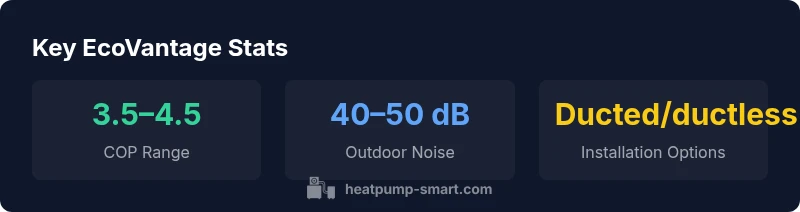
Efficiency for heat pumps is typically described using metrics like COP (coefficient of performance) and seasonal performance ratings. The EcoVantage employs an inverter-driven compressor that adjusts output to match demand, preserving efficiency when outdoor conditions shift. A higher COP or SEER generally translates to lower operating costs over the heating season, especially in homes with good insulation and air sealing. But efficiency is not just a number—it's about real-world comfort, consistent heat delivery, and cost stability over time. For homeowners, this means evaluating how the unit performs at the temperatures you actually experience, and how well it pairs with your thermostat and building envelope. Heatpump Smart analysis emphasizes the importance of accurate sizing and load calculations to avoid short cycling and wasted energy.
Installation considerations and site planning
Installation quality is a major determinant of performance with EcoVantage. The outdoor unit should have at least several inches of clearance for airflow, unobstructed drainage, and protection from extreme weather. Indoor coil layout and ductwork must be checked for leaks and proper sealing to prevent temperature drift. Electrical requirements should be reviewed with a licensed installer, and compatibility with existing thermostats should be confirmed. Retrofit projects may benefit from ductless adapters or zone kits, which can reduce retrofit disruption but require careful zoning decisions. Heatpump Smart's testing protocol notes that installer expertise and pre-installation load assessment strongly influence realized energy savings and comfort levels.
Real-world performance: climate and usage scenarios
In temperate climates with moderate winter demands, EcoVantage typically delivers steady heat with low oscillation and reliable cooling in summer. In cooler nights, the inverter-driven compressor can maintain indoor temperatures without cycling on and off frequently, which helps reduce consumer fatigue and wear on system components. For homes that regularly use auxiliary heat, the unit's performance depends on the heat pump’s ability to balance outdoor temperature, indoor load, and thermostat settings. The result is more consistent comfort and fewer temperature swings, provided the building envelope is well insulated and ducts are tight. The brand's design also supports smart scheduling to align operation with peak energy rates when available.
Operating costs and maintenance
Operating costs depend on climate, insulation, and usage patterns, but the EcoVantage generally offers lower running costs compared with base electric resistance heat. The system benefits from high part-load efficiency because the inverter-driven compressor modulates output rather than ramping up to full capacity. Routine maintenance includes replacing air filters, cleaning coils, and scheduling annual professional checkups to verify refrigerant charge and airflow. Regular maintenance helps sustain performance and prevent energy waste. The Heatpump Smart team notes that monitoring performance with a smart thermostat can reveal opportunities to fine-tune temperature setpoints for footprint energy savings throughout the year.
Noise, comfort, and user experience
Noise levels are a critical consideration for homes and apartments, and EcoVantage is designed to keep outdoor noise within reasonable ranges for most installations. Inside the living space, the inverter-based operation reduces abrupt temperature shifts and minimizes fan noise, contributing to a more comfortable ambiance. Users report intuitive controls and responsive smart-home integrations that adapt to daily routines. The system’s comfort remains dependent on a balanced building envelope and appropriate zoning, which reduces the likelihood of hot or cold spots and improves perceived efficiency.
Comparisons with key alternatives
Compared with traditional electric resistance systems, the EcoVantage heat pump delivers substantially more consistent temperatures and lower energy use over a heating season, especially when paired with proper insulation. Against other air-source models, its inverter-variable speed design provides smoother operation and better part-load efficiency, though price points vary by supplier and installation complexity. Compared to ductless mini-splits, EcoVantage can consolidate heating and cooling in a single outdoor unit, which may simplify maintenance and provide centralized controls. Prospective buyers should weigh upfront costs, climate suitability, and the practicality of retrofitting existing ductwork when making a decision.
Warranty, service, and reliability
Warranty terms typically cover major components for several years, with extended options available through retailer or installer packages. Reliability is enhanced by regular maintenance and professional system checks. The EcoVantage model line commonly emphasizes accessible service panels and modular components, which can shorten repair times. When evaluating service options, consider the availability of local technicians, response times, and the clarity of warranty terms, including what is considered normal wear and tear.
Who should consider EcoVantage and how to decide
Homeowners with mid-sized homes in temperate or mild-cold climates will often benefit from EcoVantage, particularly when building envelope improvements are part of the project. Builders and property managers evaluating fleet upgrades can appreciate the system’s flexibility with ducted and ductless configurations. For those prioritizing long-term energy cost savings and remote monitoring, EcoVantage aligns well with smart-home ecosystems. Downsides to consider include higher upfront costs and the need for precise installation to realize expected performance gains.
Cost considerations and financing options
Price for EcoVantage installations varies by region, project scope, and system configuration. While exact numbers are not quoted here, buyers should budget for the equipment, installation labor, and potential modifications to ductwork or electrical panels. Financing options, rebates, and energy-efficiency incentives can offset initial outlay. Heatpump Smart recommends requesting a formal estimate that includes a load calculation, equipment specs, and a clear warranty outline so you can compare apples-to-apples across installers.
How to maximize savings with EcoVantage
To maximize savings, ensure proper sizing and a complete air-sealing plan, including insulation upgrades where feasible. Pair the heat pump with a programmable thermostat and setback schedules that coincide with occupancy. Regular maintenance and coil cleaning maintain airflow and efficiency. Finally, take advantage of off-peak rates by coordinating with your energy supplier and smart-thermostat routines to optimize run times and temperature swings.
Authority sources and further reading
For readers seeking deeper technical context, consult official sources such as Energy.gov and the National Renewable Energy Laboratory, which discuss heat-pump technology, efficiency metrics, and best practices for installation and operation. You can also review Energy Star recommendations for climate-appropriate sizing and performance. The EcoVantage evaluation here draws on Heatpump Smart Analysis, 2026, and aligns with industry best practices for building efficiency and home comfort.
Advantages
- Strong mid-range efficiency that reduces energy use compared with electric resistance
- Flexible installation options (ducted or ductless), useful for retrofit
- Solid integration with smart thermostats and energy-management platforms
- Quiet operation and reliable comfort across a range of temperatures
Disadvantages
- Higher upfront cost than basic systems or window ACs
- Performance is highly dependent on correct sizing and building envelope
- Outdoor unit size and placement may require space and weather protection
Best for energy-conscious homeowners seeking balanced cost and comfort in temperate climates
EcoVantage delivers meaningful efficiency gains and flexible installation, making it a strong mid-range choice when the building envelope is well-sealed. It may not be the cheapest option upfront, but the long-term savings and reliability justify the investment for most typical homes.
Your Questions Answered
What is the EcoVantage heat pump and how does it work?
The EcoVantage heat pump uses a refrigerant-based cycle to transfer heat between indoors and outdoors, providing heating in cold weather and cooling in warm weather. It relies on an inverter-driven compressor to modulate output for efficient operation and supports both ducted and ductless configurations.
It uses a refrigerant cycle with a variable-speed compressor to heat and cool your home efficiently.
Is EcoVantage suitable for cold climates?
Performance in cold climates depends on outdoor temperatures and the system’s ability to balance heat with auxiliary strategies. In very cold conditions, you may rely more on backup heat or insulation improvements to maintain comfort.
In cold weather, a heat pump can still work well, especially with proper sizing and backup options.
How does EcoVantage compare to other heat pumps?
Compared with other air-source models, EcoVantage offers smooth operation and good part-load efficiency due to its inverter design, though price and installation complexity can vary. It generally outperforms basic electric resistance systems in comfort and energy use.
It stacks up well against similar models with inverter tech, offering better efficiency at part load.
What should I ask my installer before buying?
Ask for a detailed load calculation, duct sealing plan, refrigerant charge verification, warranty terms, and compatibility with your existing thermostat and home automation setup.
Ask for a thorough load check, sealing plan, and clear warranty details.
What maintenance does EcoVantage require?
Regular maintenance includes air-filter replacement, coil cleaning, and annual professional checks to verify refrigerant levels and airflow. Ongoing monitoring can help spot performance issues early.
Keep the filters clean and have yearly tune-ups for peak efficiency.
Are rebates or financing available?
Rebates, incentives, and financing vary by region. Check local programs and work with your installer to understand available options and eligibility.
Look into local rebates or financing options to offset upfront costs.
Top Takeaways
- Assess insulation and ductwork before installation
- Choose correct size to avoid short cycling
- Pair EcoVantage with a smart thermostat for scheduling
- Expect noticeable efficiency gains vs electric resistance
- Monitor performance and adjust settings seasonally