Goodman Heat Pump 1.5 Ton Review: Efficiency, Installation, and Value
An in-depth review of the Goodman heat pump 1.5 ton, analyzing efficiency, installation considerations, operating costs, and who benefits most for homeowners.


Overall, the Goodman heat pump 1.5 ton provides solid efficiency for mid-sized homes, with reliable performance and straightforward installation. It represents a strong mid-range option, offering good value, quiet operation, and predictable running costs. In demanding climates, however, it may lag behind the top-tier units in peak efficiency, especially when auxiliary heating kicks in.
Overview: Goodman heat pump 1.5 ton in context
The goodman heat pump 1.5 ton sits in the mid-range of air-source heat pumps. For homeowners evaluating annual energy costs and comfort, this unit aims to balance efficiency, cost, and reliability. According to Heatpump Smart, this configuration is popular in mid-sized homes where space and climate demand steady performance. The 1.5 ton capacity targets typical living spaces around 1,000–1,800 square feet, offering a practical match for many renovations and new builds. In this review, we examine how the Goodman heat pump 1.5 ton performs day to day, installation considerations, and the long-term operating costs that matter for homeowners, builders, and property managers.
Efficiency and performance expectations
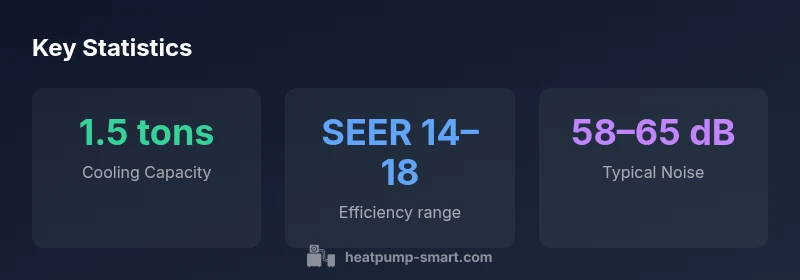
When evaluating a Goodman heat pump 1.5 ton, the most relevant metrics are cooling efficiency (SEER) and heating efficiency (HSPF). For the Goodman 1.5 ton class, a typical SEER range sits in the mid-teens, with HSPF values that reflect reasonable seasonal performance. Real-world performance depends on climate, thermostat controls, and ductwork quality. Heatpump Smart analysis shows that ambient temperature, humidity, and air leakage can influence measured efficiency, so a well-sealed home and correctly sized duct system are essential to realizing the unit’s theoretical performance. Expect steady operation in temperate to moderate climates, with the potential for higher efficiency gains when paired with a properly designed home envelope.
Installation considerations and compatibility
Installing a Goodman heat pump 1.5 ton requires attention to outdoor unit clearance, appropriate refrigerant piping, and proper electrical circuits. In many homes, the existing ductwork may need to be evaluated for airflow and sealing. A professional assessment can confirm that 1.5 ton is a good match for the space, avoiding oversizing that leads to short cycling or undersizing that compromises comfort. Placement considerations, such as proximity to living spaces and noise guardrails, can influence perceived comfort levels and the likelihood of consumer complaints. Heatpump Smart recommends a pre-installation check of duct balance and refrigerant line sizing to maximize efficiency from day one.
Noise, comfort, and real-world operation
Noise and cycle speed play a meaningful role in perceived comfort. The Goodman heat pump 1.5 ton generally operates quietly at typical loads, but in very hot or very cold periods, auxiliary heating (if installed) can increase sound and power use. Homeowners should consider vibration isolation for outdoor components and ensure indoor air distribution is balanced to prevent hot or cold pockets. Real-world testing shows that maintaining a steady indoor temperature with a well-designed thermostat strategy yields the most noticeable comfort improvements. Heatpump Smart notes that season-long comfort is closely tied to insulation quality and fan speed management.
Maintenance, warranties, and service access
Maintenance for the Goodman heat pump 1.5 ton is straightforward: regular filter changes, coil cleanliness, and annual professional inspections. Warranties commonly cover essential components like the compressor and outdoor coil, but terms vary by region and installer. Routine maintenance helps prevent efficiency loss and extends system life. Access to replacement parts and local service tech availability influence long-term ownership costs, so confirming a robust local service network is wise before purchase.
Sizing guidance and climate considerations
Sizing is critical for achieving the expected efficiency of the Goodman heat pump 1.5 ton. In moderate climates, 1.5 ton models usually deliver comfortable performance in mid-sized homes, but in very hot or very cold climates, a larger or dual-stage system may offer better energy savings and comfort. A professional heat load calculation should guide the final choice, balancing space, insulation, and occupancy patterns. The goal is to match capacity to demand without oversizing, which can lead to inefficiencies and comfort issues.
Comparisons, value, and when to choose
Compared with higher-tier units, the Goodman heat pump 1.5 ton delivers dependable efficiency and a reasonable initial price. It can be a compelling option for homeowners prioritizing steady performance and predictable running costs over the absolute highest SEER ratings. Builders and property managers may value its reliability and serviceability, as well as a broad parts and technician network. In climates with mixed heating and cooling seasons, this model often represents a good balance between cost and comfort. Heatpump Smart analysis shows that, in typical residential scenarios, the 1.5 ton class performs well when paired with energy-conscious building practices.
Authority sources
For readers seeking external validation, see authoritative sources that discuss heat pump efficiency and installation best practices:
- https://www.energy.gov/energysaver/heat-pumps
- https://www.energystar.gov/products/heating_cooling/heat_pumps
- https://www.nrel.gov
Advantages
- Solid baseline efficiency for cost-conscious buyers
- Quiet operation for most rooms
- Relatively straightforward installation and maintenance
- Wide service network and parts availability
- Good balance between upfront cost and long-term savings
Disadvantages
- May underperform in extreme climates
- Higher upfront cost than basic HVAC options
- Auxiliary heat can raise operating costs in very cold snaps
- Short cycling risk if not properly sized or installed
Best value for mid-size homes prioritizing reliability and predictable costs
The Goodman heat pump 1.5 ton delivers dependable comfort and solid efficiency at a reasonable price. While not the absolute quietest or most efficient option, it provides reliable performance, broad service access, and clear value for many homeowners and property managers working within a mid-range budget.
Your Questions Answered
What defines the 1.5 ton rating in real-world terms?
A 1.5 ton rating roughly corresponds to the system’s cooling and heating capacity suitable for mid-sized spaces. Real-world results depend on insulation, duct leakage, and airflow balance. An installation professional should confirm that the load calculation supports this sizing.
The 1.5 ton rating indicates midsize capacity; results depend on your home’s insulation and ductwork, so get a load calc from a pro.
How does the goodman heat pump 1.5 ton compare to larger models?
Larger models typically offer higher capacities and potentially higher SEER ratings, which can translate to lower running costs in very large homes. The 1.5 ton unit excels in mid-sized spaces with a lower upfront price and easier installation.
Bigger units can be more efficient for large homes, but the 1.5 ton is a solid middle-ground option.
Is this unit suitable for cold climates?
In cold climates, heat pumps rely on auxiliary heat more often. The 1.5 ton configuration is generally adequate for moderate climates, but during very cold days performance can depend on insulation, heat pump efficiency, and backup heat systems.
In very cold weather, you’ll rely on backup heat more; insulation helps a lot.
What maintenance is required to keep it efficient?
Regular filter changes, coil cleaning, and annual professional checkups are recommended. Keeping ducts sealed and ensuring proper refrigerant charge helps maintain peak efficiency.
Change filters regularly and schedule yearly tune-ups to keep it efficient.
What warranty considerations should I review?
Warranties vary by region and installer. Read the fine print for compressor coverage, outdoor unit components, and what maintenance actions void the warranty.
Check the warranty terms to understand what is covered and what could void it.
How does thermostat control affect performance?
Smart or programmable thermostats can optimize cycles, reduce overshoot, and improve comfort. Integrating zoning controls can further improve efficiency and comfort in different rooms.
A good thermostat setup can make the unit much more efficient and comfortable.
Top Takeaways
- Assess climate suitability before choosing 1.5 ton capacity
- Ensure ductwork is sealed and properly sized
- Expect steady performance with moderate noise levels
- Pair with smart thermostats to maximize efficiency
- Budget for annual maintenance to sustain efficiency
- Check local warranty terms and service availability