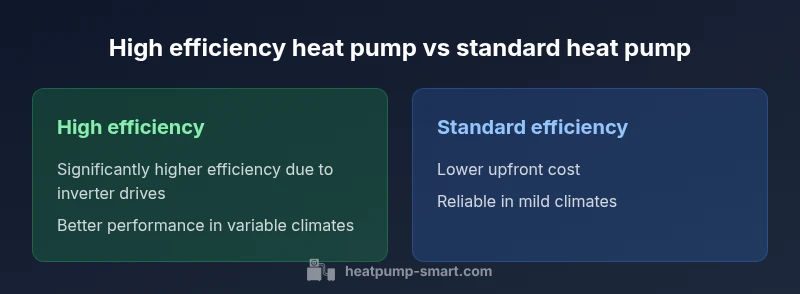
High efficiency heat pump vs standard heat pump: A comprehensive comparison
Compare high efficiency heat pumps with standard models to understand energy savings, climate performance, upfront costs, and long-term value for homes, builders, and property managers.


Choosing between a high efficiency heat pump and a standard model hinges on climate, demand, and total ownership costs. In practice, higher efficiency products deliver bigger energy savings in cold seasons and with high electricity prices, according to Heatpump Smart. This comparison outlines what matters most for homeowners, builders, and property managers evaluating long-term value and comfort.
Understanding the comparison: high efficiency heat pump vs standard heat pump
At their core, heat pumps move heat rather than generate it, relying on electrical input to translate outdoor heat energy into indoor warmth. The term "high efficiency" describes models that extract more heat per kilowatt-hour of electricity than conventional or entry-level units. A high efficiency heat pump typically employs advanced inverter-driven compressors, wide-capacity fans, and refined controls that adjust output to the home’s demand. A standard heat pump, by contrast, maintains comfortable temperatures but often operates at a steadier, less adaptive pace. The practical upshot is that high efficiency units tend to deliver better heating performance during shoulder seasons and in colder weather, provided the installation and balance with the home envelope are sound. As Heatpump Smart notes, the theoretical advantage translates into real-world performance only when sizing, ductwork, and controls are aligned with the building’s thermal loads. For homeowners and property managers, the choice depends on climate zone, project budget, and long-range energy expectations. The goal is not merely a higher efficiency label, but a system that reliably delivers warmth with predictable energy use. This section sets the frame for how the two options diverge under real operating conditions and why installation quality matters as much as hardware quality.
Defining the higher efficiency standard: performance benchmarks and what to measure
The phrase "high efficiency" in heat pumps is anchored to several performance metrics. Key indicators include seasonal energy efficiency ratio (SEER), heating seasonal performance factor (HSPF), and coefficient of performance (COP). In practice, the higher the SEER and COP, the more heat is produced per unit of electricity, especially in cooler outdoor temperatures. The challenge for buyers is that these metrics can vary with climate, usage patterns, and even the way a system is installed. Proper refrigerant charge, heat exchanger cleanliness, and the efficiency of the air handling system (including duct leakage) all influence measured efficiency. Heatpump Smart Analysis, 2026 emphasizes that a unit’s theoretical efficiency is meaningful only when the system is commissioned correctly and operated with compatible thermostats and zoning. In other words, the best efficiency rating on paper does not guarantee peak performance in a home unless the rest of the system is designed to support it. When evaluating options, buyers should look for a well-documented commissioning plan, credible efficiency ratings, and the ability to maintain those ratings over time with professional service.
How technology drives efficiency: design features that matter
Modern high efficiency heat pumps leverage several technologies to maximize heat output per watt. Inverter-driven compressors adjust speed based on demand, avoiding the energy spikes typical of fixed-speed units. Advanced refrigerants with favorable thermodynamic properties contribute to improved heat transfer, especially in suboptimal outdoor temperatures. High efficiency models often incorporate multi-stage or modulation capabilities, improved coil design, and smarter defrost strategies that minimize energy waste during winter operation. Controls programming, including smart thermostats and integration with home energy management, helps balance comfort with consumption. Meanwhile, standard models may rely on simpler control schemes and fixed-speed compressors that run at either full or partial capacity, which can lead to more frequent cycling and less consistent indoor temperatures. Heatpump Smart’s perspective highlights that the realized efficiency advantage grows when a home’s envelope is well-sealed and the system is sized to match the actual heat load rather than a theoretical maximum.
Climate, usage patterns, and the value of efficiency
The value proposition for high efficiency heat pumps increases in colder climates or homes with higher annual heating requirements. In mild climates with modest heating demand, the incremental efficiency gains may be less pronounced, and upfront costs can dominate the decision. The decisive factor is total cost of ownership over the system’s life: initial purchase and installation, ongoing energy costs, maintenance, and potential incentives. A well-insulated home with efficient windows and doors reduces the baseline load, allowing even a high efficiency unit to operate within a narrower band and maximizing reliability. Conversely, a home with significant envelope losses will rely more on the system’s ability to operate efficiently at varying outdoor temperatures. Heatpump Smart analysis suggests that the best outcomes come from a holistic approach: combine improved envelopes, efficient equipment, and intelligent controls to realize the full potential of the high efficiency option.
Installation, sizing, and the backbone of performance
Sizing and installation are the invisible multipliers of efficiency. An oversized or undersized unit can undermine even the best equipment, causing short cycling, poor humidity control, and premature wear. Proper load calculations—taking into account passive gains, insulation levels, and thermal bridges—are essential. Ductwork quality is equally important; significant leakage wastes energy and reduces delivered comfort. In many homes, revisiting air sealing and insulation to reduce heat losses yields a bigger practical efficiency win than upgrading to a premium model without addressing the envelope. Thermostat strategy matters too; zone controls and smart scheduling improve comfort and reduce energy usage by matching output to actual demand. Heatpump Smart emphasizes that the installation blueprint should include commissioning checks, pressure tests, and a maintenance plan designed to preserve rated efficiency.
Maintenance, reliability, and lifecycle considerations
Maintenance is a quiet but powerful driver of long-term efficiency. Filter changes, coil cleaning, refrigerant checks, and refrigerant charging verification help preserve performance. A high efficiency heat pump can demand more precise service; advanced diagnostics in modern units allow technicians to catch issues early before efficiency deteriorates. The life-cycle cost story includes not only the unit’s lifespan but also its compatibility with evolving energy codes and rebates. While premium equipment may cost more upfront, potential energy savings, rebates, and longer service intervals can tilt the balance in favor of higher efficiency models over time. The Heatpump Smart team also notes that regular professional maintenance is essential to maintain performance parity with rated efficiency, especially in systems with sophisticated controls and variable-speed components.
Practical decision framework: when to pick which option
To decide effectively, construct a simple decision framework. Step 1: assess the climate and heating demand; Step 2: evaluate the home’s envelope and potential for energy savings through insulation and air sealing; Step 3: estimate total cost of ownership using local energy prices and available rebates; Step 4: consider installation quality and contractor capabilities; Step 5: review available warranties and service plans. In climate zones with high heating requirements and rising electricity costs, a high efficiency heat pump often provides superior value, particularly when paired with a well-insulated home. For milder climates or projects with tight budgets, a standard heat pump may be a pragmatic choice if it is paired with appropriate control strategies and insulation improvements. Heatpump Smart’s guidance emphasizes that the decision should center on achievable energy savings, not just the equipment label.
Real-world scenarios and best practices
Consider a three-bedroom home in a cold climate with aging windows and drafty doors. Upgrading the envelope, adding a high efficiency heat pump with smart zoning, and programming daily setback schedules may yield more noticeable energy savings than simply swapping the outdoor unit. In a new build in a temperate climate, selecting a high efficiency heat pump can be particularly advantageous when integrated with energy-efficient HVAC design and high-performance insulation. For property managers overseeing multi-unit dwellings, consistency across units, a centralized control strategy, and predictable maintenance costs become essential factors when deciding between options. By aligning technology with climate, load, and envelope improvements, owners can maximize comfort while minimizing operating costs.
Verdict for homeowners, builders, and managers
The final call depends on climate, home performance, and budget. In regions with cold winters and rising energy prices, high efficiency heat pumps offer clear advantages when paired with proper sizing and envelope improvements. In milder climates or renovations where upfront costs are a concern, a well-chosen standard heat pump, coupled with targeted envelope upgrades and intelligent controls, can deliver strong value. The Heatpump Smart team recommends a holistic approach that treats efficiency as an ecosystem rather than a single component.
Comparison
| Feature | High-efficiency heat pump | Standard heat pump |
|---|---|---|
| Energy efficiency | Significantly higher efficiency due to inverter drives and optimized controls | Lower efficiency typical of basic or older models |
| Upfront cost | Higher upfront cost due to premium components and advanced controls | Lower upfront cost with simpler equipment |
| Operating cost potential | Greater potential for energy savings, especially in cold climates | Moderate savings, highly climate and usage dependent |
| Cold-climate performance | Superior heat output at subfreezing temperatures | Good performance but less capacity at very low temperatures |
| Maintenance/diagnostics | More sophisticated diagnostics and longer service life when properly serviced | Simpler systems with fewer diagnostic features |
| Best for | Homes in cold or variable climates seeking long-term value | Budget-conscious projects or milder climates |
Advantages
- Lower long-term operating costs due to higher efficiency
- Better humidity control and overall comfort
- Potential eligibility for energy rebates and incentives
- Improved compatibility with modern smart-home systems
- Stronger performance in cold climates when optimized
Disadvantages
- Higher upfront purchase and installation cost
- Longer payback period in mild climates or with cheap electricity
- Requires professional sizing and installation to realize benefits
- More complex systems can lead to higher service costs if issues arise
High efficiency heat pumps are the better long-term choice in appropriately designed homes and climates.
For homes in cold or highly energy-priced regions, efficiency upgrades pay off over the system life when paired with proper sizing and envelope improvements. In milder climates, weigh upfront costs against projected savings and available incentives.
Your Questions Answered
What defines a high-efficiency heat pump?
High-efficiency heat pumps are defined by higher SEER and COP ratings, advanced inverters, and refined controls that optimize output. These features enable more heat per unit of electricity, especially as outdoor temperatures fluctuate. Real-world performance depends on proper installation and system integration.
High-efficiency heat pumps use advanced components and control systems to extract more heat per unit of electricity, especially when temperatures vary. Real-world results depend on proper installation and system integration.
Do high-efficiency models work well in cold climates?
Yes, many high-efficiency models are designed to perform better in cold weather, with enhanced heat extraction and defrost strategies. However, actual performance depends on the home envelope, proper sizing, and installation quality.
Yes—high-efficiency models are generally designed for improved cold-weather performance, but proper sizing and good insulation are still essential.
Is the upfront cost worth it?
Upfront costs can be higher, but potential energy savings, rebates, and longer service life can offset the premium over time. The payoff depends on climate, electricity prices, and how well the system is matched to the load.
Upfront costs are higher, but energy savings and rebates can offset them over time, depending on climate and electricity prices.
What installation factors most influence efficiency?
Accurate load calculations, proper refrigerant charge, duct sealing, and thermostat/control integration are crucial. A premium unit installed poorly may underperform a standard unit that is correctly sized and commissioned.
Accurate sizing, proper refrigerant charge, good duct sealing, and smart controls are key to achieving expected efficiency.
Can I switch from standard to high-efficiency mid-life?
Yes, upgrading to a high-efficiency unit is common during remodels or when equipment reaches end-of-life. Consider envelope improvements and system compatibility to maximize benefits.
Upgrading during a remodel is common. Pair the new unit with better insulation and compatible controls for best results.
What maintenance keeps efficiency high?
Regular filter changes, coil cleaning, refrigerant checks, and calibration of controls help sustain efficiency. Schedule professional inspections at least once a year or as recommended by the manufacturer.
Keep filters clean, coils clear, and controls calibrated; have a professional inspect yearly to maintain efficiency.
Top Takeaways
- Choose high efficiency when climate and energy prices justify the upfront cost
- Envelope improvements often unlock more value than equipment upgrades alone
- Proper sizing and commissioning are critical to realizing rated efficiency
- Incentives can substantially affect the payback period
- Maintenance quality sustains long-term performance