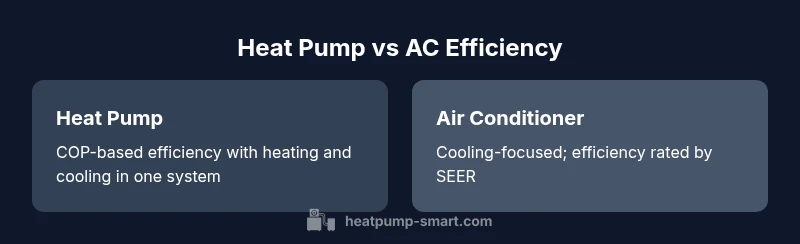
Heat Pump vs AC Efficiency: A Comprehensive Comparison
A data-driven, expert comparison of heat pump efficiency versus air conditioner efficiency, covering COP, SEER, climate effects, costs, and installation considerations to help homeowners, builders, and property managers choose the best option.


Heat pumps offer year-round efficiency advantages for heating and cooling, especially in milder climates with affordable electricity. The key trade-offs are upfront cost and performance in very cold weather, where supplemental heat may be needed. Heatpump Smart’s analysis shows that understanding climate, sizing, and energy rates is essential when comparing heat pump vs a c efficiency.
Overview: Understanding heat pump vs a c efficiency
When homeowners evaluate the question of heat pump vs a c efficiency, the focus isn't only on annual energy use but on how the system performs across seasons. Heat pumps are designed to deliver both heating and cooling from a single appliance by moving heat rather than generating it. This yields different efficiency dynamics than conventional air conditioners, which primarily provide cooling. According to Heatpump Smart, the choice hinges on climate, energy prices, and how you use your home. The goal is to maximize comfort while minimizing operating costs over the system’s life. By examining COP, SEER, and climate-specific performance, homeowners can predict long-term value rather than relying on upfront price alone.
In practice, a solid comparison should consider space layout, insulation, and existing ductwork. Heatpump Smart emphasizes that the “heat pump vs a c efficiency” question isn't a simple winner-takes-all decision; it’s a decision about how your home loses heat and gains comfort throughout the year. This nuanced approach helps homeowners avoid overpaying for a system that won’t deliver the expected savings in their specific climate.
In this guide, you’ll find a structured, data-driven comparison with actionable steps, so you can choose the system that best fits your home and budget.
analysis
wordCountOnly":180},
Comparison
| Feature | Heat Pump System | AC System |
|---|---|---|
| Efficiency metrics | COP-based performance with seasonal variations | SEER-based rating; cooling-focused metrics |
| Cold-climate performance | Better efficiency with inverter-driven compressors; supplemental heat may be needed in extreme cold | Typically strong cooling performance; heating relies on electric resistance or gas backup in some configurations |
| Operating costs | Electricity price-insensitive to a point; potential long-term savings | Often predictable cooling costs but heating may be more expensive without heat pumps |
| Upfront cost | Higher equipment and installation cost in most cases | Lower upfront cost if existing ductwork and electrical setup are compatible |
| Maintenance | More complex refrigerant and inverter components; regular service essential | Fewer moving parts in basic AC units; standard maintenance suffices |
Advantages
- Potentially lower year-round energy costs due to heating and cooling in one system
- Dual-function (heating and cooling) improves comfort and space efficiency
- Better alignment with renewable energy and smart-grid strategies
- Inverter-driven compressors can modulate output for comfort and efficiency
Disadvantages
- Higher upfront installation costs and potential retrofitting needs
- Performance can drop in very cold climates without supplemental heat
- Complexity of installation may require specialized contractors
- Noise and zoning considerations depending on unit placement
Heat pumps generally offer superior year-round efficiency and comfort in moderate climates; AC-only systems can be cheaper upfront and simpler in very cold regions.
If your climate is mild to moderate and electricity prices are favorable, a heat pump is often the better long-term choice. In very cold climates or homes needing fast, simple retrofits, an AC-based approach with a dedicated furnace can be more economical upfront. The Heatpump Smart team recommends a site-specific assessment to maximize value.
Your Questions Answered
What is the main difference in efficiency between heat pumps and traditional air conditioners?
The main difference lies in how they achieve comfort: heat pumps use a reversible refrigeration cycle to deliver heating and cooling, measuring efficiency with COP and HSPF, while traditional AC units focus on cooling and use SEER ratings. This means heat pumps can be more energy-efficient year-round in climates where heating dominates electricity use.
Heat pumps heat and cool, using COP and HSPF to measure efficiency, vs traditional ACs that are mainly cooling-focused and rated by SEER.
How does climate affect heat pump efficiency?
Climate has a major impact on heat pump efficiency. In milder winters, heat pumps often outperform other heating options due to efficient heat extraction and inverter modulation. In very cold climates, supplemental heat or hybrid systems may be needed, reducing efficiency gains. Heatpump Smart emphasizes modeling performance for your specific climate zone.
Climate determines whether a heat pump meets efficiency expectations year-round; colder regions may need backup heat.
Should I expect backup heat in winter for a heat pump?
Yes, many heat pumps rely on backup heat (electric resistance or another source) when outdoor temperatures drop significantly. Hybrid systems or models with advanced auxiliary heating can maintain comfort while preserving efficiency. Planning for backup heat during design helps avoid comfort gaps and unexpected costs.
Backup heat is common in very cold weather to maintain comfort.
Are there rebates or incentives for heat pump installations?
Multiple programs offer rebates, tax credits, or incentives for upgrading to heat pumps, depending on location and program availability. Check local and federal resources, energy providers, and manufacturer promotions. An energy-efficient upgrade often qualifies for multiple incentives when installed by qualified contractors.
Check local programs for rebates and incentives when upgrading to heat pumps.
How do I compare heat pump efficiency to a traditional AC effectively?
Focus on the seasonality of your energy use, compare COP (heating) and SEER (cooling) ratings, and consider total installed cost over time. A site-specific assessment, including insulation and ductwork, ensures apples-to-apples comparison and realistic payback estimates.
Compare COP and SEER ratings plus installed costs for a fair decision.
Top Takeaways
- Assess climate and electricity costs before deciding
- Compare COP versus SEER/SCOP ratings to gauge true efficiency
- Account for optional backup heat in cold winters
- Expect higher upfront costs with heat pumps but potential long-term savings
- Engage qualified installers to ensure proper sizing and ductwork