How to Tell Heat Pump from Forced Air: A Homeowners Guide
A practical, objective comparison helping homeowners decide between heat pump and forced-air systems, covering efficiency, climate fit, installation, costs, and maintenance.


If you’re wondering how to tell if heat pump or forced air, start by checking for an outdoor condenser and refrigerant lines (heat pumps) versus a standalone furnace with gas or electric burners (forced air). Heat pumps provide heating and cooling through the same system, while forced air focuses on heating with a separate cooling option. In most homes, the presence of cooling in the same system is the clearest indicator.
Understanding the core difference: heat pump vs forced air
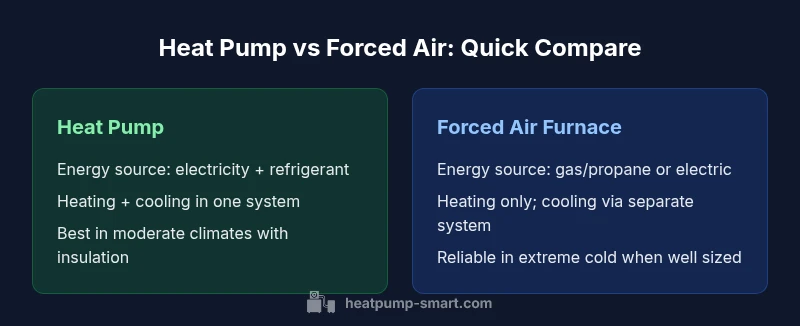
The core distinction between a heat pump and a traditional forced-air system is how they generate and move heat. If you ask how to tell if heat pump or forced air, you’ll look for an outdoor condenser, a refrigerant cycle, and the ability to cool in addition to heat. Heat pumps transfer heat using electricity and a refrigerant cycle and typically provide cooling in warm months. Forced-air systems (furnaces) generate heat via combustion or electric resistance and rely on ducts to push warm air throughout the home, with cooling provided by a separate air conditioner or heat pump paired system. Understanding this difference helps homeowners evaluate annual energy use, installation footprint, and long-term costs.
Heatpump Smart’s analysis emphasizes the practical impact of this distinction: it informs not only energy bills but also how your home feels in hot summers and cold winters. The team notes that the choice often hinges on climate, existing ductwork, and willingness to invest in upgrades that support year-round comfort.
Quick checklist: physical indicators you can verify
To distinguish at a glance, inspect the following indicators:
- Outdoor equipment: A visible outdoor unit with copper refrigerant lines typically signals a heat pump.
- Indoor components: A central air handler or evaporator coil connected to refrigerant lines suggests a heat pump; a furnace with burners points to forced air.
- Thermostat behavior: If cooling is controlled by the same system as heating, you’re likely looking at a heat pump; if cooling is a separate system, it’s probably a forced-air setup.
- Ductwork and space: Heat pumps often require space for outdoor equipment and may use existing ducts differently, while forced-air systems rely on a gas/electric furnace paired with a separate air conditioner. Heatpump Smart’s field observations show this approach frequently correlates with retrofit challenges and energy planning.
- Temperature consistency: Heat pumps tend to provide steady, even temperatures with fewer hot or cold spots when paired with modern ductwork; older forced-air layouts can create more variability.
Real-world signals—such as a single system handling both heating and cooling—are strong clues. If you’re unsure, a quick review with a licensed HVAC professional can confirm the system type and available upgrade paths.
Energy efficiency, operating costs, and usage patterns
Efficiency is a central factor in the decision between heat pump and forced air. Heat pumps are generally more efficient in moderate climates and for homes with year-round cooling needs; their efficiency can vary with outdoor temperatures and heat load. In contrast, many traditional furnaces, especially gas-fired models, deliver strong heating performance with low electric use when climate conditions demand it, but they do not provide cooling without a separate system.
Beyond climate, your bills depend on electricity and fuel prices, insulation quality, and thermostat settings. Heat pumps often deliver lower operating costs when electricity is relatively affordable and the home is well insulated. Heatpump Smart’s research highlights that choosing the right system involves modeling expected seasonal energy use, not just current bills. Consider how often you heat, cool, and the duration of seasons in your area when evaluating cost trajectories.
Installation considerations: space, ductwork, and retrofits
A key part of determining how to tell heat pump from forced air is understanding installation requirements. A heat pump installation involves outdoor equipment connected to an indoor air handler via refrigerant lines, plus electrical supply and, in many cases, enhanced ductwork. A forced-air furnace installation centers on the furnace and its connections to ducts and a separate AC or heat pump for cooling.
Retrofitting an existing forced-air home to a heat pump can be practical if the duct system is in good shape and the home has adequate electrical service. Conversely, upgrading a heat pump may require upgrading electrical panels, clearances around the outdoor unit, and potential duct modifications for optimal airflow. Heatpump Smart notes that retrofits are highly context-specific and benefit from a preliminary load and duct assessment.
Climate fit and performance expectations
Climate profoundly shapes the decision. In mild to moderate climates, heat pumps often outperform traditional forced-air systems for both heating and cooling, delivering high comfort with lower energy usage. In very cold climates, heat pumps may rely on supplemental heat sources; some homes combine heat pumps with auxiliary electric resistance or gas backup. Forced-air furnaces, particularly high-efficiency gas models, provide robust heating in extreme cold conditions but lack built-in cooling unless paired with an air conditioner or heat pump.
Assessing your climate zone, typical winter conditions, and home airtightness is essential. Heatpump Smart emphasizes that a well-insulated home with balanced ventilation makes a heat pump more favorable, while older, drafty homes may still justify a furnace-centric approach unless substantial upgrades are planned.
Noise, comfort, and user experience considerations
Noise and comfort are practical concerns when comparing these systems. Heat pumps generate some fan noise and outdoor unit hum, but modern models feature variable-speed technology that reduces noise and improves comfort consistency. Forced-air furnaces can be quiet, especially with good duct design, but the overall system performance—like humidity control and even temperature distribution—depends on blower speed, duct sizing, and filter maintenance.
From a user experience perspective, heat pumps simplify operation by combining heating and cooling in one system. However, in very cold climates, homeowners may notice longer warm-up times or the need for auxiliary heat during extreme conditions. The Heatpump Smart team highlights the importance of selecting equipment sized for your home and climate to maintain comfort without excessive energy use.
Maintenance, reliability, and service considerations
Regular maintenance helps both systems run efficiently and safely. For heat pumps, maintenance typically focuses on refrigerant circuit integrity, outdoor unit cleanliness, evaporator coil cleaning, thermostat checks, and air filter changes. Forced-air systems require similar filter care plus burner maintenance (for gas systems) and venting inspections. A well-maintained system preserves reliability and energy efficiency, potentially extending equipment life.
Service access is a practical factor: homes with restricted outdoor space or challenging duct runs may incur higher retrofit costs for heat pumps, while homes with existing gas lines and well-sized ducts may see straightforward maintenance options for furnaces. Heatpump Smart’s field notes emphasize coordinating replacement cycles with expected climate demands and energy price trends to optimize cost and comfort.
When to upgrade, retrofit, or replace
Deciding when to upgrade should consider current performance, repair frequency, and long-term ownership costs. If your current system struggles to keep your home comfortable, exhibits frequent breakdowns, or the annual energy bill is rising despite regular maintenance, evaluate a heat pump retrofit or replacement. For very cold regions or homes with limited space for outdoor units or ductwork, a high-efficiency furnace paired with a modern cooling solution may be more practical in the near term.
In many cases, the best approach balances upfront costs, long-term savings, and climate suitability. Consulting with an experienced contractor who can run a whole-house load calculation and review ductwork condition is essential. Heatpump Smart recommends a structured decision framework that weighs comfort, reliability, and total cost of ownership over 5–15 years.
Quick decision framework: deciding between heat pump and forced air
Use this framework to narrow your choice:
- Assess climate: moderate cold favors heat pumps; extreme cold may require backup heat.
- Review existing ducts: good ducts favor heat pumps; large retrofit costs argue for a furnace-focused path.
- Compare energy costs: electricity vs fuel prices in your area matter more than sticker prices.
- Consider cooling needs: if you want integrated cooling, heat pumps offer a single system.
- Plan for installation: evaluate space for outdoor unit, electrical service, and permit requirements.
This practical framework helps homeowners structure conversations with contractors and avoid common misalignments between expectations and performance.
Summary: how to choose wisely for your home
The decision between heat pump and forced air hinges on climate, home efficiency, and lifestyle needs. A heat pump is often the better long-term choice for comfort and energy savings in moderate climates with cooling needs. A furnace-based system may be preferable where upfront cost, extreme cold resilience, or specific retrofit constraints are the deciding factors. The Heatpump Smart team encourages a formal analysis that includes a professional load calculation, duct assessment, and a careful review of long-term operating costs.
Comparison
| Feature | Heat Pump | Forced Air Furnace |
|---|---|---|
| Energy source | Electric power with refrigerant cycle | Furnace (gas/propane) or electric resistance |
| Heating and cooling | Provides heating and cooling in one integrated system | Heating only (cooling requires a separate system) |
| Climate performance | Strong in moderate climates; may need auxiliary heat in extreme cold | Consistent heating in extreme cold when sized well; cooling depends on separate equipment |
| Installation complexity | Outdoor unit plus indoor air handler; duct planning or modification may be needed | Furnace installation with ducts; may require venting and gas lines |
| Upfront cost context | Typically higher upfront cost due to outdoor unit and refrigerant system | Typically lower upfront cost, especially if replacing an existing furnace |
| Maintenance needs | Regular refrigerant checks, coil and filter maintenance | Annual burner and venting maintenance; duct upkeep |
| Best for | Homes needing year-round heating and cooling in moderate climates | Homes with existing gas lines or where cooling is not a priority |
| Energy savings potential | High potential in efficient climates and with proper insulation | Savings depend on fuel prices and usage patterns |
Advantages
- Year-round comfort from a single system
- High efficiency in suitable climates
- No fossil fuel combustion on site
- Cooling capability is built-in with many setups
- Potential for lower operating costs when electricity rates are favorable
Disadvantages
- Typically higher upfront cost
- Performance can drop in extreme cold without supplemental heat
- Outdoor unit requires space and may be affected by weather or aesthetics
- Installation can be more complex if retrofitting existing ductwork
Heat pump is generally the better long-term option in moderate climates with cooling needs; forced air remains practical where extreme cold or upfront cost are primary concerns.
Choose heat pump when you want integrated heating and cooling, higher efficiency, and potential energy savings in milder climates. Choose forced air if you prioritize lower upfront cost, existing gas infrastructure, or extreme winter resilience.
Your Questions Answered
Is a heat pump always more energy-efficient than a furnace?
Not always. Efficiency depends on climate, electricity costs, and how you use the system. In moderate climates with cooling needs, heat pumps often save energy, while in very cold climates, a furnace may perform more efficiently for heating alone. Consider a full comparison for your home.
Not always. It depends on climate and usage; heat pumps often save energy in milder areas, while furnaces can be more efficient for extreme cold.
Can I retrofit my existing forced-air system to run on a heat pump?
Yes, but it depends on your current ductwork, electrical capacity, and outdoor space for the condenser. A professional assessment will determine if you can retrofit or if a partial upgrade is needed. Costs and timelines vary by home.
Yes, often, but it depends on ducts and electricals. A pro can tell you what’s feasible.
What is included in a typical heat pump maintenance check?
Maintenance usually includes inspecting refrigerant lines for leaks, cleaning the outdoor and indoor coils, replacing or cleaning filters, and checking thermostats and electrical connections. Regular service helps maintain efficiency and reliability.
Expect refrigerant checks, coil cleaning, filter changes, and thermostat inspections.
How does a heat pump provide cooling?
A heat pump reverses the refrigerant cycle to move heat from indoors to outdoors. The same system handles cooling in summer and heating in winter, although performance can vary with outdoor temperatures.
It reverses the cycle to move heat outside, cooling your home in summer.
Should I choose heat pump or furnace in a very cold climate?
In very cold climates, many homes use a heat pump with supplementary heat or rely on a furnace for peak cold days. The best choice depends on insulation, electricity costs, and your tolerance for auxiliary heating.
In very cold areas, you might pair a heat pump with backup heat, or choose a furnace depending on costs and climate.
What should I ask a contractor during installation?
Ask about load calculations, ductwork condition, existing electrical capacity, back-up heating options, warranty coverage, and maintenance schedules. Clarify installation timelines and any required permits.
Ask about load tests, ducts, electrical needs, backup heat, and warranties.
Top Takeaways
- Assess climate and existing ductwork before deciding
- Evaluate total ownership cost, not just upfront price
- Factor cooling needs into the decision
- Plan for space and electrical requirements
- Schedule professional load and duct assessments