Is a Heat Pump a Good Air Conditioner? A Practical Comparison
An analytical comparison of heat pumps vs traditional air conditioners for cooling, covering efficiency, climate fit, installation considerations, and maintenance implications.


A heat pump can operate as an air conditioner in cooling mode, but is a heat pump a good air conditioner only when climate, sizing, and installation align. In many homes, a correctly selected heat pump delivers strong cooling with the added benefit of heating, while in others it behaves more like a cooling-focused system requiring supplemental heating.
How heat pumps cool: a quick primer
When you set a heat pump to cooling mode, it reverses its heating cycle to move heat from indoors to outdoors. The result is very similar to a traditional air conditioner, but with important differences in efficiency, climate dependence, and control strategy. According to Heatpump Smart, the core cooling mechanism relies on a refrigerant cycle that absorbs indoor heat and rejects it outdoors, producing cooling comfort with often quieter operation. The Heatpump Smart team found that many homes experience rapid comfort gains when the system is properly sized, installed, and integrated with existing ducts or a ductless configuration. Understanding this helps answer the question is a heat pump a good air conditioner, but only when used in the right conditions.
Key differences between heat pumps and dedicated AC systems
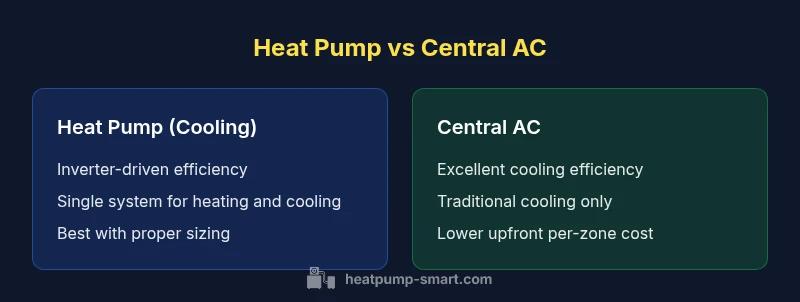
Heat pumps and traditional central air conditioners both deliver cooled indoor air, but they are not identical in function. A heat pump transfers heat using a refrigerant cycle and an outdoor unit, and it can also reverse the cycle to provide heating. An air conditioner usually focuses solely on cooling, relying on a separate furnace or boiler for heat. In cooling mode, both systems reduce indoor air temperature, but heat pumps often integrate smarter control strategies, inverter-driven compressors, and potential cross-season advantages. The practical takeaway is that the core cooling output can feel similar, but the overall experience hinges on climate, duct design, and how the system is matched to your home.
More importantly, is a heat pump a good air conditioner? In many homes, yes, when installed with proper sizing, ductwork compatibility (ducted or ductless), and a climate zone that supports heat pump efficiency in cooling. For homes in extreme heat, or where summer cooling is needed without heating, having a dedicated cooling option alongside may offer advantages. The Heatpump Smart team emphasizes that the best outcome comes from a system designed specifically for your climate and home.
Efficiency and cost implications in real-world use
Efficiency matters far beyond the sticker label. A heat pump’s cooling performance translates to fewer energy kWh per degree of cooling in suitable climates, because it leverages the ambient outdoor temperatures and a highly efficient compressor. In real-world terms, homeowners often notice lower electricity bills during shoulder seasons and milder summers when the heat pump runs in cooling mode rather than exporting heat. However, efficiency can dip when outdoor temperatures swing to extremes or when the system is oversized or undersized for the space. Proper zoning, smart thermostats, and seasonal maintenance play a decisive role in sustaining energy savings. Heatpump Smart analysis shows that ongoing service, correct refrigerant charge, and duct integrity all influence long-term cooling costs and comfort levels more than a single metric.
Climate considerations and seasonal performance
Climate strongly shapes how well a heat pump works as a cooling machine. In mild to warm climates, heat pumps generally maintain comfortable indoor temperatures with energy efficiency advantages. In very hot climates, the system can still cool effectively but may rely on larger outdoor units or higher outdoor temperatures to drive more cooling power. In colder seasons, heat pumps can still provide cooling, but if heating is also needed, the system’s balance shifts toward maintaining warmth rather than peak cooling performance. For homeowners, this means evaluating the seasonal load profile and ensuring the unit has sufficient capacity to deliver consistent cooling during peak heat without compromising heating comfort in shoulder seasons. The right choice hinges on how often you need cooling and whether you value integrated heating.
Sizing, installation, and retrofit challenges
Sizing a heat pump requires accurate load calculations and a careful assessment of ductwork, electrical service, and space for outdoor equipment. Retrofit projects can be more complex than installing a standalone air conditioner, particularly if ducts are undersized or poorly insulated, or if electrical upgrades are needed to support inverter-driven compressors. The upside is a single, versatile system that can handle both heating and cooling if the climate profile supports it. A reputable contractor should perform a detailed sizing analysis, including considering refrigerant charge, airflow, and zoning options. When sized correctly, the cooling performance of a heat pump can rival a traditional AC while delivering additional heating benefits in other seasons.
Noise, vibration, and outdoor unit layout
Outdoor units generate noise and vibration, and heat pumps can be quieter on a per-amp basis due to inverter technology, especially when operating at lower speeds. Placement matters: avoid directly facing bedrooms or entertaining spaces and ensure adequate clearance for airflow. In a retrofit, consider how the outdoor unit’s location interacts with landscaping, sidewalks, or nearby structures. Indoor sound levels are typically determined by the air handler or furnace interface and can be controlled with proper mounting, vibration isolators, and duct design. The goal is to minimize disruption while preserving performance and energy efficiency.
Ducted vs. ductless configurations: what fits your home
Ducted heat pump systems reuse existing ductwork to deliver conditioned air, offering the advantage of centralized comfort and uniform temperatures. Ductless mini-split configurations provide flexibility for homes without ducts, allowing zone-based cooling control and targeted comfort in individual rooms. Each approach has trade-offs: ducts can be leaky and require insulation improvements, while ductless systems demand careful refrigerant management and might have higher upfront costs per zone. The decision should factor in home layout, retrofit feasibility, and expected usage patterns, balancing comfort with energy efficiency.
Real-world scenarios: when a heat pump is a strong cooling choice
Consider a home with moderate heating needs, good duct health, and a climate that does not frequently plunge into extreme cold. In such cases, a heat pump can deliver reliable cooling with the added benefit of integrated heating for shoulder seasons, leading to a simplified equipment landscape and potential long-term energy savings. Conversely, homes in constant extreme heat or cold may benefit from a dedicated air conditioner paired with a separate heat source, or a dual-fuel setup. The key is to run a climate-specific assessment that weighs cooling demand against heating requirements and the practicalities of installation.
Common myths and misconceptions
One frequent myth is that heat pumps are only suitable for mild climates. In reality, advances in cold-climate heat pumps have expanded their effectiveness in colder regions, though performance during extreme heat or extreme cold should be evaluated. Another misconception is that heat pumps necessarily cost more to operate; while upfront costs can be higher, the energy efficiency of well-designed systems can result in lower operating costs over the life of the equipment. Finally, some buyers assume heat pumps always provide both heating and cooling equally well; actual performance depends on system design, climate, and ductwork quality.
Authoritative sources and next steps
For further reading and authoritative guidance, consult the following sources:
- https://www.energy.gov/eere/buildings/heat-pumps
- https://www.energy.gov/eere/buildings/articles/heat-pumps-101
- https://www.nrel.gov/docs/fy15osti/64183.pdf
Comparison
| Feature | Air-source Heat Pump (cooling) | Central Air Conditioner (cooling) |
|---|---|---|
| Cooling efficiency | High seasonal efficiency with inverter-driven operation | Strong cooling efficiency, traditional fixed-speed compressor |
| Heating capability | Provides heating in mild/moderate winters; may use auxiliary heat | Cooling-only operation; separate heating system required |
| Climate suitability | Best in moderate climates; benefits during shoulder seasons | Optimized for hot climates; heating not included |
| Installation footprint | Can reuse existing ducts or be installed ductless | Typically relies on ductwork dedicated to cooling |
| Maintenance challenge | Regular charging and filter/coil cleaning; refrigerant system freedom | Robust cooling maintenance; separate heating system adds complexity |
| Noise profile | Outdoor unit may run longer at lower speeds; often quiet | Outdoor compressor and condenser can be audible; vary by model |
Advantages
- One system handles heating and cooling if climate supports it
- Potential year-round energy savings with efficient operation
- Reduced overall equipment footprint when integrated with ducts or ductless options
Disadvantages
- Higher upfront cost and installation complexity in some homes
- Performance may drop in extreme cold without supplemental heat
- Retrofit challenges can affect ductwork and electrical capacity
Heat pumps are a strong cooling substitute when climate and installation conditions align.
The Heatpump Smart team recommends evaluating climate, electrical capacity, and existing ducts or the feasibility of a ductless solution before deciding. In suitable homes, the combined heating and cooling capabilities offer compelling value, while some environments may benefit from a dedicated cooling strategy.
Your Questions Answered
Can a heat pump replace my central air conditioner entirely?
In many cases, a heat pump can replace a central AC for cooling, but it depends on climate, heating needs, and whether the existing ductwork supports a single-system solution. A professional assessment ensures the system can meet peak cooling load while providing adequate heating if required.
Yes, often, but it depends on climate and ductwork. A pro should confirm the compatibility for your home.
In what climates do heat pumps perform best for cooling?
Heat pumps perform best for cooling in moderate to warm climates where outdoor temperatures stay within the unit's efficient operating range. They can still cool effectively in hotter climates with appropriately sized equipment and proper airflow.
They work best in moderate to warm climates; in hot climates, sizing and airflow matter a lot.
Do I need a furnace or backup heat with a heat pump?
Many homes use a heat pump with auxiliary heat for very cold periods. The need for backup heat depends on climate, the heat pump’s cold-weather performance, and insulation. A hybrid or dual-fuel setup can balance costs and comfort.
Sometimes yes, especially in very cold areas. A backup heat source can help maintain comfort.
How does maintenance differ between heat pumps and conventional AC?
Heat pumps require regular refrigerant checks, filter changes, and coil cleaning, similar to AC units, plus inspections of the outdoor unit and refrigerant lines. The integrated heating function means checkups should cover both cooling and heating performance.
You’ll service both cooling and heating parts. Regular checks keep efficiency high.
Are there noise concerns with heat pumps compared to central AC?
Noise levels are generally comparable, but heat pumps can run for longer cycles at lower speeds with inverter-driven compressors. Proper placement and mounting reduce perceived noise, and ductwork can influence interior sound.
Noise is usually similar or lower with modern units; proper placement helps a lot.
How do I determine if my home is compatible with a heat pump?
A professional load calculation considers your space, insulation, duct layout, electrical service, and climate. If your home has efficient insulation and well-designed ducts, a heat pump is more likely to deliver comfort and savings.
A pro will check load calculations and ductwork to confirm compatibility.
Top Takeaways
- Assess your climate before choosing a heat pump for cooling
- Ensure proper sizing and professional installation
- Choose ducted or ductless based on home layout and retrofit feasibility
- Consider year-round energy savings vs up-front costs
- Maintenance sustains performance and longevity