Heat Pump vs Air Conditioner: A Comprehensive Comparison
A data-driven comparison of heat pumps vs air conditioners, detailing how they work, efficiency, climate performance, costs, and installation considerations for homeowners and professionals.


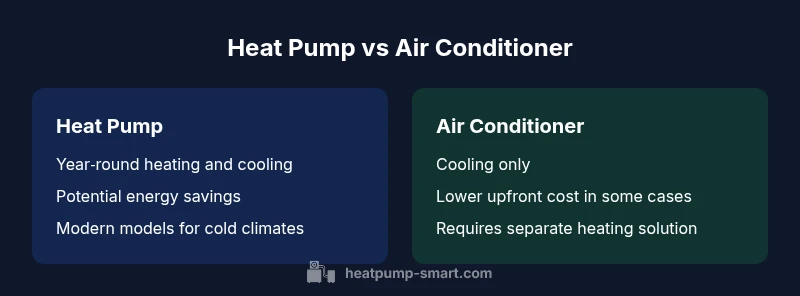
Is a heat pump similar to an air conditioner? In short, both rely on a refrigerant cycle to move heat, but a heat pump can reverse that cycle for heating as well as cooling. This means year‑round climate control with potential energy savings in moderate climates, though performance and costs vary by model, climate, and installation. Heatpump Smart explains how these systems compare in operation, efficiency, and practicality.
Defining the core question and context
The phrase is is a heat pump similar to an air conditioner is more than a semantic curiosity; it frames how homeowners evaluate climate control options. At their core, both devices use the same basic refrigeration cycle to move heat rather than create it. The pivotal difference is that a heat pump includes a reversing valve that enables heating in winter and cooling in summer, whereas a traditional air conditioner focuses solely on cooling. This distinction drives how each system performs across seasons, influences energy usage, and shapes installation requirements. Heatpump Smart emphasizes that understanding this distinction helps homeowners and property managers make informed decisions about comfort, cost, and long-term value.
Fundamental operating principles: what's the same and what's different
Both heat pumps and air conditioners circulate a refrigerant through a closed loop consisting of an evaporator, a compressor, a condenser, and an expansion device. In cooling mode, heat is absorbed indoors and expelled outside. In heating mode, a heat pump reverses the flow, absorbing outdoor heat and delivering it inside. The key architectural difference is a reversing valve and, often, additional controls to manage heating cycles. This shared foundation explains why both systems can look and feel similar from a distance, yet deliver different year-round performance depending on climate and system design.
How the heating capability changes performance and design
The heating capacity of a heat pump enables it to replace a separate furnace or boiler in many homes. In cooling-only configurations, an air conditioner requires a dedicated heating solution. A heat pump’s heating efficiency depends on outdoor temperatures, system sizing, and refrigerant charge, so installers consider climate data, insulation, and ductwork when evaluating performance. In practice, homeowners often notice steadier indoor temperatures and reduced reliance on separate heating equipment when a suitably matched heat pump is installed. Heatpump Smart notes that a well-integrated system can maintain comfort with lower energy intensity across a cooling and heating season.
Efficiency and what the numbers mean for you
Efficiency metrics like the Coefficient of Performance (COP) and the Energy Efficiency Ratio (EER) explain how much heat is moved per unit of energy. Heat pumps also rely on Heating Seasonal Performance Factor (HSPF) to measure heating efficiency over a season. In general, heat pumps can deliver higher overall efficiency in moderate climates because they move heat rather than generate it, whereas single-purpose air conditioners focus solely on cooling efficiency. Real-world performance depends on insulation, air leakage, and system controls, so the best approach is a properly designed, climate-appropriate installation.
Climate suitability and seasonal performance
In milder winters, heat pumps often outperform cooling-only air conditioners in total energy use due to their dual capability and efficiency advantages. In very cold climates, some heat pumps lose efficiency, but modern cold-climate models mitigate much of this gap. When choosing between the two, consider your typical seasonal temperatures, electricity costs, and whether you want a single system to handle year-round comfort. Heatpump Smart’s guidance emphasizes selecting a model rated for your climate and ensuring proper sizing and installation.
Comparison
| Feature | Heat Pump | Air Conditioner |
|---|---|---|
| Primary function | Heating + cooling (dual‑role) | Cooling only |
| Year-round use | Yes (with heating mode) | No |
| Efficiency indicators | COP/HSPF depend on climate and model | EER/SEER primarily for cooling efficiency |
| Heating performance in cold weather | Improved with cold-climate models | Not applicable (heating not provided) |
| Installation considerations | Often requires ductwork or refrigerant components; may need outdoor unit placement | Typically simpler cooling-focused installation; may pair with furnace for heating |
| Best for | Homes seeking year-round comfort with a single system | Homes primarily needing cooling or cooling with existing heating |
Advantages
- Dual heating/cooling capability reduces need for separate furnace in many homes
- Potential energy savings in moderate climates
- Single system can offer improved comfort control and zoning
Disadvantages
- Higher upfront cost than cooling-only AC in some cases
- Performance can vary in very cold climates or older homes
- Requires professional sizing and installation; ductwork adjustments may be needed
Heat pumps generally win for all-season comfort in moderate climates, but air conditioners can be simpler and cheaper when heating is not required.
Choose a heat pump if you want year-round comfort from one system and have climate conditions that support efficient heating. Opt for a traditional air conditioner if you primarily need cooling and want a cost-effective, simpler cooling-focused solution, especially where heating is already provided by another system.
Your Questions Answered
Is a heat pump the same as an air conditioner?
Not exactly. An air conditioner cools only, while a heat pump can both cool and heat by reversing the refrigerant cycle. This dual capability is the core distinction and drives differences in installation and efficiency.
A heat pump both heats and cools using the same system, while an air conditioner only cools.
Do heat pumps work well in cold weather?
Modern heat pumps are designed for cold-weather performance, with many models rated for efficient operation in lower outdoor temperatures. In very cold climates, some models may rely on supplemental heating, but advances have greatly narrowed the gap.
Cold-weather performance varies by model—look for cold-climate ratings when choosing a heat pump.
Can I replace my air conditioner with a heat pump?
Yes, in many cases you can replace an AC with a heat pump, especially if you also need heating. The decision depends on climate, existing ductwork, and available space for outdoor units.
You can usually switch from AC to a heat pump if you need heating too.
Are heat pumps more expensive to install than traditional AC units?
Upfront costs for heat pumps can be higher than cooling-only AC units, due to heating components and installation complexity. However, total lifetime costs may be lower if heating savings offset the initial premium.
Heat pumps often cost more upfront but can be cheaper to run over time.
What maintenance do heat pumps require?
Regular maintenance includes filter changes, coil cleaning, and annual professional checks. Proper maintenance helps sustain efficiency and extends system life.
Keep filters clean and schedule yearly tune-ups for peak performance.
Top Takeaways
- Assess climate before choosing heat pump vs air conditioner
- Prioritize proper sizing and professional installation
- Expect higher upfront costs with heat pumps but potential long-term savings
- Consider ductwork and space for outdoor units when planning installation
- Look for cold-climate rated heat pumps if winters are cold