Should a Heat Pump Run Constantly in Winter? A Practical Guide
Learn whether a heat pump should run nonstop in winter, how to optimize operation for comfort and efficiency, and when to call a pro. Step-by-step tips, maintenance checks, and expert guidance for homeowners and managers.


In winter, a heat pump should generally not run nonstop. It should cycle on and off to maintain your setpoint, though longer runs can occur in very cold weather or when heating demand is high. If you notice constant operation, review thermostat settings, insulation, and outdoor unit clearance, and consider professional service if the issue persists.
How winter operation works
Winter heating relies on two main modes: the heat pump’s compressor-driven heating and the auxiliary resistance heat that kicks in when temperatures plunge or when the outdoor coil defrost cycle occurs. In mild cold, the heat pump can meet most heating loads efficiently, but when the outdoor temperature drops, the system may run longer to maintain comfort. According to Heatpump Smart, modern air-source heat pumps are engineered to maximize efficiency in a range of climates, but correct sizing, installation, and controls matter just as much as component quality. Note that continuous operation in winter isn’t inherently bad: a longer but lower-intensity run can be more efficient than short, frequent cycles if the home is poorly insulated.
How winter operation works
Winter heating relies on two main modes: the heat pump’s compressor-driven heating and the auxiliary resistance heat that kicks in when temperatures plunge or when the outdoor coil defrost cycle occurs. In mild cold, the heat pump can meet most heating loads efficiently, but when the outdoor temperature drops, the system may run longer to maintain comfort. According to Heatpump Smart, modern air-source heat pumps are engineered to maximize efficiency in a range of climates, but correct sizing, installation, and controls matter just as much as component quality. Note that continuous operation in winter isn’t inherently bad: a longer but lower-intensity run can be more efficient than short, frequent cycles if the home is poorly insulated.
Tools & Materials
- Smart thermostat with adaptive scheduling(Enable eco/away modes and seasonal setbacks to reduce unnecessary running)
- Infrared thermometer(For measuring outdoor unit surface temps and duct temperatures)
- Notebook and pen(Record settings, observations, and any anomalies)
- Weatherstripping/door sweeps(Seal drafts around doors and windows to reduce heat load)
- Tape measure(Check for gaps around windows and between ductwork)
- Flashlight(Inspect the outdoor unit and around the installation area)
Steps
Estimated time: 30-60 minutes
- 1
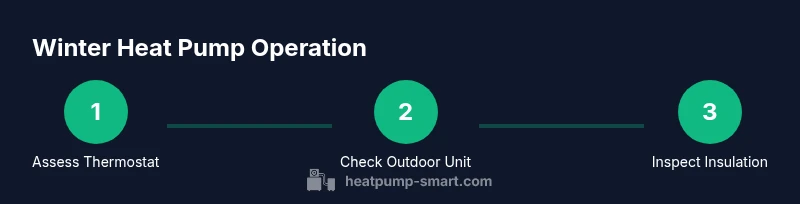
Verify thermostat settings and setpoint strategy
Check that the thermostat is in heat mode with a reasonable setpoint and that no programs are forcing constant high temperatures. Consider a moderate setback to reduce cycling while maintaining comfort.
Tip: Avoid large temperature swings; small setbacks (2–4°F) save energy without sacrificing comfort. - 2
Inspect outdoor unit clearance and airflow
Ensure there’s at least 2–3 feet of clearance around the condenser and that snow, leaves, or ice aren’t blocking the coil. Clean debris and remove any stacked snow to maintain efficient heat exchange.
Tip: Clear snow promptly after storms to prevent defrost cycles from increasing run-time. - 3
Check insulation and ducts for leaks
Identify obvious air leaks around doors, windows, and attic access. Inspect ductwork for loose connections or crushed sections that reduce airflow and force longer operating cycles.
Tip: Seal leaks with proper tape or mastic; balanced airflow improves efficiency and reduces run-time. - 4
Assess heat load and zone controls
Evaluate whether decoupled zones are being heated unevenly. If some rooms warm quickly while others stay cooler, adjust zoning or add insulation to maintained hot spots.
Tip: Use programmable zoning to avoid heating unoccupied spaces, lowering overall load. - 5
Observe defrost cycles and backup heat usage
Defrost cycles can briefly interrupt heating and feel like the system is running differently. If backup electric heat kicks in too often, the outdoor temperature or seal integrity may need attention.
Tip: A properly charged system and clean filters reduce reliance on auxiliary heat. - 6
Test response to gradual setpoint changes
Make small adjustments to the thermostat in 1–2°F steps and monitor how quickly the system responds. Large, abrupt changes can cause unnecessary cycling.
Tip: Program gentle transitions rather than abrupt jumps to stabilize operation. - 7
Schedule professional maintenance
Have a qualified tech verify refrigerant charge, electrical connections, and overall system health, particularly before peak cold periods.
Tip: Annual or biannual professional checkups catch problems before they drive up run-time.
Your Questions Answered
Should a heat pump run constantly in winter?
Generally no. A properly sized and well-maintained heat pump cycles on and off to maintain set temperatures. Constant running may indicate a thermostat issue, insulation problems, or an airflow restriction.
In most cases, a heat pump should not run nonstop in winter. If it does, check the thermostat and insulation, and consider a professional check if needed.
What’s the difference between cycling and constant running?
Cycling means the system turns on and off in short intervals; constant running implies the unit stays on for long periods. Short cycling often signals an oversized system or thermostat issues, while longer runs can be normal during very cold days.
Cycling is typical; constant running could mean a problem or extreme cold load.
How can I tell if my heat pump is oversized or undersized for winter?
Signs include frequent short cycling (oversized) or very long run times with high energy use (undersized). A professional load calculation and testing can confirm the correct size for winter conditions.
If you notice frequent short cycles, you may have an oversized unit. Long runs point to a possible undersized unit or high load.
Can adjusting the thermostat reduce running costs?
Yes. Maintaining a steady, reasonable setpoint and using small, gradual adjustments helps the system run efficiently. Avoid drastic temperature changes and consider zone heating for unoccupied spaces.
Steady temperatures save energy; avoid big jumps and use zones when possible.
When should I call a professional for winter operation issues?
Call a professional if you notice unusual noises, ice buildup on the outdoor unit, frequent cycling, or a sudden spike in heating bills. A tech can diagnose refrigerant issues, electrical problems, and airflow concerns.
If you hear strange noises or see ice buildup, or your bills spike, get a pro to check it.
Are there rebates or programs that support winter efficiency?
Yes, many programs exist at federal, state, or utility levels to support efficient heat pumps. Check local incentives and ensure the unit is ENERGY STAR-qualified where applicable.
There are rebates and incentives in many areas; check local programs and ENERGY STAR ratings.
Top Takeaways
- Heat pumps should cycle, not constantly run, in winter.
- Cool-season performance depends on insulation, airflow, and thermostat strategy.
- Defrost cycles are normal and can extend run-time briefly.
- Small thermostat setbacks save energy without sacrificing comfort.
- Regular maintenance improves efficiency and reduces unnecessary running.