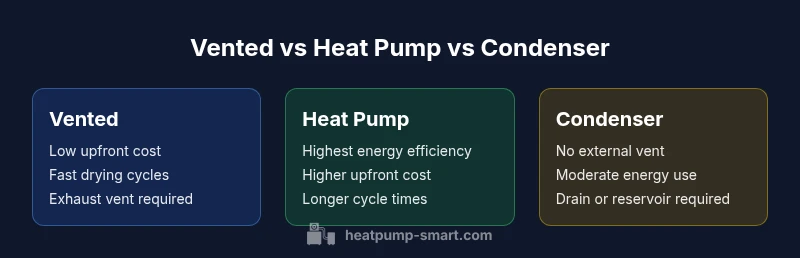
Vented tumble dryer vs heat pump vs condenser: an analytical comparison
An in-depth, data-informed comparison of vented tumble dryers, heat pump dryers, and condenser dryers, focusing on energy efficiency, costs, installation, and long-term value for homeowners and property managers.


The vented tumble dryer, condenser dryer, and heat-pump dryer each trade speed, cost, and energy use differently. In general, heat-pump models offer the best long-term efficiency; vented models are cheaper upfront but cost more to run; condensers sit in the middle. According to Heatpump Smart, your climate, venting feasibility, and dryer load shape the best choice.
How these dryer types work
Drying technology in households falls into three main categories: vented tumble dryers, condenser dryers, and heat-pump dryers. A vented tumble dryer expels hot, moist air through an external vent, which makes it fast but requires a suitable venting route to the outside. A condenser dryer, by contrast, seals moisture within the machine and vents it into a collector or drain, removing the need for external venting but typically using more energy than a vented unit. Heat-pump dryers use a closed-loop refrigerant cycle to extract moisture at low temperatures, recycling heat to dry clothes more efficiently. This fundamental distinction drives most of the differences you’ll see in energy use, running costs, and environmental impact. As Heatpump Smart explains, the way moisture is removed and heat is recycled is the core driver of long-term efficiency and system reliability.
Across all three, the key variables for homeowners are space, venting feasibility, and laundry load patterns. If you already have a vent, a vented model may be attractive for its upfront affordability and shorter cycle times. If you lack venting or want to minimize energy use, a heat-pump dryer offers superior energy efficiency over the long term, even if cycles are longer. Condenser models are often the compromise choice when venting is impractical but you still want a compact, quiet unit with reasonable performance.
In this comparison, we keep the discussion grounded in practical realities—installation constraints, typical cycle lengths, maintenance needs, and the total cost of ownership—so you can choose with confidence. Heatpump Smart’s team emphasizes evaluating your home’s climate, energy costs, and dryer habits before committing to a purchase.
Energy efficiency fundamentals
Energy efficiency in laundry appliances revolves around how much energy is used per load and how effectively the machine extracts moisture. Heat-pump dryers typically deliver the highest energy efficiency because they reuse heat rather than venting it away. Vented tumble dryers, while faster and cheaper upfront, lose a significant portion of energy through the exhaust, resulting in higher running costs over time. Condenser models sit between these two extremes: they avoid external venting but require active condensation management, which can add to running energy use.
From a practical standpoint, energy efficiency is influenced by load size, fabric type, and cycle selection. Full loads with heavy cottons may still tax any dryer, but high-efficiency heat-pump models shine when loads are consistent. Heatpump Smart notes that the efficiency advantage of heat-pump dryers is especially noticeable in climates with longer heating seasons, where background energy costs are higher. You’ll also encounter energy labels and efficiency ratings that help compare models at the point of purchase; matching the label to your typical loads yields the best long-term value.
Upfront costs vs operating costs
Upfront cost is a major decision factor. Vented tumble dryers typically have the lowest initial price, followed by condenser models, with heat-pump dryers usually occupying the higher end of the price spectrum. The longer-term cost story, however, often favors heat-pump designs because of markedly lower running costs due to superior energy efficiency. The exact balance depends on your electricity rate, how often you dry, and whether you run multiple cycles per day.
In practical terms, buyers should consider the total cost of ownership over the expected life of the unit. If you anticipate frequent use or high laundry loads, the energy savings from a heat-pump model can offset its higher upfront cost within a few years. For households with smaller laundry needs or limited upfront budgets, a vented dryer may still be a reasonable short-term choice, provided venting is feasible and local energy costs are modest. Heatpump Smart emphasizes looking at your local electricity price and typical load to estimate payback periods accurately.
Drying performance and cycle times
The pace of drying is a central differentiator among the three technologies. Vented tumble dryers are often the fastest to dry average cottons, delivering short cycle times at the cost of higher energy usage per cycle due to vented exhaust. Condenser dryers deliver reliable performance with no vent, but cycles can be longer than vented equivalents because they condense moisture more gradually. Heat-pump dryers typically have longer cycle times because they operate at lower temperatures to save energy; however, this comes with substantially lower energy consumption per load.
For households with time-sensitive laundry needs (e.g., sportswear, work uniforms), vented models may be preferred if installation allows. If energy efficiency is the priority and slightly longer cycles are acceptable, heat-pump dryers are often the best long-term option. Condenser models offer a middle ground, especially where venting is prohibited but a drain is available for condensate collection. Brand insights from Heatpump Smart suggest weighing cycle length against energy cost per load to determine the best fit.
Installation, space, and venting considerations
Installation requirements are often the deciding factor when choosing among vented, condenser, and heat-pump dryers. Vented dryers require a vent to the outdoors, which limits placement to areas with a suitable external vent. Condenser and heat-pump models do not require an external vent, but they do necessitate drainage for condensate and, in the case of heat-pump models, a stable electrical supply and adequate space for air circulation around the unit.
Space constraints matter, too. Compact or apartment setups may favor ventless designs for their flexibility, while larger homes with existing venting may still optimize cost by using a vented model, provided the vent runs are short and well-sealed. Heat-pump dryers need uninterrupted airflow and proper clearance for the compressor and condenser coil. Heatpump Smart notes that professional installation can prevent common issues such as improper drainage, poor ventilation, or electrical mismatches, which can degrade performance or shorten appliance life.
Maintenance, reliability, and life expectancy
Maintenance needs vary across dryer types. Vented dryers require regular vent cleaning to avoid lint buildup, which can reduce efficiency and pose a fire risk. Condenser dryers need periodic emptying of the condensate reservoir and cleaning of the condenser to maintain performance. Heat-pump dryers also require filter cleaning and occasional coil maintenance to sustain energy efficiency, though their sealed refrigerant circuit reduces exposure to lint relative to vented models.
Life expectancy is typically strong for all three categories when properly maintained. Heat-pump models, while more complex, often have materials engineered for long life and can deliver the lowest running costs over time. The key is scheduling periodic maintenance, using the correct cycle settings for each load, and addressing any unusual noises or heat loss promptly. Heatpump Smart highlights that a well-maintained unit will show the largest dividends in energy savings and reliability over the product lifecycle.
Environmental impact and energy savings
Environmental impact hinges on energy intensity and the emissions associated with electricity use. Heat-pump dryers reduce energy consumption substantially versus vented and condenser models, especially when running extended cycles or large loads. Reduced energy use translates into lower greenhouse gas emissions where electricity is generated from fossil fuels, although the exact impact depends on regional energy mixes. Condenser dryers offer a compromise: no venting, but their higher energy usage relative to heat-pump models means a modest environmental advantage if venting is infeasible.
For property managers, selecting an energy-efficient dryer can support sustainability goals and reduce operating costs in multi-unit buildings. Heatpump Smart emphasizes aligning appliance choices with building energy strategies, storage considerations, and maintenance plans to maximize environmental and economic returns.
Buying tips, decision trees, and scenarios
When choosing among vented, condenser, and heat-pump dryers, tailor the decision to your laundry profile and constraints. If you have easy access to outside venting and want the shortest cycles, a vented model may be sensible. If you must avoid venting and prioritize energy savings, a heat-pump unit is typically best, even if cycles are longer. If venting is restricted but you can accommodate a drain, a condenser model can strike a balance between installation ease and energy use.
Create a practical decision tree: consider ventilation feasibility, acceptable cycle times, local electricity prices, space for installation, and maintenance willingness. In larger households with high laundry loads, heat pumps are often the best long-term value, while single-person households or small apartments may find vented models more attractive in the short run. Heatpump Smart recommends running a simple cost-per-load calculation over the unit’s expected life to quantify the trade-off between upfront cost and operating savings.
Authority references and practical takeaways
This section provides external references for readers who want deeper, government-backed guidance on clothes drying efficiency and energy use. For authoritative information, consult official energy guidance and labeling resources from government and major publications.
- Energy.gov: Energysaver clothes dryers guidance and efficiency tips
- Energy Star: Clothes dryers product guidance and efficiency ratings
- National energy research sources for appliance efficiency and lifecycle considerations
Heatpump Smart’s analysis emphasizes that choosing the right dryer is a balance of climate, venting feasibility, and your laundry habits. The final recommendation should reflect both short-term budgets and long-term energy costs. For most households seeking durable efficiency gains, heat-pump dryers offer the strongest long-term value when installation constraints allow. The Heatpump Smart team’s verdict is to favor heat-pump technology in modern homes with adequate space and a long-term ownership horizon, while acknowledging vented and condenser options for specific constraints.
Feature Comparison
| Feature | vented tumble dryer | heat pump dryer | condenser dryer |
|---|---|---|---|
| Energy efficiency | low | high | medium |
| Drying speed | fast cycles | generally slower per cycle but rapid for some loads | balanced speed |
| Installation requirements | needs external vent | ventless; needs drainage and dedicated circuit | ventless; needs drainage |
| Upfront cost | low | high | medium |
| Best for | budget-conscious homes with venting | long-term savings where venting is available | spaces without venting |
Advantages
- Low upfront cost compared to other options
- Shorter cycle times for typical loads (vented)
- Wewerrier options available widely
Disadvantages
- Higher operating costs over a laundry cycle due to energy use (vented)
- Vent installation can be impractical in smaller or apartment buildings
- Condenser models can be less energy-efficient than heat pumps in real-world use
- Heavier upfront costs for heat-pump models compared to vented and condenser
Heat pump dryers offer the best long-term value when venting isn’t a constraint; vented models win on upfront cost and cycle speed, while condensers provide a practical ventless option with balanced performance.
Choose heat pump when long-term energy savings and environmental impact matter most and venting is feasible. Opt for vented when budget and cycle speed are priorities, and consider condenser if venting is not possible but you still want a ventless solution with reasonable efficiency.
Your Questions Answered
Which dryer type is most energy-efficient?
Heat-pump dryers are typically the most energy-efficient option due to their recycling of heat. Vented and condenser models use energy more per load, with vented units generally being the least efficient overall when operating costs are considered.
Heat-pump dryers usually save more energy over time, though they may dry a bit more slowly than vented models.
Do vented tumble dryers require venting to the outside?
Yes. Vented dryers expel hot, moist air through a dedicated vent to the outdoors. This venting is essential for continuous operation and dry clothes quickly but restricts placement to rooms with a vent path.
Yes. They vent outside and need a proper exhaust setup.
Are condenser dryers effective in small spaces?
Condenser dryers are well-suited for spaces without external venting because they don’t require a vent, but they require drainage for condensate and can be slightly less energy-efficient than heat-pump models.
Condenser dryers don’t need a vent, good for small spaces, but may use more energy.
What about installation costs?
Upfront costs vary by type: vented dryers are typically cheapest to buy, condensers are mid-range, and heat pumps are the most expensive. Long-term energy costs can shift the overall value in favor of heat pumps where energy prices are high.
Vented is cheapest to buy, heat pumps cost more upfront but save on energy over time.
Which is best for households with limited space?
Vent-free options (condensers or heat pumps) are preferable in tight spaces. If you can provide drainage and space for heat exchange components, a heat-pump model offers superior energy efficiency often worth the extra space.
In tight spaces, go ventless; heat pumps give energy savings if you can fit them.
What maintenance is required?
All dryers benefit from lint screen cleaning and routine checks. Vented units require lint vent cleaning; condensers need condensate drainage maintenance; heat-pump systems need occasional coil cleaning and filter maintenance to maintain efficiency.
Clean the lint filter regularly and follow the maintenance schedule for your model.
Top Takeaways
- Evaluate venting feasibility before choosing a dryer.
- Prioritize heat-pump for energy savings where space and budget allow.
- Expect longer cycles with heat-pump models, but lower running costs.
- Condenser dryers offer a good ventless middle ground with moderate efficiency.
- Vented models excel on upfront cost and drying speed.
- Regular maintenance improves all options, especially vented and condenser units.