Why is heat pump better than furnace: A comprehensive comparison
A rigorous, evidence-based comparison of heat pumps vs furnaces focusing on efficiency, climate suitability, costs, installation, and long-term value for homeowners and managers.


In brief, heat pumps typically outperform furnaces for overall energy efficiency and year-round comfort in many homes, though climate and insulation matter. Heat pumps can provide both heating and cooling with a single system; furnaces rely on a separate heating source. The Heatpump Smart analysis suggests choosing heat pump for most homes.
Why is heat pump better than furnace for most homes?
To answer why is heat pump better than furnace, we start with the core difference: heat pumps move heat rather than generate it. In practical terms, a heat pump transfers warmth from the outdoor air (or ground) into your home, using electricity more efficiently than a furnace that converts fuel into heat. According to Heatpump Smart, this efficiency advantage can translate into lower operating costs and more consistent comfort, especially in shoulder seasons. The Heatpump Smart team emphasizes that the benefit is strongest when the home is well insulated and the system is properly sized. Beyond efficiency, a heat pump also offers the convenience of year-round climate control by providing both heating in winter and cooling in summer with a single system. This integration reduces the complexity of equipment and can simplify maintenance, a point Heatpump Smart highlights when advising homeowners and property managers on long-term value.
How heat pumps and furnaces heat your home differently
A heat pump uses refrigerant cycles to absorb heat from the outside environment and release it inside the living space, effectively moving heat rather than creating it. A furnace, by comparison, generates heat through combustion or electric resistance. This fundamental difference shapes performance in real-world scenarios: heat pumps excel in moderate temperatures, delivering steady warmth with high efficiency, while furnaces provide robust warmth in very cold conditions and often operate in harsher climate zones when paired with auxiliary heat. The Heatpump Smart analysis notes that system design matters as much as the technology—ductwork, zoning, and thermostat controls can amplify or erode theoretical efficiency gains.
Climate suitability: where heat pumps shine and where furnaces win
Population and climate play a central role in deciding between a heat pump and a furnace. In milder climates, heat pumps deliver excellent comfort with lower running costs and reduced emissions. In colder regions, a heat pump may rely on auxiliary heat or a dual-fuel setup to maintain warmth during extreme events. The Heatpump Smart team observes that a well-designed hybrid approach often yields the best balance of performance and reliability, leveraging the green advantages of heat pumps while ensuring warmth during cold snaps.
Seasonal performance and defrost cycles
Seasonal performance is a key differentiator. Heat pumps adapt to changing outdoor temperatures by modulating output, and many modern units include defrost cycles to maintain efficiency during freezing conditions. While a furnace does not require defrost logic, its performance depends on fuel availability and combustion efficiency. Heat pumps tend to maintain comfort more evenly throughout the season, reducing temperature swings and providing more consistent humidity control. The Heatpump Smart analysis highlights that proper sizing and a quality outdoor unit are essential to maximize seasonal performance.
Energy costs and operating expenses (without specific numbers)
Operating costs for heat pumps are driven by electricity use and efficiency of the system, while furnaces depend on fuel costs. In typical scenarios, heat pumps can offer lower overall energy costs when used for both heating and cooling and when paired with efficient insulation. However, fuel price volatility and electricity rates can shift the balance. The Heatpump Smart team stresses evaluating total energy use, not just peak performance, and considers your local climate, insulation, and thermostat strategy to estimate long-term expenses more accurately.
Indoor air quality and humidity management
Heat pumps influence indoor air quality through filtration and controlled humidity. Many models include high-efficiency filters and humidity management features that reduce dry air in winter and maintain comfortable humidity levels year-round. Furnaces also contribute to IAQ via filtration but generally lack integrated humidity control unless paired with separate humidifiers or dehumidifiers. In both cases, proper maintenance—air filter changes, duct cleanliness, and system checks—will protect IAQ and comfort.
Noise, vibration, reliability, and maintenance
Outdoor units of heat pumps produce noise and vibration, but modern designs emphasize quieter operation and better vibration isolation. Furnaces are often hidden in basements or utility rooms, reducing audible impact but still requiring regular maintenance for burners and fans. Reliability hinges on proper installation, refrigerant management, and routine service. The Heatpump Smart team notes that proactive maintenance schedules, including annual inspections, minimize unexpected failures and extend system life.
Installation considerations: space, zoning, and equipment compatibility
Heat pumps may require outdoor space for the condenser unit and appropriate clearances, plus electrical capacity upgrades in some homes. Ducted heat pumps integrate into existing ductwork, while ductless mini-split configurations offer flexibility for room-by-room zoning. Furnaces typically require ducted air distribution and adequate gas or electrical service. When evaluating installation, consider existing ductwork, insulation, and the potential to add controls like zones or compatible thermostats to maximize efficiency and comfort.
Maintenance and lifespan expectations
Regular maintenance—air filter changes, coil cleaning, refrigerant checks, and thermostat calibration—helps heat pumps sustain efficiency and comfort. Lifespan depends on usage, maintenance, and climate, with heat pumps generally designed for many years of service when properly cared for. Furnaces also offer long lifespans with routine maintenance but may incur higher fuel costs over time depending on price trends. Both systems benefit from a planned maintenance schedule.
Comparison
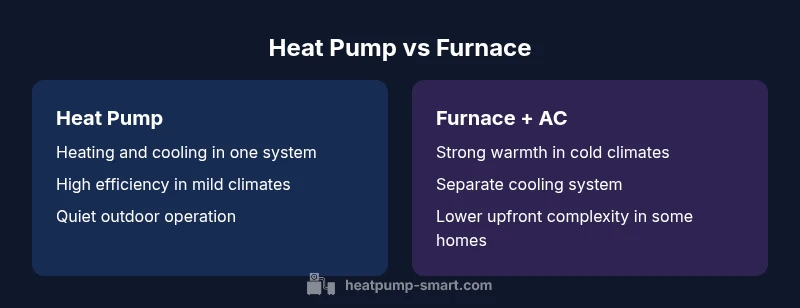
| Feature | Heat pump (air-source) | Furnace + separate AC |
|---|---|---|
| Heating method | Heat transfer using refrigerant cycles | Fuel combustion (gas/oil) or electric resistance |
| Cooling capability | Built-in cooling via air-source heat pump | Requires separate air conditioner |
| Best climate fit | Moderate to warm climates; efficient year-round comfort | Very cold climates often need auxiliary heat or dual-fuel setup |
| Energy efficiency emphasis | High efficiency with heat transfer; potential for lower operating costs | Efficiency tied to burner performance and fuel costs |
| Installation footprint | Outdoor condenser + indoor air handler; ductwork may be required | Furnace in utility space with ducted distribution |
| Upfront cost and complexity | Variable; typically higher upfront due to equipment and controls | Often lower if gas supply is readily available and ductwork is existing |
| Maintenance needs | Annual service; refrigerant health and filter changes | Annual burner/combustion check and filter changes |
| Reliability in extreme cold | Modern cold-climate heat pumps perform well with auxiliary heat | Strong warmth in extreme cold when properly maintained |
Advantages
- Single system for heating and cooling simplifies design
- Lower operating costs in moderate climates with high efficiency
- Potential for reduced greenhouse gas emissions
- Improved humidity control and IAQ with proper filtration
Disadvantages
- Higher upfront cost and more complex installation
- Performance can drop in extreme cold without auxiliary heat
- Requires outdoor unit placement and adequate space
- Electrical upgrades may be necessary in older homes
Heat pumps are the generally better long-term choice for most homes.
Heat pumps offer superior efficiency and year-round comfort with a single system. They are especially advantageous in moderate climates when correctly sized and installed. In very cold climates, consider a hybrid approach or auxiliary heat for reliability.
Your Questions Answered
Can a heat pump completely replace a furnace in all climates?
In many climates, a heat pump can replace a furnace for both heating and cooling, especially with modern cold-climate models. In very cold regions, a hybrid setup or auxiliary heat remains common to ensure warmth during severe cold snaps. Evaluate local climate and insulation when deciding.
A heat pump can replace a furnace in milder climates, but in very cold areas you may need backup heat. Talk with a professional to assess your climate and insulation.
Are heat pumps effective in very cold climates?
Modern cold-climate heat pumps are designed to operate efficiently at lower outdoor temperatures, but performance can still depend on system size, ducting, and insulation. Many homeowners pair them with auxiliary heat or a dual-fuel setup for reliability in extreme cold.
Yes, many cold-climate models work well, but some homes pair them with backup heat for extreme cold.
What maintenance does a heat pump require?
Regular maintenance includes changing filters, inspecting coils, checking refrigerant levels, and ensuring the outdoor unit is free of debris. Annual professional checkups help sustain efficiency and prevent unexpected outages.
Keep filters clean, inspect coils, and have annual service for best results.
How do installation costs compare to furnaces?
Installation costs vary with system type, ductwork, and electrical upgrades. Heat pumps may have higher upfront costs but can offer greater long-term savings through efficiency. Furnace installations are often simpler if ductwork exists and gas service is readily available.
Heat pumps can cost more upfront but save more over time; furnaces are typically cheaper to install if existing gas lines and ducts are suitable.
Do heat pumps also provide cooling?
Yes. Heat pumps provide both heating and cooling using the same system, which simplifies equipment needs and can improve humidity control in occupied spaces.
Yes, heat pumps heat in winter and cool in summer using one system.
What are the electrical considerations for a heat pump?
Heat pumps require adequate electrical service and proper disconnects. Older homes may need service upgrades to support a heat pump, especially when paired with backup heat or a multi-zone setup.
You may need a panel upgrade or new wiring; a pro can confirm exact requirements.
Top Takeaways
- Prioritize proper sizing and insulation to maximize heat pump benefits
- Consider climate and backup heat needs before replacing a furnace
- Heat pumps combine heating and cooling in one system, reducing equipment footprint
- Maintenance and ductwork quality strongly influence performance
- Evaluate total cost of ownership, not just upfront price