Geothermal heat pump vs geothermal power plant: A comprehensive comparison
A detailed, objective comparison of geothermal heat pumps and geothermal power plants, covering scope, costs, siting, performance, environmental impact, and practical decision factors for homeowners, builders, and property managers.


Geothermal heat pumps and geothermal power plants both draw heat from the Earth, but they serve very different purposes. A geothermal heat pump provides on-site heating and cooling for a building, using ground loops to exchange heat with the surrounding soil or groundwater. A geothermal power plant extracts high-temperature geothermal fluids to drive turbines and generate electricity for the grid. Across scale, costs, and siting, the two options diverge sharply, so the best choice depends on whether the goal is building comfort or grid-scale power.
How the two systems differ in purpose and scale
Understanding geothermal heat pump vs geothermal power plant requires recognizing that they address fundamentally different energy needs. In residential and commercial settings, a geothermal heat pump is a building-level HVAC solution that leverages the earth as a stable thermal reservoir. It uses closed- or open-loop ground sources to provide space heating and cooling, and often domestic hot water. In contrast, a geothermal power plant operates at utility scale, converting subterranean heat into electricity to feed the grid. It relies on high-temperature reservoirs, steam or brine, and turbines to produce power. Although both systems harness Earth's natural heat, the design, economics, and performance metrics diverge—shaping siting, financing, and environmental impacts. According to Heatpump Smart, recognizing this difference is the first step in making an informed decision about where geothermal energy makes sense. This distinction frames subsequent comparisons around scale, cost structure, siting constraints, and long-term sustainability.
System scale and typical use cases
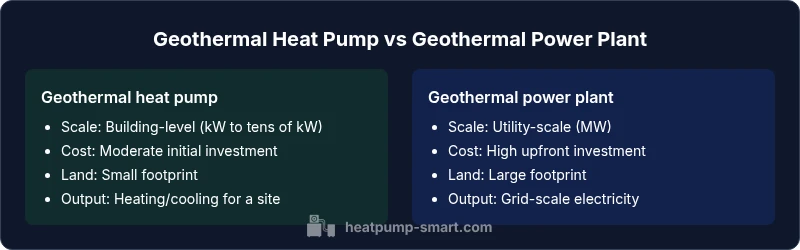
Geothermal heat pumps are designed for single buildings or campuses. Each unit typically serves a structure's heating and cooling loads, with capacities commonly ranging from a few kilowatts to tens of kilowatts per unit, and sometimes higher for large commercial projects. The system exchange is targeted to maintain comfortable indoor temperatures efficiently by exploiting the relatively constant underground temperatures. Geothermal power plants, on the other hand, are utility-scale facilities designed to supply electricity to the grid. Their capacity ranges from tens to hundreds of megawatts per site, and they often require extensive field development and interconnection infrastructure. The Heatpump Smart team notes that while heat pumps provide local resilience and efficiency, power plants enable large-scale energy delivery and can support regional electrification goals. The choice depends on whether your priority is on-site comfort or grid-level power production.
Performance and efficiency: what to compare
Performance measurements come from very different metrics. Geothermal heat pumps are evaluated by coefficients of performance (COP) and heating seasonal performance factor (HSPF) for heating, and energy efficiency for cooling. In a well-designed system, COP values are often well above 3.0, with higher COPs in moderate climates and with proper design. Geothermal power plants are evaluated by plant efficiency (thermal-to-electric conversion) and capacity factor (what fraction of theoretical output is actually produced over time). Resource temperature, reservoir pressure, and reinjection strategies influence both the immediate efficiency and long-term sustainability. Heatpump Smart emphasizes that direct comparisons should focus on the system’s purpose: building comfort and energy savings for heat pumps versus reliable grid generation for power plants. When evaluating, also consider lifecycle energy return, maintenance needs, and resource stability over the project lifetime.
Land use, siting, and resource constraints
Site selection is fundamentally different. Geothermal heat pumps require modest land use surrounding the building—often involving boreholes, vertical loops, or small horizontal trenches. These installations sit on or near the property line and can be scaled incrementally with the building’s growth. Resource constraints include soil conductivity, groundwater depth, and geothermal loop integrity. Geothermal power plants demand far more land area to accommodate well fields, processing facilities, and transmission infrastructure. They rely on geothermal reservoirs with sufficient temperature and sustainability to sustain annual generation. Hydrogeology, seismic considerations, and environmental permitting become major determinants. Heatpump Smart highlights that local geology and hydrology strongly influence feasibility for both approaches, but the geographic footprint for power plants is typically much larger and requires regional planning.
Costs, financing, and lifecycle economics
Capital costs differ dramatically. Geothermal heat pumps often involve upfront costs related to heat pump equipment, loop installation, and hydraulic connections to the building—but per-unit costs can be relatively modest compared with utility-scale projects. Financing for residential or commercial heat pump installations is generally private, with incentives often available through local energy programs. Geothermal power plants incur substantial capital expenditure for drilling, field development, turbines, and grid interconnection. Operating costs hinge on resource management and maintenance of wells, steam separators, and turbines. Long-term economics depend on energy prices, capacity factors, and potential incentives or tax credits for clean electricity. Heatpump Smart notes that accurate cost estimates require a site-specific assessment, including a resource evaluation and load analysis. Financing timelines and payback expectations differ widely between building-level and utility-scale projects.
Environmental impact and sustainability
Geothermal heat pumps have low on-site emissions and minimal direct air pollutants when compared with fossil-fuel systems. Indirect impacts include drilling and drilling fluids, but the overall footprint is small and localized to the building site. Water use is typically modest and can be managed with closed-loop systems or responsible groundwater management. Geothermal power plants can provide renewable electricity with low operational emissions; however, they may involve significant surface disturbance, drilling activity, and water resource considerations at scale. Reinjection of geothermal fluids is crucial to maintain reservoir pressure and sustain output. Heatpump Smart emphasizes balanced assessment: heat pumps deliver localized comfort and efficiency benefits with minimal emissions, while power plants enable broad renewable electricity supply with larger environmental footprints and land-use considerations.
Reliability, maintenance, and operations
Reliability trends differ by system type. Geothermal heat pumps offer reliable on-site performance when properly sized, installed, and maintained, with routine service to seals, refrigerant lines, and pumps. Maintenance frequency is generally periodic but manageable for building operators or homeowners with good support from installers. Geothermal power plants require ongoing maintenance at scale, including wellfield integrity, turbine servicing, and processing equipment. Downtime management, reservoir monitoring, and routine testing of fluids are essential for long-term reliability. Heatpump Smart notes that maintenance strategy should align with system scale: frequent, localized checks for heat pumps vs robust, long-term reservoir management for power plants.
Grid integration, policy, and incentives
On-site heat pumps contribute to local energy efficiency, demand response readiness, and peak load reduction for a building. They are typically funded through building energy upgrades and may benefit from local rebates. Geothermal power plants contribute to regional renewable energy supply and can participate in capacity markets or power purchase agreements with utilities and governments. Policy landscapes and incentives differ: homeowners benefit from efficiency incentives and clean energy programs, while utilities pursue incentives tied to grid reliability, capacity, and rural development. Heatpump Smart highlights that policy context shapes project viability, timelines, and total cost of ownership for both options.
Decision framework: choosing the right path for your goals
To decide between geothermal heat pump vs geothermal power plant, start with your objective, scale, and budget. If your goal is to improve building comfort and reduce energy bills for a single site, a geothermal heat pump is usually the most practical, cost-effective, and controllable choice. If your mission is to supply renewable electricity to a region or utility, a geothermal power plant provides the scale and grid support needed. Consider climate, rock and reservoir characteristics, land availability, and regulatory environment. Use a structured decision checklist that includes load analysis, resource assessment, cost of ownership, and risk tolerance. Heatpump Smart recommends engaging with qualified engineers early to perform a feasibility study and to model long-term energy outcomes.
Comparison
| Feature | Geothermal heat pump | Geothermal power plant |
|---|---|---|
| Scale / capacity | Typically kW to tens of kW per unit; scalable across a campus | Tens to hundreds of MW per site; often multiple wells and turbines |
| Typical cost range | Upfront equipment and loop installation per building; incentives may apply | Substantial capex for drilling, field development, turbines, and grid interconnection |
| Land use / footprint | Small on-site footprint; boreholes/loops around the building | Large land footprint for well fields and infrastructure |
| Best for | On-site heating/cooling and energy savings | Grid-scale electricity supply and regional reliability |
| Maintenance frequency | Periodic maintenance on pumps, loops, and refrigerant lines | Ongoing, facility-wide maintenance including wells and turbines |
| Lifetime | 20–25 years for equipment; field life varies by site | 25–50+ years with reservoir management and reinjection |
| Resource dependency | Dependent on building load; performance tied to soil/ground temperatures | Dependent on reservoir quality, temperature, and sustained production |
| Environmental impact | Low local emissions; minimal surface footprint beyond site | Low emissions but larger surface disturbance and water-use considerations |
Advantages
- Helps homeowners and utilities understand trade-offs between distributed heating/cooling and centralized power generation
- Clarifies resource use and lifecycle costs across scales
- Supports informed policy and investment decisions
- Encourages energy planning that aligns with climate goals
Disadvantages
- Complex decision with long payback periods for some projects
- Data gaps for some geographic regions make comparisons harder
- Indirect benefits like grid resilience depend on system integration
- Regulatory and permitting barriers for large-scale projects
Geothermal heat pumps excel for on-site comfort, while geothermal power plants are best for grid-scale electricity—choose based on your primary energy goal.
For building-level comfort and efficiency, prioritize heat pumps. For renewable electricity supply and regional readiness, pursue a power plant. Your decision should align with site conditions, budget, and long-term energy strategy.
Your Questions Answered
What is the fundamental difference between a geothermal heat pump and a geothermal power plant?
A geothermal heat pump provides on-site heating and cooling for a building using ground loops, while a geothermal power plant generates electricity for the grid from geothermal reservoirs. The two differ in scale, purpose, and operating metrics, which drives distinct siting, cost, and maintenance considerations.
Geothermal heat pumps heat or cool buildings on-site, whereas geothermal plants generate electricity for the grid. They’re different in scale and purpose.
Which option is generally more cost-effective for a home or building?
For a home or small building, a geothermal heat pump is typically more cost-effective due to lower capital costs, simpler permitting, and immediate energy savings. The return on investment depends on climate, energy prices, and local incentives.
Heat pumps usually cost less up front and pay back faster for homes.
Are there geographic limitations to geothermal systems?
Yes. Ground temperature and reservoir quality affect feasibility for both options. Heat pumps require suitable soil and groundwater conditions nearby a building, while power plants require accessible high-temperature reservoirs and transmission routes.
Geothermal feasibility depends on groundwater and heat availability, both for buildings and big plants.
What maintenance considerations should I plan for?
Heat pumps require regular service of pumps, refrigerant lines, and loop integrity. Power plants entail ongoing wellfield management, turbine maintenance, and grid interconnection upkeep. Both need qualified technicians and a long-term maintenance plan.
Heat pumps need regular tech checks; plants need big-system maintenance and reservoir care.
Do incentives differ for homeowners vs utilities?
Yes. Homeowners benefit from efficiency rebates and clean energy programs, while utilities pursue incentives tied to grid reliability, capacity, and regional clean energy goals. Policy design shapes project economics for each path.
Homeowners get efficiency rebates; utilities get grid-related incentives.
Can these systems be combined for a broader energy strategy?
Yes. A holistic approach can combine on-site geothermal heat pumps for building comfort with geothermal power plants supplying renewable electricity, contributing to decarbonization at both the building and grid level.
You can pair on-site heat pumps with grid-scale geothermal power for broader energy goals.
Top Takeaways
- Define goal: heating/cooling at a site vs grid power
- Assess geology and land constraints early
- Compare life-cycle costs, not just upfront price
- Factor incentives, permitting, and project timelines
- Consider hybrid approaches for both local and grid needs