Ground Heat Pump vs Air Heat Pump: An Objective Comparison
A thorough comparison of ground-source vs air-source heat pumps, covering how they work, efficiency, costs, climate suitability, and installation considerations for homeowners and builders.


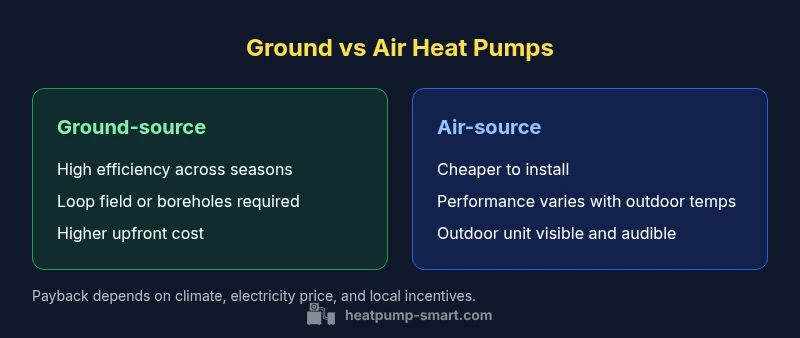
Ground heat pump vs air heat pump: ground systems use buried loops to extract stable geothermal heat, while air systems pull heat from outdoor air. Ground-source units typically deliver higher efficiency and steadier performance, but require land or boreholes, increasing upfront costs. According to Heatpump Smart, ground loops pay off in long heating seasons, while air-source systems suit retrofit projects. Air-source systems are cheaper and easier to retrofit but can be less efficient in extreme cold.
Overview: Ground Source vs Air Source Heat Pumps
When homeowners, builders, and property managers compare heating options, the debate often centers on a fundamental question: should you install a ground-source (geothermal) heat pump or an air-source heat pump? This guide uses the keyword ground heat pump vs air heat pump to reinforce the central comparison and help you evaluate system performance, installation requirements, and long-term value. The Heatpump Smart team emphasizes that the right choice hinges on site conditions, climate, and budget, not just headline efficiency numbers. In most regions, a well-designed system will deliver reliable comfort and energy savings, but the practicality of a given installation varies widely from property to property. This article provides a structured, evidence-based framework to compare the two approaches side by side, with practical guidance you can apply in real-world projects.
Comparison
| Feature | Ground-source heat pump | Air-source heat pump |
|---|---|---|
| Installation requirements | Ground-source: requires underground loops or boreholes and adequate land area | Air-source: installs outside unit with minimal site disruption |
| Efficiency potential | Ground-source: typically higher COP/SCOP across seasons | Air-source: strong efficiency but tightly tied to outdoor temperatures |
| Cold-weather performance | Ground-source: less affected by cold; stable ground temperatures help | Air-source: COP drops in freezing conditions unless optimized for cold climates |
| Initial cost and payback | Ground-source: higher upfront due to loop field or drilling | Air-source: lower upfront and faster installation |
| Space and installation disruption | Ground-source: loop field or vertical boreholes require outdoor space | Air-source: outdoor unit with minimal indoor disruption |
| Outdoor noise and aesthetics | Ground-source: fewer visible components; quieter operation | Air-source: outdoor compressor can introduce noise and visual impact |
| Maintenance needs | Ground-source: fewer moving parts in the field, steady service cycles | Air-source: outdoor units need regular coil cleaning and filter changes |
| Lifespan and reliability | Ground-source: durable, long-term performance with minimal indoor components | Air-source: robust but may require more frequent component replacements |
| Environmental impact | Ground-source: high efficiency can reduce emissions if electricity is clean | Air-source: emissions depend on grid electricity; performance varies with climate |
| Incentives and codes | Ground-source: rebates available in many regions; depends on local programs | Air-source: incentives vary; often similar to geothermal programs depending on region |
Advantages
- Higher long-term efficiency in many climates
- Less impact from outdoor temperature swings (ground loop)
- Fewer indoor mechanical changes; quiet indoor operation
- Potentially longer system lifespan with fewer moving parts
Disadvantages
- Higher upfront installation costs and longer project timelines
- Requires adequate land or borehole access for loops
- Site-specific permitting and drilling can complicate projects
Ground-source heat pumps offer the best long-term efficiency when site conditions permit, while air-source heat pumps provide flexibility and lower upfront costs.
The Heatpump Smart team recommends weighing site feasibility, climate, and budget. If you have land and long heating seasons, ground-source is worth considering for energy savings; if you need a retrofit with minimal disruption and lower initial expense, air-source is a practical choice.
Your Questions Answered
What is the key difference between ground-source and air-source heat pumps?
Ground-source heat pumps rely on buried loops to tap stable geothermal heat, while air-source systems extract heat from outdoor air. Each has distinct installation needs, efficiency profiles, and climate suitability that impact long-term costs and comfort.
Ground-source uses underground loops; air-source uses outdoor air. Both are efficient, but the choice depends on site and climate.
Which heat pump is more efficient in cold climates?
Ground-source systems generally maintain higher efficiency in cold weather due to stable underground temperatures. Air-source units can experience reduced performance in extreme cold unless they are specifically designed for cold climates and paired with auxiliary heat.
Ground-source tends to be steadier in the cold; air-source may drop efficiency in very cold days.
Are rebates available for geothermal or air-source heat pumps?
Rebates and incentives vary by region and program. Both geothermal and air-source options can qualify in many locations, depending on local energy efficiency initiatives and utility offerings.
Incentives depend on where you live; check local programs for both options.
Can I retrofit a ground-source system in an existing home?
Retrofitting a ground-source system is possible but more complex than an air-source retrofit. It requires space for loop fields or boreholes, and professional planning to minimize landscape disruption.
Retrofitting is doable but more involved than air-source—consult a qualified installer early.
How long does installation take for each type?
Air-source installations are typically quicker, often completed in days. Ground-source installations can take longer due to trenching or drilling, plus potential permitting and site preparation.
Air-source is usually faster; ground-source can take longer because of the loops or boreholes.
What maintenance is required for heat pumps?
Both systems require periodic filter changes, coil cleaning, and annual service. Ground-source systems may need loop integrity checks, while air-source units need outdoor unit inspections and weather-proofing checks.
Regular checks and filters keep both systems running smoothly.
Top Takeaways
- Evaluate ground-loop feasibility before committing to options
- Expect higher upfront costs for ground-source systems
- Air-source heat pumps suit retrofits and space-limited homes
- Climate, electricity prices, and incentives shape payback
- Engage a qualified installer early to assess boreholes, space, and permits