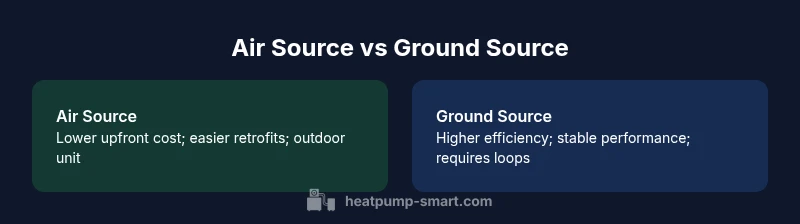
Air Heat Pump vs Ground Source: Which Is Right for Your Home?
A rigorous, objective comparison of air-source and ground-source heat pumps, covering performance, efficiency, installation, climate suitability, and long-term value.


Air heat pumps and ground-source heat pumps both offer efficient heating and cooling, but they differ in installation requirements, climate performance, and long-term value. This comparison helps homeowners, builders, and property managers decide between the simpler, lower-cost air-source option and the potentially more efficient but installation-intensive ground-source approach. The best choice depends on your climate, available space, and long-term energy goals.
What drives the air heat pump vs ground source decision
Choosing between an air heat pump vs ground source system is a decision rooted in climate, space, and long-range goals for energy use. For homeowners, builders, and property managers, the right choice balances upfront cost, time to install, and ongoing energy performance. In practical terms, the air heat pump vs ground source conversation often boils down to whether you prioritize lower initial expenditure and a faster installation (air-source) or the potential for higher, steadier efficiency and longer-term savings (ground-source) when conditions favor it. According to Heatpump Smart, successful comparisons begin with site-specific factors such as soil conditions, available land for loops, and whether burying loops or boreholes is feasible. Local climate patterns and utility rates should also shape expectations for performance and maintenance. Framing the decision around what matters most—cost realism, reliability, or environmental impact—helps stakeholders narrow options quickly and avoid over-investing in an unsuitable approach.
How air-source and ground-source heat pumps differ in design and operation
Air-source heat pumps move heat between the outdoors and your home via an outdoor unit, a refrigerant loop, and an indoor air-handling coil. Ground-source systems use buried loops or boreholes to exchange heat with the earth, leveraging a relatively stable subterranean temperature. The core distinction is heat-source stability: outdoor air swings with seasons, which can reduce efficiency during extreme cold, while the ground provides a more constant heat reservoir. In a typical air heat pump vs ground source comparison, the ground-loop option often sustains higher efficiency and more consistent performance, provided the loop design matches soil conditions and available space. The Heatpump Smart team emphasizes that both technologies rely on inverter-driven compressors and modern controls, but the ground loop’s consistency commonly translates to a higher life-cycle COP when properly designed and installed.
Performance across climates and seasonal conditions
Seasonal performance is a critical factor when comparing air-source and ground-source systems. Air-source units excel in temperate climates and shoulder seasons, delivering efficient heating with modest environmental impact. In very cold winters, their efficiency can drop, and defrost cycles may briefly reduce output. Ground-source heat pumps, by contrast, draw heat from underground, resulting in more stable performance across a wider range of temperatures. This stability translates into more predictable comfort with potentially lower energy consumption in extreme cold or heat. When evaluating the two options, consider not only outdoor temperature averages but also humidity, wind exposure, and the building envelope. Heatpump Smart analysis suggests that climate, soil characteristics, and property layout together determine whether an air-source or ground-source system yields the best end-user experience.
Efficiency metrics explained: COP, SCOP, EER
To understand the air heat pump vs ground source efficiency, you need to interpret key metrics such as COP (coefficient of performance), SCOP (seasonal COP), and EER (energy efficiency ratio). COP measures how much heat energy is produced per unit of electricity under specific conditions, while SCOP averages that performance across a season. EER compares cooling efficiency at a standard outdoor temperature. Ground-source systems tend to maintain higher COP and SCOP values in colder conditions because the heat source is less affected by outdoor weather. Air-source units may show strong SCOP in mild seasons but can degrade in freezing temperatures unless supplemental heating is provided. In practice, evaluating these metrics requires looking at performance curves for your climate zone and the device’s inverter-driven compressor technology. Heatpump Smart’s framework recommends comparing COP and SCOP across operating modes and ensuring the rating applies to real-world climate and usage patterns.
Installation realities: space, drilling, trenching, and outdoor unit placement
Installation realities heavily influence the air heat pump vs ground source decision. Air-source systems typically require less space and fewer invasive activities, with an outdoor condenser unit connected to an indoor air handler. Ground-source systems demand substantial space for loops or boreholes, along with trenching or drilling work and, in some cases, a major excavation. This translates into longer installation timelines and higher upfront labor costs. For retrofit projects, the footprint and access become decisive factors. Noise concerns, local codes, and permitting should be considered for outdoor units. Heatpump Smart emphasizes that successful installation hinges on professional loop design, accurate soil testing, and a clear plan for borehole or trench placement to minimize disruption and maximize performance.
Cost considerations and long-term value (no price specifics)
Cost considerations in the air heat pump vs ground source debate revolve around upfront investment, installation complexity, and long-term energy savings. Air-source systems typically cost less to install and require shorter lead times, making them attractive for budget-conscious projects or quick builds. Ground-source installations incur higher initial costs due to loop field creation or boreholes, but they can deliver greater long-term efficiency, especially in climates with pronounced heating and cooling seasons. When evaluating value, consider not only the upfront price but also expected energy bills, maintenance requirements, and system lifespan. A well-designed ground-source loop in an appropriate setting can offer extended service life and more stable performance, which translates into meaningful total-cost-of-ownership advantages in suitable properties. Heatpump Smart recommends a site-specific economic assessment rather than relying on generic assumptions.
Maintenance, reliability, and warranty expectations
Maintenance expectations differ between air heat pump vs ground source systems but share core practices. Air-source units require routine filter changes, coil cleaning, and periodic refrigerant checks, with indoor components accessible for servicing. Ground-source systems demand loop integrity checks, antifreeze management (where applicable), and more complex refrigerant and pump maintenance, given the buried components. Both systems benefit from professional annual inspections and a clear understanding of warranty terms, particularly for the loop portions of a ground-source installation. Reliability is highly dependent on proper installation, regular servicing, and choosing equipment rated for the local climate. Heatpump Smart notes that a robust maintenance plan can extend system life and ensure consistent performance across seasons.
Environmental impact and incentives
Environmental impact considerations include refrigerant choice, energy consumption patterns, and system efficiency. Air-source heat pumps often use refrigerants with low global warming potential, and their emissions footprint scales with electricity use. Ground-source systems reduce temperature swings in the living space and can offer higher overall efficiency in suitable soils, potentially reducing energy demand over time. Rebates and incentives vary by region, but many utilities and governments provide programs to encourage heat pump adoption, especially when paired with energy-efficient building envelopes. The Heatpump Smart analysis shows that incentives, when combined with a well-designed system, can significantly improve payback times and overall environmental benefits.
Real-world scenarios: homeowners, builders, and property managers
Every project has unique constraints that influence the air heat pump vs ground source decision. A retrofit homeowner with limited outdoor space might prioritize air-source for its simpler install and lower disruption. A new-build in a climate with harsh winters and adequate land could justify a ground-source loop for long-term energy savings and a smaller fuel mix. Builders weighing multiple units across a development should factor in land availability, soil conditions, and maintenance plans for tenants. For property managers overseeing multifamily or commercial properties, reliability, ease of maintenance, and long-term cost of ownership are critical factors. Across all scenarios, a careful site assessment, cost-benefit analysis, and consultation with qualified installers are essential to achieving predictable comfort and energy performance.
Sizing, design, and professional guidance
Appropriate sizing and design are central to the air heat pump vs ground source decision. A professional should perform load calculations (e.g., heating and cooling loads), assess insulation quality, and determine whether a ground loop or air-source configuration best meets building needs. Ground-source sizing involves loop length calculations and soil conductivity assessments to ensure adequate heat exchange. In both cases, selecting equipment with a suitable SEER/COP range, inverter-driven technology, and robust controls is vital. Early engagement with a qualified HVAC designer reduces the risk of under- or oversizing, which can erode efficiency, comfort, and system life.
Decision toolkit and next steps
To move from analysis to action, use a structured decision toolkit. Start with climate and space constraints, then compare the long-term energy goals and expected maintenance requirements. Gather quotes from multiple installers who can present comparable loop designs and performance projections. Request explicit warranty terms, service agreements, and expected installation timelines. Finally, audit your building envelope and consider supplementary measures such as improved insulation and air sealing to maximize the effectiveness of either heat pump choice. This holistic approach ensures you select an air heat pump vs ground source solution that aligns with budget, space, climate, and occupancy needs.
Comparison
| Feature | Air-Source Heat Pump | Ground-Source Heat Pump |
|---|---|---|
| Installation complexity | Simpler, outdoor unit; minimal digging | Extensive loop field; drilling/trenching; longer timelines |
| Heat source stability | Air temperature-dependent; performance varies seasonally | Ground temperature is stable; consistent performance |
| Typical efficiency considerations | Strong efficiency in mild climates; COP drops in extreme cold | High, steady efficiency across a wide range of conditions |
| Space and zoning needs | Smaller footprint; retrofit-friendly | Requires adequate land or borehole access; less flexible |
| Upfront cost and value proposition | Lower installation costs; faster payback in many cases | Higher installation costs but potential for greater long-term savings |
| Lifespan and maintenance | Comparable service life with routine maintenance | Loop components may require more specialized maintenance |
Advantages
- Lower upfront costs and quicker installation
- Flexible retrofits for existing homes
- Less invasive to property during install
- Faster commissioning and simpler servicing
Disadvantages
- Potentially higher energy use in very cold weather
- Ground-source requires land or boreholes; longer install
- Defrost cycles in air-source can affect comfort in extreme cold
Air-source generally fits most homes for lower upfront costs; ground-source excels where space and climate stability justify higher initial investment.
For budget-focused projects, air-source is typically best. If you have space and climate conditions that favor steady performance, ground-source can offer stronger long-term value.
Your Questions Answered
What is the main difference between air-source and ground-source heat pumps?
Air-source units pull heat from outdoor air, while ground-source systems exchange heat with buried loops. Ground-source often delivers higher efficiency and steadier performance in extreme climates, but requires more space and installation work.
Air-source pulls heat from outside air; ground-source uses buried loops for a steadier, often more efficient performance.
Which system performs better in cold climates?
Ground-source generally maintains higher efficiency in cold weather due to stable ground temperatures, while air-source efficiency can fall during freezing conditions unless supplemental heating is used.
Ground-source usually stays efficient in the cold; air-source can drop without extra heating.
Are there rebates or incentives for heat pumps?
Yes, many regions offer rebates or incentives for heat pump installations, especially when paired with energy-efficiency upgrades. Availability and amounts vary by location.
rebates are common in many areas; check local programs for current offers.
How long do these systems last and what maintenance do they require?
Both systems typically have long service lives with regular maintenance. Air-source units mainly require filter changes and coil cleaning; ground-source systems need loop checks and occasional professional servicing.
Regular maintenance extends life; air-source needs filters, ground-source requires loop checks.
Do I need special land or drilling for a ground loop?
Ground-source loops require land for horizontal loops or access to boreholes for vertical loops. Availability and soil conditions drive feasibility and cost.
Ground loops need land or boreholes; feasibility depends on soil and space.
What should I ask a contractor during the quote process?
Ask for loop design details, COP/SCOP ratings for your climate, system sizing justification, warranty coverage, and a clear installation timeline with milestones.
Ask about loop design, efficiency ratings, warranty, and timeline.
Top Takeaways
- Prioritize air-source for lower upfront cost and quick install
- Consider ground-source when climate stability and long-term efficiency matter
- Assess land availability and soil conditions before choosing
- Involve a Heatpump Smart-approved contractor for a precise design