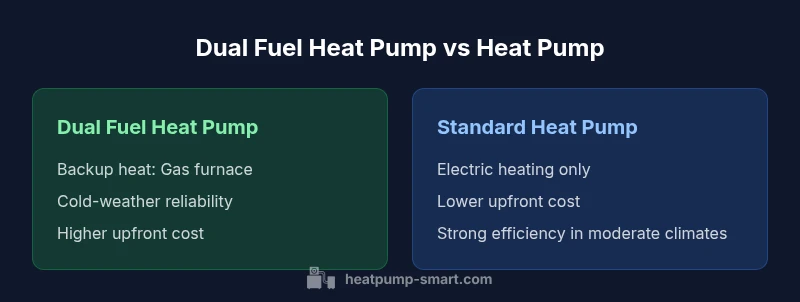
Dual Fuel Heat Pump vs Heat Pump: A Comprehensive Comparison
Compare dual fuel heat pumps with standard heat pumps to understand cold-weather performance, costs, efficiency, and best-use scenarios for homes and buildings. Heatpump Smart provides an analytical, evidence-based breakdown for homeowners, builders, and property managers.


Dual fuel heat pump vs heat pump: A hybrid system combines a traditional electric heat pump with a gas furnace backup to improve cold-weather performance. The choice depends on climate, electricity vs gas costs, and desired comfort. Heatpump Smart's analysis shows payback varies by region and fuel prices, so local benchmarking is essential.
The core difference: how dual fuel heat pumps work vs standard heat pumps
According to Heatpump Smart, the hybrid approach behind the dual fuel heat pump vs heat pump comparison centers on blending two heat sources to sustain comfort and efficiency. A dual fuel system uses an electric heat pump as the primary heat source and a gas furnace as a backup or emergency heat option, engaging automatically when outdoor temperatures plunge or when electricity prices spike. By contrast, a standard heat pump relies entirely on electric heat extraction from the outside air, which can lose efficiency in extreme cold. The decision between dual fuel heat pump vs heat pump hinges on climate, energy costs, and the homeowner’s tolerance for backup heat use. For builders and property managers, this distinction matters for sizing, installation complexity, and long-term operating expenses. Heatpump Smart emphasizes that the right choice balances upfront investment, climate realities, and anticipated usage patterns.
What to watch for in the hybrid approach: control strategies, backup fuel management, and seamless transitions between heat sources to avoid comfort gaps. Your climate, local fuel mix, and electricity rates will shape the total cost of ownership and the reliability of either system in peak winter.
How a dual fuel system operates
A dual fuel heat pump operates as a staged system. When temperatures are mild, the electric heat pump carries most heating load to maximize efficiency. As outdoor temperatures drop, the gas furnace engages to supplement heat, maintaining steady indoor comfort with reduced cycling of the heat pump. Modern controls, variable-speed compressors, and smart thermostats coordinate the switchovers to minimize temperature swings and reduce run-time inefficiencies. Installation typically requires compatibility checks between the heat pump, furnace, and the existing duct or hydronic network. The hybrid setup offers a predictable fallback path during power outages or extremely cold spells, which can be an appealing feature for multi-family buildings or remote properties. For homeowners weighing dual fuel heat pump vs heat pump, consider how quickly the backup heat can respond and how the system prioritizes energy cost savings vs. reliability. As always, proper commissioning is critical to ensure seamless transitions and to avoid short cycling.
Climate impact on performance
The climate plays a pivotal role in the comparative performance of dual fuel heat pump vs heat pump. In regions with severe winters, a hybrid system can curb heat pump strain by using gas backup during the coldest periods, potentially reducing electricity consumption during peak demand days. In milder climates, the heat pump alone may deliver most of the heating load with high efficiency, making the supplemental gas heat less economical. Heatpump Smart notes that the decision should consider local electricity prices, natural gas costs, and the expected number of cold days per season. Climate is not the only factor; building insulation, air leakage, and thermostat behavior also influence both systems’ real-world performance. The result is a decision that blends technology with climate-specific economics, rather than a one-size-fits-all approach.
Cost considerations and value math
Cost is a central pillar in the dual fuel heat pump vs heat pump decision. A dual fuel installation typically involves higher upfront costs due to the integration of a second heat source, controls, and potential modifications to the existing furnace and ductwork. Ongoing operating costs depend on the relative price of electricity and natural gas, the efficiency gains from using the heat pump, and how often the backup heat is engaged. In some markets, dual fuel systems can deliver meaningful savings during cold snaps or when electricity rates spike, but the payback period varies widely by region and usage patterns. Heatpump Smart recommends a lifecycle approach: compare installed costs, maintenance requirements, fuel price forecasts, and incentives to estimate the payback horizon. If your local fuel mix is favorable for gas backup and winters are consistently harsh, the dual fuel option may offer a compelling value proposition.
Efficiency, COP, and energy use
Efficiency in heating systems is commonly discussed using coefficients like COP (coefficient of performance) and HSPF ( Heating Seasonal Performance Factor). In a dual fuel heat pump vs heat pump comparison, you’ll see the electric heat pump operating at its rated COP for most of the season, with gas backup stepping in when needed. The hybrid approach can improve overall comfort and reduce temperature drops during extreme cold, but it may also reduce the average seasonal efficiency if gas use dominates. The overall energy picture depends on when and how often the backup is engaged, ambient temperatures, and how the system is commanded by a thermostat or building automation. Homeowners should track seasonal energy use and compare it to baseline electric-only heat pump performance to gauge real-world efficiency gains. Heatpump Smart emphasizes that efficiency is climate- and usage-dependent, not a universal constant.
Sizing, installation, and maintenance
Sizing a dual fuel system involves a careful assessment of heating load, furnace capacity, duct design, and the interaction between heat sources. Improper sizing can lead to short cycling, comfort issues, or unnecessary backup heat use. Installation complexity is higher than for a standard heat pump, particularly in retrofits where existing gas lines or venting must be preserved or upgraded. Maintenance for a hybrid system requires regular service of both the heat pump and the furnace, plus checks of the switching logic and safety controls. If you’re deciding on dual fuel heat pump vs heat pump for a new build, invest in right-sizing and a robust commissioning plan. For retrofits, ensure the furnace and heat pump have compatible controls and that the home’s insulation and sealing are adequate to maximize the system’s effectiveness.
Use-case scenarios by climate and home type
- Very cold climates with reliable gas infrastructure: Dual fuel heat pump can offer more consistent comfort and potentially lower energy costs during freezing periods when electric resistance would otherwise run for long cycles.
- Mild climates with high electricity rates: A standard heat pump may deliver the best balance of efficiency, upfront cost, and long-term savings.
- Multi-zone buildings or retrofits: Hybrid systems can be advantageous where some zones are more challenging to heat efficiently or where centralized backup heat management is beneficial.
- New construction with energy modeling: A heat-pump-only approach benefits from simpler zoning and control strategies, while a hybrid option should be modeled for payback against gas price forecasts.
When weighing dual fuel heat pump vs heat pump, map your climate, fuel prices, insulation quality, and occupancy patterns to identify the option that minimizes total cost of ownership while delivering the desired comfort. Heatpump Smart’s framework encourages practical testing, such as simulations or a staged rollout, to confirm expected performance before a full replacement.
Decision framework and step-by-step checklist
To choose between dual fuel heat pump vs heat pump, follow this practical framework:
- Gather local energy prices (electricity and gas) and typical winter temperatures.
- Run a simple payback model using installed costs, expected energy savings, and fuel price forecasts.
- Assess the existing equipment and space for compatibility with a hybrid system and identify retrofit needs.
- Evaluate comfort goals: is consistent warmth during cold snaps a priority?
- Check for rebates or incentives that apply to hybrid or heat-pump installations in your area.
- Consult with a qualified contractor to verify load calculations, ductwork, and controls integration.
- Plan for commissioning and test the system during the first cold period to confirm expected performance.
This checklist helps translate the dual fuel heat pump vs heat pump decision into concrete steps, aligning technical performance with financial realities. Heatpump Smart recommends documenting all assumptions and comparing apples-to-apples scenarios to avoid regrets later.
Authority sources
- Heatpump Smart analyses and commentary on hybrid heat pump systems.
- https://www.energy.gov/eere/buildings/articles/heat-pumps-what-you-need-know
- https://www.energy.gov/energysaver/heat-pumps
- https://www.nrel.gov/heat-pump-technology.html
- For consumers and installers, related best-practice guides and climate considerations can be found through credible energy agencies and national labs.
Summary of practical takeaways
The dual fuel heat pump vs heat pump decision is climate-driven, cost-sensitive, and installation-dependent. A standard heat pump often delivers the best balance in mild climates, while a dual fuel system can provide enhanced cold-weather reliability in very cold regions with accessible gas backup. Engage a professional for a load calc, explore incentives, and model payback across multiple scenarios to ensure you select the option that aligns with comfort goals and long-term savings.
Comparison
| Feature | Dual-fuel heat pump | Standard heat pump |
|---|---|---|
| Climate performance | Better reliability in very cold weather via gas backup | Relies on electric heating; efficiency remains high in milder conditions |
| Energy efficiency | Hybrid efficiency depends on backup usage and climate | Highest efficiency in moderate temps when the heat pump runs alone |
| Upfront cost | Higher installation and equipment cost | Lower upfront cost with a single heat pump |
| Maintenance | Two systems to service; more complex controls | One system to service; simpler maintenance |
| Best for | Very cold climates with gas access; backup reliability | Milder climates with cheap electricity; simple operation |
| Incentives | Possible hybrid incentives in some regions | Standard heat pump incentives widely available |
Advantages
- Hybrid backup improves cold-weather comfort
- Can leverage existing gas furnace as backup heat source
- Potential for better long-term energy cost management in volatile fuel markets
- Flexibility in fuel strategy across seasons
Disadvantages
- Higher upfront and installation costs
- Increased system complexity and maintenance
- Fuel price exposure can affect long-term savings
- Potentially lower seasonal efficiency if gas heats dominate
In very cold climates, a dual fuel heat pump can offer more reliable comfort, while in milder climates a standard heat pump typically provides greater value.
The hybrid approach helps when winter demands are high and electricity prices fluctuate. For most homes in warmer zones or where electricity is cheap, a standard heat pump is generally the better investment. Assess local fuel prices, climate, and incentives to determine the best overall choice.
Your Questions Answered
What is a dual fuel heat pump?
A dual fuel heat pump combines an electric heat pump with a gas furnace backup. The system uses the heat pump under normal conditions and engages the gas furnace during very cold periods or when electricity prices are high, providing reliable warmth with potential fuel-cost optimization.
A dual fuel heat pump blends an electric heat pump with a gas furnace backup to keep you warm when it’s very cold or electricity is expensive.
How does a dual fuel heat pump work in cold weather?
In cold weather, the system detects temperature drops and automatically switches to the gas furnace to provide supplemental heat, reducing the load on the heat pump and maintaining indoor comfort. Modern controls ensure smooth transitions to minimize temperature swings.
In cold weather, the gas furnace kicks in to supplement heat and keep rooms warm without overworking the heat pump.
Is a dual fuel heat pump more expensive to install?
Yes, installing a dual fuel system generally involves higher upfront costs due to additional equipment, controls, and potential ductwork modifications. Ongoing maintenance is also broader since two systems require service.
Yes, it usually costs more upfront because you’re adding a second heat source and more controls.
When should I choose a dual fuel heat pump over a standard heat pump?
Choose a dual fuel system if you live in a very cold climate with gas infrastructure and expect electricity costs to rise, making backup heat economically attractive. If winters are mild and electricity is affordable, a standard heat pump often delivers better value.
Pick hybrid if cold snaps are frequent and gas is affordable; otherwise, a standard heat pump is typically sufficient.
What maintenance is required for a dual fuel system?
Maintenance covers both the heat pump and the furnace, including filter changes, refrigerant checks, duct inspections, and verifying the control logic that switches between heat sources. Regular professional service is recommended.
Keep both the heat pump and furnace clean and tested; have a technician verify switches between heat sources.
Are there rebates or incentives for dual fuel systems?
Rebates and incentives can exist for energy-efficient hybrids, but availability varies by region and program. Check local utility programs, state energy offices, and federal incentives to determine eligibility.
Yes, incentives may exist in some areas—check local programs to see if hybrids qualify.
Top Takeaways
- Evaluate climate and energy costs before deciding
- Account for higher upfront costs with hybrid systems
- Consider existing furnace as backup heat opportunity
- Model payback using local fuel price forecasts
- Check for local rebates and incentives before purchase