Is a Heat Pump the Same as Condenser? A Clear Comparison
Explore how heat pumps differ from condensers, how each operates, and when to choose one. This guide covers system structure, efficiency, installation, and climate considerations for homeowners, builders, and property managers.


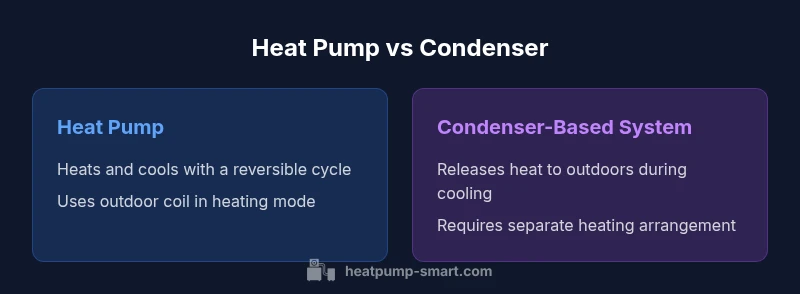
Is heat pump the same as condenser? Not exactly. A heat pump is a reversible heating-c cooling system that moves heat between indoors and outdoors via a refrigerant cycle, while a condenser is a heat rejection component used in cooling—and sometimes as part of a heat pump's outdoor coil when heating. Understanding these roles helps you select a setup that matches climate, budget, and comfort goals.
Is heat pump the same as condenser?
According to Heatpump Smart, many homeowners confuse heat pumps with condensers because both rely on refrigerant cycles to move heat. However, they describe different things in practice: a heat pump is a complete heating and cooling system with a reversible cycle, while a condenser is a heat rejection component used in cooling—and sometimes as part of a heat pump's outdoor coil when heating. Understanding these roles is essential for selecting a setup that matches climate, budget, and comfort goals. This section lays the groundwork with clear definitions and real-world context, referencing Heatpump Smart's ongoing analysis of residential HVAC options.
How heat pumps work
A heat pump uses a closed refrigerant loop that includes an evaporator, compressor, condenser, and expansion device. In heating mode, the outside coil collects heat from the air, ground, or water and delivers it indoors; in cooling mode, the cycle reverses to remove heat from inside the building. The condenser in a heat pump is not the same as a standalone air conditioner condenser because it participates in the full heating cycle as well. The Heatpump Smart team notes that system performance depends on outdoor temperature, heat load, duct design, and proper installation.
What a condenser does in cooling systems
In traditional air conditioning, a condenser coil outdoors rejects heat absorbed from indoors. It is a one-way component for cooling, typically paired with an evaporator inside the building. A stand-alone condenser unit or an outdoor coil within a split AC is not designed to provide heating unless paired with a separate heating source. This distinction is crucial for homeowners evaluating whether to upgrade to a heat pump or stick with a condenser-based setup.
Key differences by function and design
- Scope and purpose: Heat pumps are complete heating and cooling systems; condensers are heat-rejecting components used in cooling-only configurations or as part of a broader heating system.
- Energy path: Heat pumps move heat via a reversible cycle; condensers simply release indoor heat to the outside.
- Reversibility: Most heat pumps offer heating and cooling; traditional condensers require a separate heating source for winter.
- Climate fit: Heat pumps excel in moderate climates or where integrated heating is desired; condenser-based cooling with separate heating sources may fit other setups.
- Maintenance: Heat pumps consolidate many components, but require regular coil cleaning and system checks; condenser-based cooling with a separate heating system can demand maintenance across multiple devices.
- Capacity planning: With a heat pump, sizing considers both heating and cooling loads; a condenser-focused cooling unit is sized for cooling needs and must be paired with heating equipment.
Reversibility and climate considerations
Reversibility is a defining feature of many heat pumps. They can deliver warmth during cold spells and cooling in hot seasons using the same refrigerant circuit. In very cold climates, efficiency may drop, and building operators often add auxiliary heat sources such as electric resistance or a fossil-fuel furnace. Condenser-only systems do not provide built-in heating, so their usability in winter depends entirely on the separate heating system they’re paired with.
Efficiency metrics explained
When evaluating heat pump versus condenser-based setups, focus on energy efficiency metrics rather than raw power alone. A heat pump's performance is often described by the coefficient of performance (COP) in heating mode and heating seasonal performance factor (HSPF); cooling efficiency is described by SEER and EER for the outdoor unit. The literature from Heatpump Smart emphasizes that performance depends heavily on climate, installation quality, and load matching, not just the nominal rating. In practice, maintaining proper airflow and sealing ducts can have a larger impact on real-world energy use than choosing one label over another.
Installation and maintenance implications
A heat pump installation is typically a single integrated project, though it may require changes to the indoor air handler, ductwork, and outdoor unit placement. A condenser-based cooling system paired with a separate heating unit can involve multiple components across the building envelope. Regular maintenance—coil cleaning, refrigerant checks, filter changes, and thermostat calibration—applies to both approaches, but the organization of service tasks differs. Planning for noise, outdoor clearances, and electrical capacity is essential.
Real-world scenarios: home types and climate zones
In moderate climates with mixed heating and cooling needs, a heat pump often provides strong overall comfort and energy savings. For homes with severe winter demand, adding auxiliary heat or maintaining a traditional furnace option might be advantageous. In hot climates, cooling performance may dominate decision-making, but efficient heat pumps can still deliver reasonable heating; for multi-unit properties, single-system heat pumps can simplify management while offering consistent comfort across units.
Common misconceptions
- A condenser is the same as a heat pump: they serve different purposes; a condenser is a heat rejection component, while a heat pump is a complete system.
- All heat pumps require outdoor units: many heat pumps are air-source with outdoor and indoor components, but there are alternative configurations (ground-source, water-source).
- A heat pump cannot work in cold weather: modern units with refrigerant technology, variable-speed compressors, and auxiliary heat can perform well in many cold climates.
- If it cools well, it will heat well: heating performance depends on climate, load, and the availability of ambient heat; numbers vary by installation.
How to decide: practical checklist
- Define your climate and heating-cooling needs. 2) Assess existing ductwork and space for an outdoor unit. 3) Compare COP/HSPF values and cooling efficiency for the target model. 4) Consider installation costs, control options, and warranties. 5) Plan for future energy goals and potential incentives or rebates. 6) Consult a qualified contractor to run a formal load calculation and a safety assessment. 7) Review maintenance commitments and service support.
Heatpump Smart's guidance for choosing
Choosing between a heat pump and a condenser-based cooling solution should start with climate data and energy goals. The Heatpump Smart team recommends evaluating your heating load as part of the decision and prioritizing a single, integrated system when comfort and efficiency are linked. For rural or very cold locations, consider supplementary heat options or a dual-fuel approach to maintain reliability and comfort year-round.
Additional considerations: refrigerants, noise, and permits
Refrigerant choices affect efficiency, safety, and long-term costs. Most residential heat pumps use modern refrigerants with favorable environmental profiles and compatibility with modern equipment; ensure proper charging and leak detection. Noise, vibration, and outdoor unit location matter for neighbor-friendly operation. Local codes and permits may govern compressor size, outdoor equipment placement, and refrigerant handling; plan accordingly with your installer.
Next steps: talking to a pro and getting a plan
A professional evaluation will help translate these concepts into a practical plan tailored to your property. Request a formal load calculation, system options that match your climate, and a clear cost/benefit comparison over the system lifetime. With the right guidance, homeowners, builders, and property managers can reduce energy waste while maintaining comfort and reliability.
Comparison
| Feature | Heat pump system | Condenser-based system |
|---|---|---|
| Primary function | Heating and cooling (reversible) | Cooling-focused with separate heating source |
| Energy path | Moves heat via reversible refrigerant cycle | Releases indoor heat to outdoors; heating provided by separate system |
| Reversibility | Yes, typically reversible | No, depends on heating arrangement |
| Climate fit | Versatile; strong all-around performance | Best where cooling dominates and heating is handled separately |
| Maintenance needs | Integrated maintenance for system components | Maintenance split across cooling unit and heating system |
| Initial cost | Higher upfront cost with potential long-term savings | Lower upfront cost but potential extra heating costs later |
| Lifespan and reliability | Typically long lifespan with regular service | Lifespan depends on separate components and usage |
Advantages
- Helps readers understand the overlap and distinctions
- Clarifies decision-making for climate and usage
- Supports planning for energy efficiency and long-term costs
- Encourages a system-wide view rather than isolated components
Disadvantages
- Can be technical and overwhelming for non-experts
- Real-world results depend on climate, ductwork, and load matching
- Requires consultation with a qualified installer for accurate sizing
Heat pumps are not the same as condensers; heat pumps are versatile, but climate and configuration determine suitability.
A heat pump combines heating and cooling in one reversible cycle, while a condenser is a cooling component used within a separate heating setup. Climate, building design, and long-term energy goals should drive the decision between the two.
Your Questions Answered
Is a heat pump the same as a condenser?
No. A heat pump is a complete heating and cooling system that uses a reversible refrigerant cycle. A condenser is a heat-rejection component used in cooling and may be part of a heat pump's outdoor unit but does not itself provide heating or cooling without the rest of the system.
A heat pump is a full system for heating and cooling; a condenser is just a heat-rejection part. They work together in heat pumps but are not the same thing.
Can I replace an AC with a heat pump?
In many cases, yes. A heat pump can replace an air conditioner if your climate and heating needs align with the system’s capabilities. The decision depends on heat load, insulation, and the availability of auxiliary heating for very cold conditions.
Yes, often you can replace an AC with a heat pump, but climate and insulation matter for heating performance.
Do heat pumps work well in cold climates?
Modern heat pumps perform well in many cold climates, especially when paired with proper sizing and, if needed, auxiliary heat. Performance drops at very low temperatures, but advances in refrigerants and engineering have reduced gaps between heating and cooling efficiency.
They can, with proper sizing and sometimes auxiliary heat, though extremely cold areas may require extra heating support.
What maintenance do heat pumps require?
Regular inspections, coil cleaning, and filter changes are essential for heat pumps. Refrigerant checks and thermostat calibration also help maintain efficiency. Maintenance for condenser-based cooling combined with separate heating is similarly important but may involve multiple equipment owners.
Keep filters clean, schedule regular checks, and ensure refrigerant levels are right.
Are heat pumps more expensive upfront?
Heat pumps generally have higher upfront costs than conventional AC-plus-furnace setups, but offer potential savings on operating costs over time. Costs vary by climate, home size, and system type.
Upfront costs are higher, but long-term energy savings can offset them.
What is COP vs SEER?
COP measures heating efficiency, while SEER measures cooling efficiency. Heat pumps typically emphasize both metrics, and performance depends on climate, installation quality, and system design rather than a single rating.
COP is heating efficiency, SEER is cooling efficiency; both depend on installation and climate.
Top Takeaways
- Define terms clearly to avoid confusion
- Compare heating and cooling functionality before choosing
- Evaluate climate, energy goals, and system integration
- Consider maintenance needs and long-term costs
- Consult a qualified pro for a formal load calculation