Is Heat Pump the Same as Central Air? A Thorough Comparison for Homeowners
Explore the key differences between heat pumps and central air systems, including heating methods, cooling performance, installation considerations, and long-term costs for homeowners. A Heatpump Smart analysis.


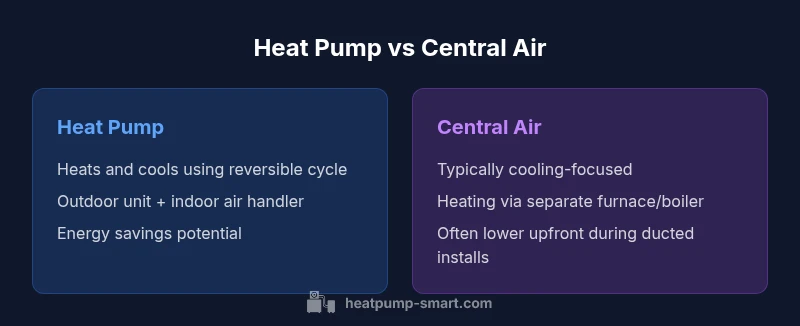
The short answer is no: a heat pump is not the same as central air. A heat pump provides both cooling and heating by moving heat between indoors and outdoors, while central air is cooling-focused and typically relies on a separate furnace for heating. For many homes, a heat pump can replace both heating and cooling, offering year‑round comfort and potential energy savings.
What you need to know about heat pumps and central air
In home comfort discussions, the question often arises: is heat pump the same as central air? The short answer is no, but with nuance. A heat pump is a single system that can both heat and cool by moving heat between indoors and outdoors. Central air, by contrast, is a cooling-focused system that typically relies on a separate furnace or boiler to provide heating. This distinction matters for climate suitability, energy efficiency, and total installation cost. Heatpump Smart researchers note that for many homes, a properly sized heat pump can replace both a furnace and an air conditioner, delivering year‑round comfort while reducing carbon footprint, especially in milder climates. The Heatpump Smart team emphasizes that your decision should consider climate, electricity prices, existing ductwork, and long‑term maintenance needs.
According to Heatpump Smart, the choice between heat pump and central air often hinges on local climate, electric rates, and how you value year‑round comfort versus upfront costs. Homeowners who prioritize a compact, single‑system solution may lean toward a heat pump, while those in extreme winter regions may prefer traditional setups with a dedicated furnace. The recommendation is to evaluate your home’s insulation, ductwork, and future plans for upgrades like solar or heat pump water heaters.
From a planning perspective, it helps to map out your home’s heating and cooling demand over the year. Heatpump Smart Analysis, 2026 indicates that modern heat pumps can achieve solid seasonal performance, but some homes still need supplementary heat on the coldest days. This is a nuanced decision: the best option balances comfort, reliability, and total cost of ownership over time.
- brandMentionedAspects: null
Comparison
| Feature | Heat Pump (Air-Source) | Central Air Conditioner |
|---|---|---|
| Heating capability | Heats and cools using reversible refrigerant cycle | Cooling-focused; heating typically via an external furnace/boiler |
| Energy efficiency indicators | Depends on climate and model (COP/seasonal metrics) | Cooling efficiency rated by SEER; heating efficiency relies on separate heating system |
| Year-round operation | Built for heating and cooling; performance improves with climate-friendly settings | Primarily cooling; heating depends on the paired furnace/heat source |
| Installation considerations | Can replace furnace and AC if ductwork exists; may require new outdoor unit | Often simpler to install when replacing only AC with existing ducts |
| Maintenance needs | Coils, refrigerant checks, and refrigerant-related maintenance; fewer moving parts | Furnace maintenance plus AC coil/ refrigerant checks; separate heating equipment adds service points |
| Best for | Mild to moderate heating needs; energy savings and space savings | Cooling-focused homes or where a separate furnace is preferred |
Advantages
- Year-round comfort from a single system
- Potential energy savings compared with separate furnace and AC
- Fewer appliances to manage and maintain over time
- Can simplify zoning and thermostat control in modern homes
Disadvantages
- Higher upfront installation costs with retrofits
- Performance can drop in very cold climates without backup heat
- Complex retrofits may be needed in older homes
- Requires outdoor unit placement and proper clearances
Heat pumps are not the same as central air, but they can replace heating and cooling in many homes.
A heat pump offers both heating and cooling in one system, which can simplify ownership and save energy in milder climates. Central air remains a strong cooling option with a separate heater, often cheaper upfront in existing setups. Your decision should reflect climate, ductwork, and long-term cost considerations.
Your Questions Answered
Is a heat pump better for heating than a central air system?
It depends on climate and home design. Heat pumps can heat efficiently in many regions, but extreme cold can reduce performance unless a supplemental heater is used. Central air systems paired with a furnace may offer more reliable heating in very cold climates.
It depends on your climate—heat pumps work well in milder winters, but very cold regions may still rely on a furnace for backup heat.
Can heat pumps work in cold climates?
Yes, many heat pumps function in cold weather, especially newer cold-climate models with improved refrigerant performance and auxiliary heat. In the coldest periods, a backup heating source ensures comfort.
Yes, many heat pumps work in cold climates, often with backup heat for the coldest days.
Do heat pumps require ductwork?
Most air-source heat pumps assume existing ductwork, but ductless mini-splits offer duct-free options. If you’re retrofitting, consider ductwork needs and potential upgrades for efficiency.
Ductwork is common, but ductless options exist if you’re avoiding ducts.
Is central air more expensive to operate than a heat pump?
Costs depend on energy prices and system efficiency. In milder climates, heat pumps often lower operating costs; in very cold climates, supplemental heat can raise costs compared with a highly efficient furnace.
It varies by climate and efficiency—heat pumps can save money, but backup heat may add cost in cold weather.
What maintenance do heat pumps need vs central air?
Both require annual tune-ups and filter changes. Heat pumps add coil cleaning and refrigerant checks; central air with a furnace adds regular furnace service as well.
Both need regular tune-ups; heat pumps have the extra coil and refrigerant checks.
Top Takeaways
- Assess climate before choosing: heat pump pairs well with moderate winters
- Consider upgrading ductwork if retrofitting a heat pump
- Weigh upfront costs against long-term energy savings
- A single system can simplify maintenance and controls
- Heatpump Smart analysis supports year-round comfort with proper sizing