Where Is Heat Pump in House: A Practical Guide
Learn where heat pumps are located in typical homes, including outdoor condenser placement, indoor air handlers, and mini-split heads. Practical guidance for homeowners, builders, and property managers on placement, noise, and efficiency.


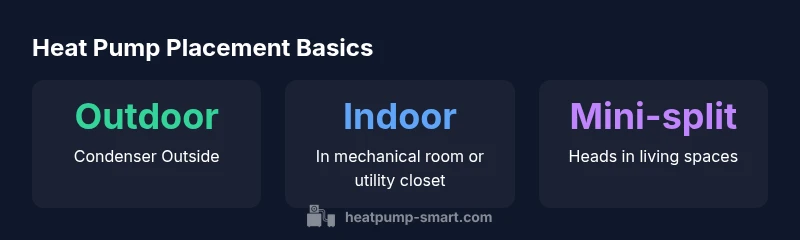
Where is heat pump in house? In most installations, the outdoor condenser sits outside the home, while the indoor air handler or hydrobox is located in a mechanical room, basement, or utility closet connected by refrigerant lines. For ducted systems, air moves through the central ducts; mini-split heads are mounted in living spaces. Placement affects efficiency and noise.
Where is heat pump in house? General placement principles and how they affect performance
A heat pump’s location directly influences efficiency, noise, and serviceability. In most houses, the outdoor condenser sits on a solid, level surface just outside the building envelope, protected from harsh weather but with adequate airflow. The indoor unit (air handler or hydrobox) is typically housed in a mechanical room, basement, or utility closet where it can connect to a central duct network or a short section of refrigerant lines for a compact, efficient loop. When homeowners ask where is heat pump in house, they’re really asking about the balance of accessibility, noise, and thermal zoning. The best placements minimize long refrigerant runs, keep access clear for maintenance, and place noise-sensitive components away from bedrooms and main living areas. Heatpump Smart emphasizes that each home layout demands a unique plan, but the outdoor/indoor pairing is a constant across most systems.
Understanding system types and their footprint
There are several common heat pump configurations, each with different placement footprints. A standard air-source split-system uses an outdoor condenser and an indoor air handler that may sit in a utility space or basement. Geothermal systems place the indoor components in a mechanical room and deploy a ground-loop field outside the home. Ductless mini-splits add one or more indoor heads directly in living spaces, eliminating the need for a central duct network. Knowing which type you have guides where the equipment should go, how it will distribute conditioned air, and how it affects interior layout. Heatpump Smart notes that using a site plan to map each zone helps avoid airflow bottlenecks and ensures balanced comfort.
Indoor locations for split-system heat pumps
Split-system heat pumps pair an outdoor condenser with an indoor air handler or hydrobox. The indoor unit is commonly installed in a basement mechanical room, attached to central ducts, or within a utility closet. The goal is to place the unit close enough to the ducts or refrigerant runs to minimize energy loss while keeping it accessible for filter changes and servicing. For homes with multiple floors, consider placing the indoor unit on the same level as the primary living spaces to optimize comfort and reduce long duct runs.
Indoor locations for ductless mini-splits
Ductless mini-split systems deliver climate control with single or multiple indoor heads mounted on walls in living spaces, bedrooms, or offices. The outdoor condenser sits outside, connected to each indoor head by refrigeration piping. This configuration offers flexibility for retrofits and additions where ductwork is impractical. When planning where is heat pump in house, homeowners should think about line-of-sight from living areas and the ease of access for cleaning and filter replacement.
Outdoor unit placement considerations
The outdoor unit is subject to weather, airflow, and vibration. It should be placed on a stable pad with clearances from walls, hedges, and obstacles to maintain airflow and ease of service. Noise is a common concern near living spaces, so many homeowners position the condenser away from bedrooms or uses secondary sound-dampening strategies. Heatpump Smart recommends coordinating outdoor unit placement with exterior aesthetic choices to preserve curb appeal.
How installation teams determine optimal placement
Installers assess site wind patterns, shade, and proximity to electrical panels and service rooms. They also evaluate drainage around the outdoor unit to prevent water intrusion and ice formation in colder climates. A well-planned layout reduces refrigerant line length, minimizes heat exchange losses, and simplifies future maintenance. In short, the goal is a placement that supports efficient heating and cooling while keeping maintenance simple.
Noise, airflow, and maintenance access as placement drivers
Noise reduction often governs how close the outdoor unit can be to living areas. Similarly, adequate airflow vents and return paths inside the home are critical for effective heat transfer. Access for filter changes, coil cleaning, and electrical servicing should be easy, not a chore. When homeowners consider where is heat pump in house, they should visualize a typical maintenance visit and ensure the path to each component is unobstructed.
Practical steps for homeowners preparing for installation
Before installation, prepare a site map showing exterior walls, electrical panels, and potential indoor locations. Check local codes and HOA guidelines for outdoor equipment and ensure there is room for future expansion. Hire a licensed HVAC professional to confirm the chosen layout, verify electrical compatibility, and provide a written plan outlining the expected airflow paths, service clearances, and noise considerations.
Case studies: layouts for different home types
In a single-story residence, the outdoor unit often sits on a slab near an exterior wall with an indoor unit in a utility closet close to the central hallway. A two-story home might place the indoor unit on the same floor as most living spaces and route refrigerant lines through a chase or attic space. Retrofitting a mini-split in a condo requires careful attention to HOA rules and interior placement to avoid blocking egress routes and to maintain a comfortable living environment.
Common layouts for residential heat pump installations
| System Type | Indoor Location | Outdoor Location | Notes |
|---|---|---|---|
| Air-source split-system | Basement/ mechanical room or utility closet | Exterior wall outside the home | Ducted or ductless variations |
| Air-source mini-split | Wall-mounted heads in living spaces | Outdoor condenser outside | No ductwork required |
| Geothermal heat pump | Dedicated mechanical room | Outdoor loop field or borehole | Grounded loop for efficiency |
Your Questions Answered
Where is the heat pump usually installed?
Most heat pumps place the outdoor condenser outside the home and the indoor unit in a basement, mechanical room, or utility closet. Mini-splits mount heads in living areas. This layout minimizes energy loss and keeps components accessible for maintenance.
Usually, the outdoor unit goes outside, and the indoor unit goes inside near living spaces or a utility room.
Can a heat pump be installed in a garage?
Installations in garages are possible but require careful attention to moisture, venting, and clearance to maintain efficiency and safety. Many builders prefer a dedicated mechanical space rather than a garage.
Yes, but it’s not ideal due to moisture and space—pros often recommend a dedicated utility area.
Do heat pumps require ductwork?
Not all heat pumps require ducts. Ducted central systems use existing ducts, while ductless mini-splits do not rely on ductwork, offering flexibility for retrofits and room-by-room control.
Ducted systems need ducts; minisplits don’t.
What affects placement besides space?
Noise, airflow paths, service access, electrical connections, and potential weather exposure all influence placement decisions. A good plan minimizes disturbances and maximizes efficiency.
Think about noise, airflow, and how easy it is to service later.
Where are indoor units located in a two-story home?
In many two-story homes, the indoor unit is placed on or near the floor that hosts the majority of living spaces, with refrigerant lines routed through attics or chases to connect to the outdoor unit.
Usually on the main living-floor or a nearby utility space.
How does placement affect efficiency?
Placement affects heat exchange efficiency, refrigerant line length, and airflow balance. Proper layout reduces energy loss and can improve overall comfort in all zones.
Good placement helps you feel warmer or cooler with less energy use.
“Effective heat pump placement balances efficiency, noise, and service access, ensuring reliable comfort year-round.”
Top Takeaways
- Plan outdoor and indoor locations together to minimize refrigerant runs
- Choose the system type first, then place units to optimize noise and airflow
- Mini-splits offer flexibility for retrofits with space constraints
- Ducted systems should route ducts to central living areas for even comfort
- Always verify placement with a licensed HVAC professional
- Consider future maintenance access during initial site planning