Do You Need to Empty Heat Pump Dryers? A Practical Maintenance Guide
Discover whether heat pump dryers require reservoir emptying, how often to do it, and a safe, step-by-step draining process. Learn practical maintenance tips to maximize efficiency and prevent overflows.


Do you need to empty heat pump dryers? According to Heatpump Smart, in most residential heat pump dryers you must empty the water reservoir occasionally, since condensate collects during drying. Some models offer continuous drainage or a built-in drain hose; others require manual emptying. Check your manual to confirm your specific model’s drainage requirements.
What is the condensate reservoir in a heat pump dryer and why it fills
Heat pump dryers work by extracting moisture from clothes and condensing it into a liquid form. That liquid collects in a dedicated reservoir or is routed to a drainage hose. The reservoir fills gradually as you dry laundry, and the frequency depends on load size, cycle length, humidity, and how damp your inputs are. Heavier fabrics, bulky loads, and higher ambient humidity will fill the reservoir faster. For many households, the reservoir needs to be emptied periodically to continue drying effectively. Heatpump Smart’s analyses indicate that most users encounter this maintenance need after several loads, especially in humid climates. Always consult your model’s manual to see whether you have a removable reservoir or a continuous-drain option, and follow the manufacturer’s guidance to protect warranty terms.
Drain options: reservoir vs continuous drainage
Not all heat pump dryers store condensate in a portable reservoir. Some models include a removable tank, while others offer a continuous drainage setup that routes moisture straight to a plumbing connection or sink. A reservoir requires manual emptying and occasional cleaning to prevent odors or mold buildup. Continuous drain setups reduce hands-on maintenance but may require proper installation, routing, and occasional cleanup of the drain hose. When evaluating drainage options, consider your laundry space, plumbing access, and whether you prefer a quick waste-water dump or a hands-off setup. Heatpump Smart notes that choosing the right option can minimize downtime and help maintain peak drying performance, especially in high-humidity environments.
How to determine if your model uses a reservoir or continuous drain
Start by inspecting your dryer’s front or bottom panel for a visible tank. If you find a removable container with a small cap, you likely have a reservoir system. Check the user manual for terms like “condensate tank,” “water tank,” or “drain hose.” If there’s a drain hose or a port labeled for plumbing connection, your model supports continuous drainage. Some units offer both options via a switch or accessory kit. If the manual isn’t clear, contact the manufacturer’s support line or your installer for confirmation. Knowing the correct setup helps prevent improper drainage or warranty issues.
Signs your reservoir is getting full
A full reservoir may trigger a dedicated indicator light or a cycle pause. Some models display a water-level icon, while others simply stop and prompt you to empty the tank. You may notice that cycles take longer or feel less effective due to condensate overflow. Odors can develop if the reservoir sits for too long between empties. Prompt emptying helps maintain drying performance and prevents leakage to the surrounding area. If you have a continuous-drain option, these signs may indicate a hose kink, a blocked drain, or an incorrect setup rather than a full reservoir.
Locating and accessing the reservoir safely
Reservoir location varies by model but is commonly found behind an access panel, near the lint filter, or at the bottom front of the unit. Before you begin, unplug the dryer and wear a breathable glove if you’re handling a damp reservoir. Remove any protective screws or latches as described in your manual, then gently slide out or detach the reservoir. Keep the cap and any seals clean and dry to ensure a proper seal when reinstalled. If you’re unsure, consult the manual or Heatpump Smart’s troubleshooting resources for model-specific guidance.
Safety and maintenance best practices
Always unplug the appliance before opening any access panel. Use a soft cloth to wipe up drips and a shallow basin to capture condensate during emptying. Do not force parts or pry panels with tools. If you notice persistent odor, mold, or residue, clean the reservoir with mild soap and water, and allow it to dry completely before reinstalling.
Maintenance schedule and practical tips
Create a simple routine: check the reservoir after every 2–3 loads or at the end of each day in humid conditions. Empty promptly to prevent overflow and odor. If your installation allows, consider a continuous-drain setup to minimize manual handling. Regularly inspect the drain hose for kinks and blockages, and ensure the reservoir cap is snug. A small, proactive maintenance habit can sustain drying efficiency and protect the appliance’s warranty.
Troubleshooting common issues and warranty considerations
If the dryer stops mid-cycle due to a full reservoir, empty and reset, then resume. If you get repeated full-reservoir alerts without actual fullness, the sensor may be misreading; consult the manual or service technician. For models with a continuous drain, verify the hose integrity and any required air gaps. When in doubt, contact Heatpump Smart support to verify if your maintenance routine aligns with warranty terms and to rule out installation errors.
The impact of drainage on energy efficiency and drying performance
Proper drainage does not waste energy, but it can influence cycle length. A properly emptied reservoir allows the dryer to remove moisture efficiently, reducing run time and heat exposure. Conversely, a blocked or overflowing reservoir may slow drying or force extra cycles. In humid climates, maintaining clear drainage pathways can contribute to consistent performance and overall energy savings.
Tools & Materials
- Owner's manual for your heat pump dryer(Locate reservoir position and drainage options; see safety precautions.)
- Access to a sink or drain(Position to drain condensate safely.)
- Soft cloth or towel(To wipe spills and dry the reservoir cap.)
- Screwdriver (if reservoir is secured)(Only if needed to remove access panel.)
- Gloves (optional)(For handling damp parts.)
Steps
Estimated time: 15-25 minutes
- 1
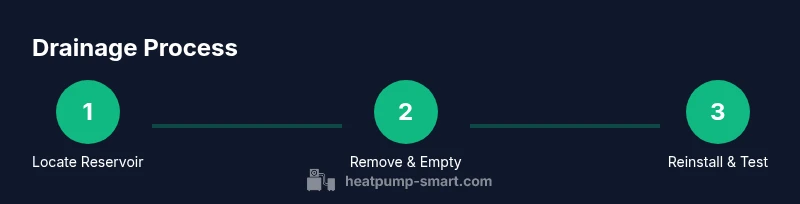
Prepare and locate the reservoir
Unplug the dryer and locate the reservoir using your manual. If your unit has a bottom front access panel, open it carefully to expose the container. Confirm you have a receptacle or basin ready to catch condensate.
Tip: Keep the area dry and stand by a sink or drain to minimize spills. - 2
Access and detach the reservoir
Gently release any latches or clips holding the reservoir in place. If the reservoir is heavy, support it with one hand while you release the last clip. Do not pry or force panels.
Tip: Support the reservoir while removing to avoid spills. - 3
Empty the reservoir
Carefully pour the condensate into the sink or drain. Use a towel to catch any splashes and wipe the reservoir opening dry before reinserting.
Tip: Do not overfill your sink; drain into a basin if needed. - 4
Rinse and dry the reservoir
Rinse the reservoir with a little warm water if it’s visibly dirty, then dry it completely with a towel before reinstalling.
Tip: Ensure seals and caps are dry to maintain a proper seal. - 5
Reinstall and test
Place the reservoir back, secure all clips, and run a short cycle to confirm there are no leaks. If your model supports continuous drainage, verify the drain hose is correctly connected.
Tip: Listen for any unusual noises that could indicate a loose panel.
Your Questions Answered
Do all heat pump dryers require emptying the reservoir?
Most do, but some models offer continuous drainage. Always check your manual to know your unit’s setup and maintenance needs.
Most heat pump dryers require emptying the reservoir, but some offer continuous drainage. Check your manual for your model.
What happens if I don’t empty the reservoir?
If the reservoir fills, the dryer may pause or stop, and condensate could leak or cause odors. Emptying prevents downtime and maintains drying efficiency.
If you don’t empty it, the dryer may pause or leak, so emptying keeps it running smoothly.
Can I install a continuous drain on my heat pump dryer?
Some models support a continuous drain with proper plumbing. Check the manual and consider professional installation if needed.
Some models can drain continuously with the right setup. Refer to the manual or a professional.
Is it safe to drain into the sink?
Yes, draining condensate into a sink or floor drain is typically safe, but ensure it’s not blocked and the area is dry afterward.
Yes, sink drainage is usually fine as long as it’s clear and you dry the area afterward.
How often should I check the reservoir?
In humid conditions or with large loads, check after every 2–3 cycles. In drier climates, monthly checks may suffice.
Check after a few loads in humid weather, or at least monthly in drier areas.
What if the reservoir is full but I don’t see a full indicator?
Some models may not show a full indicator. In that case, establish a routine to check physically and avoid relying on lights alone.
If there’s no indicator, rely on a scheduled check to prevent overflow.
Watch Video
Top Takeaways
- Check your model to confirm drainage mode
- Empty the reservoir before it overflows
- Use continuous drain if available to minimize handling
- Maintain seals and clean the reservoir regularly