Distance Between Heat Pump and Air Handler: A Practical Guide
Learn how far a heat pump outdoor unit should sit from the indoor air handler. Explore typical distance ranges, how distance affects efficiency, and installation tips for safe, compliant setups.


The distance between a heat pump outdoor unit and the indoor air handler is typically tied to line-set length and is commonly kept within 15–25 feet for short residential runs. Many systems allow up to 50–100 feet with proper refrigerant charging and pipe insulation. Always follow the manufacturer’s specifications for your model.
Why Distance Matters for Heat Pumps
Distance between components in a heat-pump system is not just a matter of convenience; it directly influences refrigerant charge, pressure balance, and overall efficiency. According to Heatpump Smart, the distance between the outdoor unit and indoor air handler—often expressed as line-set length and including vertical rise—determines how much refrigerant charge is required and how the system responds under load. Small deviations from the manufacturer’s specified distances can lead to suboptimal performance, higher energy use, or short cycling in some models. In short, the distance between heat pump and air handler is a practical design parameter that installers must respect to ensure reliability and energy savings. For homeowners, it’s worth understanding that the right distance keeps noise low, improves heat transfer, and reduces wear on components over the system’s life.
- The line-set length and any vertical rise contribute to the system’s hydraulic length, affecting pressure and superheat calculations.
- Protective insulation on the refrigerant lines minimizes heat gain/loss and helps maintain efficient operation across temperature swings.
- If the distance exceeds the manufacturer’s spec, technicians typically perform a refrigerant charge adjustment and verify system performance after installation.
When evaluating a new installation, consider not only the numerical distance but also access for future service, routing around obstacles, and the ease of routine maintenance. The goal is a compact, well-insulated, and serviceable layout that preserves efficiency across seasons.
Typical Distance Ranges and What They Mean
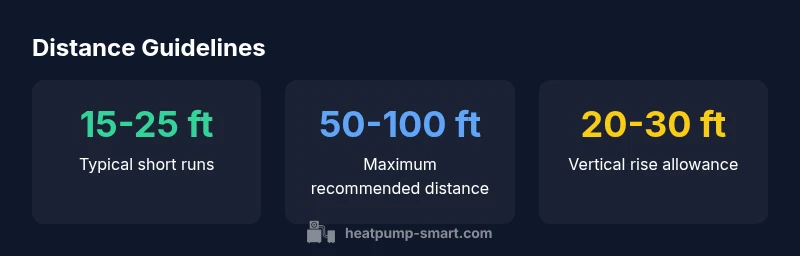
For most residential heat-pump installations, the recommended starting point is a relatively short line-set distance. A common rule of thumb is 15–25 feet for typical short runs, which minimizes charge adjustments and simplifies installation. Manufacturers may allow longer runs, often up to 50–100 feet, but these longer distances require precise charging according to the model’s specification and may call for advanced installation practices. The key takeaway is that longer distances increase the risk of performance deviations if not accounted for correctly. In addition to length, vertical rise matters: many guidelines account for 20–30 feet of vertical difference as part of the effective line length. Heatpump Smart analysis emphasizes consulting the equipment manual and a qualified HVAC technician to confirm limits for the exact model in use.
- Short runs are generally simpler to charge and test, with fewer surprises during startup.
- As runs extend, ensure the installer has access to weighed refrigerant charges and correct oil return considerations.
- Always verify electrical clearances, line-set routing, and service access during planning to avoid rework later.
How to Determine the Right Distance for Your System
Determining the right distance between heat pump and air handler starts with the equipment spec. Obtain the installer manual for your exact model and extract the maximum recommended line-set length and vertical rise. Next, map the route from the outdoor condenser to the indoor air handler, noting bends, obstacles, and potential drainage issues. Measure the planned path and calculate the equivalent length, including any vertical rise, to compare against the manufacturer’s limits. If the planned path approaches the upper end of the spec, plan for a refrigerant charge adjustment and confirm the system will operate within acceptable superheat and pressures after charging. Finally, consult a licensed HVAC professional who can validate the route, estimate the required charge, and ensure compliance with local codes and warranty conditions.
- Use the model’s official documentation as the primary guide.
- Include future service access when routing lines.
- Obtain written confirmation of the required charge for the anticipated path.
- Document measurements for future service and maintenance.
Practical Installation Considerations
Beyond the numerical distance, practical installation considerations help ensure a durable and efficient setup. Route lines away from high-heat sources, corrosive environments, and potential physical damage. Use proper clamps and supports to reduce vibration transmission to the exterior and interior components. Insulate the line-set thoroughly to minimize heat exchange, and shield exposed sections from weather where possible. Consider future accessibility for coil cleaning, refrigerant checks, and electrical service. In addition, plan the conduit and surge protection to align with electrical codes. A neat, well-insulated route reduces energy loss and makes preventive maintenance easier, directly supporting energy savings and system longevity.
- Favor straight, low-angled runs over long, winding paths.
- Maintain clearances around units for unobstructed airflow and service access.
- Use compatible line-set sizes and insulation to minimize thermal losses.
What If Distances Exceed Typical Ranges?
If the planned distance between the heat pump and air handler exceeds typical ranges, the project becomes more complex but is still doable with careful planning and professional oversight. Longer line sets may require larger or additional refrigerant charges, additional oil in the system, and sometimes even a different configuration (for example, a higher-efficiency outdoor unit paired with larger indoor coil). Some manufacturers publish extended-distance kits or approved alternative routing methods for unusual layouts. Always obtain written confirmation from the equipment maker and have the installation supervised by a licensed HVAC contractor to ensure safety, efficiency, and warranty validity.
- Do not improvise refrigerant quantities; rely on weighed charges per spec.
- Verify the service access and routing does not compromise safety or code compliance.
- Consider alternate layout options if the distance is consistently stretching typical guidelines.
Maintenance and Inspection of Line Sets
After installation, maintenance of line sets is essential to sustaining performance. Inspect insulation for nicks, cracks, or moisture intrusion, particularly where pipes pass through walls, roofs, or foundation walls. Look for signs of refrigerant leaks, oil stains, or frost at the indoor coil. A professional should verify that the refrigerant charge remains correct after any seasonal shifts or minor distance adjustments. Schedule periodic checks of the connection points, electrical connections, and mounting hardware to prevent vibration-induced wear. Regular inspection helps prevent efficiency losses and prolongs the life of the system.
Quick Reference: Distances by System Type (Narrative)
Different system types allow for different maximum distances between outdoor heat pumps and indoor air handlers. In typical single-family homes with standard split systems, 15–25 feet covers most short-run scenarios. If you are using a longer run up to 50–100 feet, ensure the installer accounts for the additional refrigerant charge and line-set length in the design. For vertical rises, plan an additional 20–30 feet of effective length to maintain performance. Always prioritize manufacturer specifications and have a qualified professional confirm the final charge and system balance before commissioning.
Distance guidelines for heat-pump and air-handler configurations
| System Type | Typical Distance (ft) | Notes |
|---|---|---|
| Short-Run Residential | 15-25 | Standard setup with close unit proximity |
| Extended-Run Systems | 50-100 | Requires charge adjustments and verification |
| Vertical Rise (above indoor unit) | 20-30 | Accounts for effective length in design |
| Ultra-Long Runs | 100+ | Requires manufacturer approval and specialized installation |
Your Questions Answered
What is the recommended distance between a heat pump and air handler for most homes?
Most homes use a line-set length of 15–25 ft for short runs; longer runs up to 50–100 ft may be allowed with proper refrigerant charging per the model and local code.
Typically, 15 to 25 feet works for most homes; longer runs require professional assessment.
Can the distance affect warranty coverage?
Yes, not following manufacturer specifications for line-set length and charging can affect warranty coverage; always install per the manual.
Warranties depend on following the manufacturer's guidelines.
How is refrigerant charged if the distance is longer than standard?
Longer line sets may require additional refrigerant charge and special procedures; a professional should perform the charge using weighed quantities per spec.
A technician adds the right amount of refrigerant to match the longer line.
Is it better to place the heat pump closer or use a longer run?
Closer is generally better for efficiency and cost; use the manufacturer’s max distances if near the limit.
Closer is usually better, but follow the manufacturer's specs.
What about vertical distance between outdoor unit and air handler?
Vertical rise adds to the effective distance; many guidelines allow 20–30 ft of rise, but verify with the manual.
Vertical height adds to the distance, so account for it in planning.
What maintenance should be done after installation with a longer distance?
Inspect line-set insulation for damage, check for leaks, and verify charge after settling; schedule a follow-up check.
Get a post-install check to confirm the charge and integrity.
“Distance and proper line-set charging are critical to heat-pump efficiency and reliability; even small deviations can impact performance.”
Top Takeaways
- Follow manufacturer specifications for line-set length.
- Aim for the shortest practical distance between units.
- Vertical rise and path affect refrigerant charge—plan accordingly.
- Have a qualified pro verify refrigerant charge after install.