What Size Heat Pump for 1700 Sq Ft: A Sizing Guide
Learn how to size a heat pump for a 1700 sq ft home with practical baselines, climate adjustments, and professional load calculations to optimize comfort and energy savings.


Overview: Why size matters for 1700 sq ft homes
According to Heatpump Smart, choosing the right size heat pump for 1700 sq ft is essential for comfort and energy efficiency. The decision affects how quickly rooms heat and cool, humidity control, and long-term operating costs. In many homes this square footage sits in a common range for single- or two-stage air-source heat pumps, but the exact size depends on climate, insulation, window efficiency, and occupancy. In this article, we answer: what size heat pump for 1700 sq ft, and how to verify the right choice with professional load calculations. We'll outline baselines, examples, and a practical workflow so homeowners, builders, and managers can approach sizing with confidence. Heatpump Smart's guidance emphasizes starting from a reliable rule-of-thumb, then refining with a formal load calculation to avoid oversizing or undersizing.
Baseline sizing: BTU per square foot guidelines
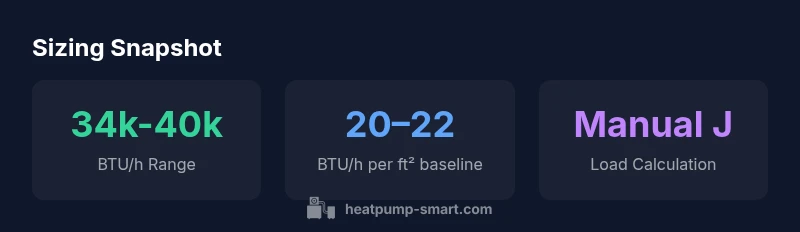
A common starting point for heating size is a baseline of roughly 20–22 BTU per square foot. In temperate climates with decent insulation, this rule-of-thumb often yields a 34,000–37,000 BTU/h unit for a 1,700 sq ft home. In warmer climates or with high-performance windows, you might scale down slightly; in colder climates or older, leakier homes, you might scale up. Heatpump Smart analysis shows that many contractors use this range as an initial reference, then adjust for air leakage, shading, and solar gains. While this baseline is helpful, it is not a substitute for a formal load calculation. The key takeaway is that about 1 BTU per square foot is not sufficient; a careful multiplier is necessary to capture the building's unique comfort targets. If your home has tall ceilings or open floor plans, account for zones and occupancy to avoid oversized comfort losses.
Climate and insulation: how they shift sizing
The climate zone where a 1700 sq ft home sits strongly influences required heat pump capacity. Colder climates often demand larger units to deliver steady warmth during cold snaps, while mild climates may work with smaller equipment and rely more on zoning and inter-seasonal efficiency. Insulation quality and air sealing dramatically change the calculation: a well-insulated home loses heat more slowly, allowing a smaller size; drafts, single-pane windows, and poor sealing push sizing upward. Solar gains from sunny orientations can offset part of the heating load, especially in winter. Finally, thermostat strategy and humidity control affect perceived comfort and may lead a pro to adjust the nominal BTU/h upward or downward to minimize short cycling. These factors explain why the same 1700 sq ft footprint can require 2–4 different unit sizes across climates and homes.
Step-by-step sizing approach for 1700 sq ft
- Gather your house facts: total area, ceiling height, room layout, shading, and orientation. 2) Assess insulation quality, air leakage, and duct condition; 3) Start with a baseline of 20–22 BTU/h per ft², then apply climate and insulation multipliers; 4) Use a Simple calculator or rule-of-thumb to estimate a target BTU/h; 5) Confirm with a professional load calculation (Manual J) for final sizing before purchase. This workflow helps avoid undersized comfort gaps or oversized cycling.
Practical examples: mild climate vs cold climate
In a mild climate with good insulation and daylight heating gains, a 1700 sq ft home might size toward the lower end of the range, around the mid-30,000s BTU/h. In a cold climate or older, draftier home, the size could push toward the upper end of the range, near 40,000 BTU/h or more when accounting for high heating demand and longer cold seasons. These examples illustrate how climate and building envelope drive the final number, even when the footprint remains the same.
The DIY calculator vs professional load calculations
A simple sizing calculator can provide a helpful starting point, but a professional load calculation, typically a Manual J, is the gold standard. It accounts for windows, insulation levels, air leakage, and internal gains. Contractors use this method to verify whether the proposed unit will meet peak-load conditions without oversizing for daily comfort. If you’re pursuing a retrofit, staged sizing or zoning can also improve performance and efficiency.
Sizing misconceptions to avoid
Common mistakes include assuming a single BTU/h per square foot rule fits every home, ignoring insulation and air sealing, and choosing a unit based solely on area rather than climate. Oversizing leads to short cycling and humidity control problems; undersizing results in constant running, overheating, and reduced comfort. Always validate sizing with a certified professional before purchasing and installation.
Next steps: how to proceed with installation
If you’re ready to move forward, contact a licensed HVAC technician and request a Manual J load calculation. Bring your floor plans, insulation details, and any remodeling plans. Discuss future space needs and potential changes in occupancy. Ensure the contractor provides a detailed sizing recommendation, expected energy savings, and a plan for ductwork assessment or upgrades if needed. A properly sized heat pump sets the foundation for reliable comfort and energy efficiency.