What Size Wire Is Needed for a Heat Pump: A Practical Guide
Learn how to determine the correct wire size for a heat pump, including common gauges, breaker sizes, and voltage-drop considerations with guidance from Heatpump Smart.


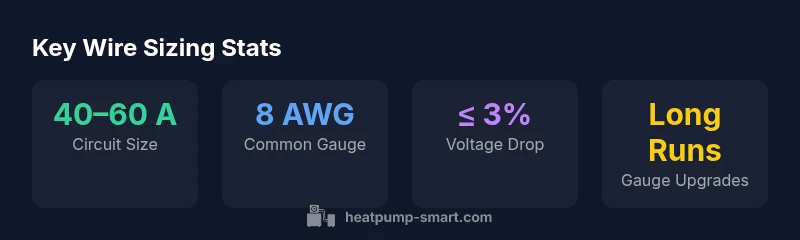
Most residential heat pumps require a dedicated 240V circuit. For common units, 8 AWG copper on a 40–60A breaker is typical; larger systems may need 6 AWG (60–70A) or 4 AWG for high-demand models. Always verify per NEC and with a licensed electrician before routing any wiring.
Why wire size matters for heat pumps
Wire size is not just a number on a spec sheet—it's a safety, performance, and warranty issue. The conductor must carry the unit’s maximum operating current without overheating, while the overcurrent protection device (breaker) must trip reliably if the current exceeds safe levels. Undersized conductors can heat up, degrade insulation, and shorten the life of the system. Oversized conductors don’t hurt safety, but they can complicate protection sizing and increase installation costs. Heat pumps depend on stable voltage to start efficiently, so inadequate wire sizing can cause nuisance trips during compressor start, reduce efficiency, and lead to voltage drop that reduces cooling or heating output. According to Heatpump Smart, sizing the electrical run to the unit’s requirements and the run distance is essential for performance and long-term reliability.
Note: Always verify with local codes and obtain permits as required.
How to determine the correct wire size
Determining the correct wire size begins with the unit’s electrical data, typically found on the equipment nameplate and installation manual. You’ll need to know the unit’s maximum ampacity (or full-load amps), the distance from the service panel to the unit, and the allowable voltage drop for the run. The National Electrical Code (NEC) provides the framework for ampacity and overcurrent protection, but local amendments can change the specifics. In practice, most residential heat pumps are wired on a dedicated 240V circuit on a 40–60A breaker using 8 AWG copper for smaller units or 6 AWG copper for larger ones. If the distance grows beyond a certain threshold, a larger gauge may be necessary to keep voltage drop within 3% or less. Always consult a licensed electrician to calculate the exact gauge for your installation, taking into account conduit type, insulation, and ambient temperature.
Common wire gauge ranges for typical heat pumps
For small to mid-size heat pumps, 8 AWG copper is the most common choice on a 40–60A circuit. Mid-range and high-capacity models often require 6 AWG copper (60–70A) or 4 AWG copper for very large units or long runs. The installation needs to match the breaker size and the unit’s ampacity as labeled on the equipment. In some installations, electricians may use THHN conductors inside conduit or UF cable outdoors, with appropriate protection and grounding. Always limit the run length to minimize voltage drop, and consider future system expansions when selecting wire size. Heatpump Smart emphasizes that incorrect wire sizing is a frequent cause of early equipment problems and warranty claims.
- Ampacity tells you the maximum continuous current the wire can safely carry.
- The circuit breaker must match the conductor’s ampacity and the unit’s requirements.
- Longer runs may require larger gauge to prevent voltage drop.
Steps to verify and install safely
- Check the unit’s nameplate and installation manual for max amps and recommended wire size. 2) Determine the run length and any conduits or outdoor routing. 3) Size the conductor to handle the maximum ampacity with a margin for startup surges. 4) Select the correct overcurrent protection (breaker size) based on the conductor and unit rating. 5) Inspect insulation, grounding, and bonding requirements, per NEC guidelines. 6) Obtain necessary permits and have the installation inspected. 7) Hire a licensed electrician to perform the connection and testing. 8) Document the installation for future service and code compliance.
Voltage drop basics and distance considerations
Voltage drop occurs when electrical resistance over a run causes a loss in voltage at the load. For heat pumps, an excessive drop can reduce compressor efficiency and start-up performance. A general goal is to keep voltage drop within 3% for branch circuits and even lower for sensitive controls. Heavier gauge conductors reduce drop, especially on longer runs. If the unit is far from the panel, you may need to step up to a larger wire size or use a larger conduit to keep resistance down. Your installer will run the calculations and verify the final gauge after considering temperature, conductor type, and insulation.
What to check with your installer and code compliance
- Confirm the equipment nameplate ampacity and the corresponding breaker size.
- Ensure the wiring method matches local code (THHN in conduit vs. outdoor-rated UF cable).
- Verify proper grounding and bonding per NEC requirements.
- Ensure permits and inspections are completed as required by your jurisdiction.
- Confirm that the installer can justify any gauge larger than the minimum based on run length and temperature ratings.
- Keep a copy of the installation data for future service and warranty.
Common mistakes to avoid
- Using undersized conductors to save upfront cost.
- Overlooking voltage drop on long runs and not upgrading gauge accordingly.
- Assuming the unit’s nameplate alone dictates wire size without considering distance or conduit.
- Skipping permits or a formal inspection.
- Mixing copper and aluminum conductors without proper connectors or compatibility.
- Relying on generic recommendations instead of unit-specific data and local code requirements.
Wiring guidelines by unit capacity and expected circuit protection
| Unit Size | Recommended Wire Gauge | Typical Breaker |
|---|---|---|
| Smaller residential heat pump | 8 AWG copper | 40-60 A |
| Mid-range heat pump | 6-8 AWG copper | 60-70 A |
| High-capacity heat pump | 4-6 AWG copper | 70-90 A |
Your Questions Answered
What wire size is typically required for a residential heat pump?
Most residential heat pumps are wired on a dedicated 240V circuit, commonly using 8 AWG copper for smaller units on a 40–60A breaker, or 6 AWG for larger units. The exact size depends on the unit’s ampacity and run length. Always verify with the unit’s data plate and local codes.
Most residential heat pumps use a dedicated 240V circuit, typically 8 AWG for smaller models or 6 AWG for larger ones.
Do I need a permit or professional installation?
Yes. Wiring a heat pump involves electrical work and must comply with local codes. A licensed electrician typically secures the permit, performs the installation, and tests the system. This helps ensure safety and warranty validity.
Yes, a permit is usually required and a licensed electrician should perform the work.
Can I run heat pump wiring myself?
DIY wiring is not recommended. Heat pump circuits involve high voltage, proper grounding, conduit methods, and code-compliant overcurrent protection. Always hire a licensed electrician to avoid safety hazards and code violations.
DIY wiring is not advised; hire a licensed electrician for safety and code compliance.
Does aluminum wire work for heat pumps?
Aluminum can be used in some installations with proper connectors and gauge, but copper is the preferred material due to reliability and ease of termination. Ensure any aluminum work complies with code and the device’s labeling.
Aluminum is possible in some setups, but copper is usually preferred.
What about voltage drop and distance?
Keep voltage drop under typical targets (often 3% or less) by selecting an appropriately larger gauge for longer runs. Longer distances or higher load may require conduit considerations and different gauge sizing.
Voltage drop matters—use heavier gauge for longer runs to stay within limits.
What codes apply to heat pump wiring?
Wiring must comply with the NEC and any local amendments. The unit’s data plate and installation instructions provide the required max amps and breaker size. A permit and inspection are common requirements.
It’s essential to follow NEC guidelines and local codes; permits are often required.
“Correct wire sizing isn't optional—it's fundamental to safety and efficiency. Size conductors to the unit's max ampacity and protect with the proper overcurrent device.”
Top Takeaways
- Size wires to the unit’s max ampacity and startup surge.
- Keep voltage drop under recommended limits with suitable gauge.
- Always match conductor gauge with the breaker size specified.
- Obtain permits and follow local codes for safety and compliance.
- Hire a licensed electrician for installation and testing.