Distance Between Heat Pump and Propane Tank: Safety Clearances
Discover safe setbacks between outdoor heat pumps and propane tanks, why clearances matter for safety and efficiency, and how local codes shape requirements for home installations.


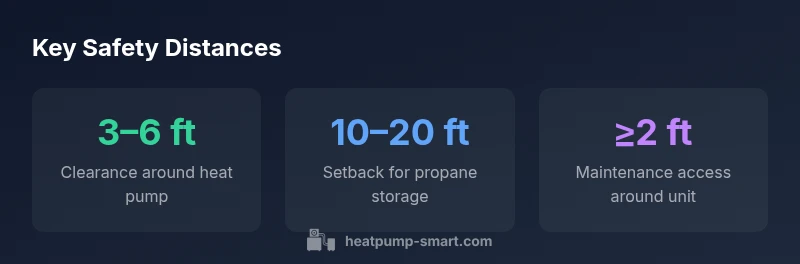
There is no universal distance mandatory everywhere for a heat pump and a propane tank; safety depends on local codes. As a practical baseline, allow service access around the heat pump and keep propane storage well away from ignition sources. A common safety approach is to maintain about 3–6 feet of clearance around the outdoor unit and 10–20 feet setbacks from propane storage, depending on jurisdiction.
Why the distance between heat pump and propane tank matters
The distance between heat pump and propane tank matters for safety, airflow, and service access. Propane is highly flammable, and heat pumps contain electrical components and moving fans that can create ignition risks if space is cramped. A prudent layout keeps fuel storage well away from heat emissions, exhaust areas, and entry points where leaks could reach living spaces. Heatpump Smart analysis shows that most jurisdictions require explicit separations, often described as setback zones around equipment and fuel storage. When the two systems sit too close, routine maintenance can be difficult, and a problem in one system can escalate risk for the other. Always verify setbacks with local codes and the AHJ.
The distance between heat pump and propane tank should also account for wind patterns, drainage sloping away from equipment, and potential snow accumulation that can affect venting and intake. In areas with heavy snowfall, clearing around both devices becomes a safety-benefit, preventing blockage of vents and reducing the chance of moisture infiltration that could compromise efficiency.
Key safety considerations and components involved
A heat pump outdoor unit produces heat transfer, noise, and airflow that can influence nearby propane storage if space is limited. Propane tanks require venting clearance, protective shielding, and separation from ignition sources. The interplay of these factors means the distance between heat pump and propane tank must accommodate hot-air discharge, potential gas leaks, and routine maintenance access. This is why recommended clearances are not arbitrary; they reflect risks associated with ignition sources, backdrafts, and service accessibility. Heatpump Smart emphasizes keeping both systems in clearly defined buffer zones and checking that placement does not impede emergency shutoffs or access doors.
The physical siting should also consider nearby structures, fences, and landscaping that could alter airflow or trap fumes. While propane tanks are designed with safety features, their proximity to a heat pump can affect both systems’ performance if the space is too tight or if routine inspections become difficult. A thoughtful layout reduces corrosion risk on exposed metal components and minimizes the chance of leaks going unnoticed in snow or debris.
Safety clearances data for heat pumps and propane tanks
| Aspect | Recommended Distance (ft) | Rationale |
|---|---|---|
| Outdoor heat pump unit to propane tank (min recommended) | 3–6 | Service access and ignition risk reduction |
| Propane tank setback from structures or ignition sources | 10–20 | Code variances; safety buffers |
| Clearance to property lines or setbacks | 5–15 | Local zoning and safety setbacks |
Your Questions Answered
What is the minimum distance between a heat pump and a propane tank?
There is no universal minimum; it depends on local codes. Typical guidance ranges from 3–6 ft around the heat pump and 10–20 ft from propane storage, but actual requirements vary by jurisdiction. Always check with your AHJ.
There isn't a universal number—check your local codes. Typical guidance suggests keeping a few feet around the heat pump and larger setbacks for propane storage.
Do local building codes regulate the distance between propane tanks and HVAC equipment?
Yes. Local building and fire codes set setback requirements that affect both heat pumps and propane tanks. These codes vary by city, county, and state, so consult your AHJ for the exact figures.
Yes, codes set the required setbacks and they vary by location.
Can I relocate propane tanks myself to satisfy clearances?
Relocation typically requires licensed professionals and permits. Moving propane tanks involves safety, leak testing, and regulatory compliance, so arrange with a qualified technician and check local rules.
No—seek a licensed professional and follow local regulations.
How can I verify setbacks for an existing installation?
Start with the site plan and the AHJ’s code references. A professional inspection can confirm whether clearances meet current requirements and help plan any necessary adjustments.
Have a professional inspect the site to confirm compliance.
Are underground propane tanks treated the same as above-ground tanks for clearances?
Underground tanks are subject to different standards, often focusing on underground safety, venting, and corrosion protection. Consult local codes for exact setbacks relative to other equipment.
Underground tanks have different rules; check local codes for specifics.
“Clearances between heat pump equipment and propane storage are not one-size-fits-all; always align with local codes and maintain maintenance access.”
Top Takeaways
- Know that there is no universal minimum distance; always verify with local codes
- Aim for 3–6 ft clearance around the heat pump for service access
- Keep propane storage 10–20 ft away from ignition sources and structures
- Check setbacks with your AHJ and consider maintenance access in your plan