Fan Not Spinning on Heat Pump: Troubleshooting Guide
Urgent, step-by-step guide to diagnose why a heat pump fan won’t spin, with safe checks, fixes, and guidance on when to call a professional.


The fan not spinning on heat pump is most often caused by electrical issues (a tripped breaker or blown fuse) or a failed capacitor, sometimes a seized blower motor. Start with safety checks: verify power at the disconnect, reset the circuit, and listen for a capacitor click. If power is active but the fan remains still, proceed with the diagnostic flow.
Understanding the symptom: fan not spinning on heat pump
When the outdoor fan refuses to spin, you may lose heating or cooling efficiency and risk further damage. According to Heatpump Smart, this symptom often signals an electrical issue or a mechanical fault that requires prompt attention. The Heatpump Smart team notes that quick, safe checks can prevent unnecessary component replacement and get your system back online faster. Start with the simplest power and fuse checks before opening panels or touching wiring. If the unit remains silent after a safe reset, move to deeper diagnostics.
Quick checks you can perform safely
Safety comes first. Before touching the unit, turn off power at the outdoor disconnect and the main service panel. Clear any obvious debris from the outdoor coil and verify there is ample clearance around the unit. Check the indoor fuse or breaker that feeds the heat pump and thermostat, then reset as needed. Finally, validate that the thermostat is set to the correct mode (heat or cool) and that the fan is configured to auto or on. If you hear a faint relay click when resetting power, you’re on the right track; if not, continue with the diagnostic flow.
Common causes and how likely they are
- Power issue (high): A blown fuse, a tripped breaker, or loose wiring can stop the fan. - Faulty start/run capacitor (high): Capacitor failure prevents the motor from starting reliably. - Motor seized or bearings worn (medium): Mechanical friction can stall the fan. - Thermostat or control board fault (medium): Incorrect signals may keep the fan from running. - Blocked outdoor unit or debris (low): Airflow restriction can reduce performance and stall the fan.
Diagnostic flow overview
This section outlines a practical path you can follow. Start at the symptom, move through electrical checks, then mechanical and control-system checks. Heatpump Smart analysis shows that most failures begin with power or capacitor problems, followed by motor issues. By following a logical flow you minimize risk and avoid unnecessary disassembly. Safety first, document each step, and prepare to hand off to a professional if needed.
Safety and energy considerations
Live electrical work is dangerous. Always disconnect power and use lockout/tagout if available. Do not test capacitors with a live circuit; use a properly rated meter. If the unit is under warranty, avoid unauthorized repairs to protect coverage. Once the fan runs again, note how airflow and system efficiency improve energy usage and comfort—proper operation matters for long-term savings.
Practical troubleshooting flow you can follow
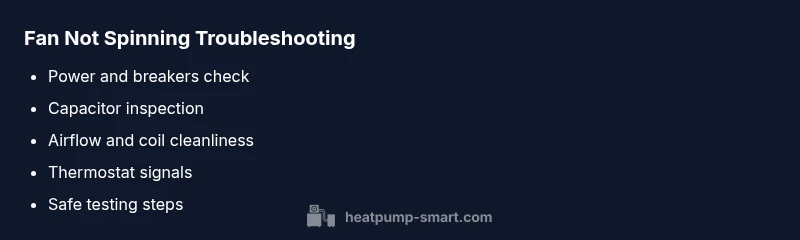
- Confirm power is off, then inspect the disconnect and circuit breaker.
- Inspect the capacitor with a proper meter; replace if bulging or failed.
- Check thermostat signals and control board outputs; adjust or replace as needed.
- Inspect blower motor wiring and bearings for resistance or noise; if binding, plan replacement.
- Reconnect power and test the system; observe for normal fan operation and airflow.
Practical fixes you can try if you’re comfortable
- Reset breakers and power to the outdoor unit; sometimes a simple reset restores operation.
- Replace a suspected faulty capacitor with an equivalent rated part (do not overspec).
- Clear debris from the outdoor coil and ensure at least 24 inches of clearance around the unit.
- Verify thermostat settings and perform a forced fan test if your system offers it.
- If the fan still won’t start, proceed with Step-by-Step fixes or call a pro.
When to call a professional and what to expect
If you’re uncomfortable with electricity or capacitor testing, contact a licensed HVAC technician. A pro will perform a controlled capacitor test, inspect the start circuit, and verify control-board signals. Expect a safety briefing, a written estimate, and possibly a temporary heating/cooling solution while repairs are made. The Heatpump Smart team recommends timely professional support for persistent issues.
Preventive maintenance to reduce future failures
Schedule annual inspections, clean the outdoor coil, replace worn wiring, and test capacitors as part of routine service. Regular maintenance helps catch issues before they become failures and keeps your heat pump running efficiently, reducing energy costs. The Heatpump Smart team emphasizes proactive maintenance for homeowners, builders, and managers.
Steps
Estimated time: 30-60 minutes
- 1
Power down safely
Turn off power at the outdoor disconnect and main panel. Use lockout/tagout if available and verify there is no voltage before touching any components.
Tip: Take a photo of wiring before disconnecting to aid reassembly. - 2
Check power and breakers
Inspect and reset the outdoor breaker and any internal fuses. Re-seat any visibly loose connections and ensure the service panel is in good condition.
Tip: If a breaker trips again after reset, stop and call a pro. - 3
Inspect the capacitor
Access the start/run capacitor and visually inspect for bulging or leakage. Use a capacitor tester if available to verify capacitance.
Tip: Discharge the capacitor safely before handling. - 4
Inspect the blower area
Check the blower wheel for obstructions and rotate the shaft by hand with the power off to feel for binding.
Tip: Never puncture the insulation or force the wheel. - 5
Test thermostat and controls
Verify thermostat is set correctly and that fan control signals are being sent. Check control board indicators if present.
Tip: Try a temporary thermostat swap if available to isolate the issue. - 6
Re-test the system
Power the unit back on and observe the fan. Listen for clicks or hums and check for normal rotation and airflow.
Tip: If the fan still won’t start, document symptoms and escalate to a professional.
Diagnosis: Fan won't spin on heat pump
Possible Causes
- highPower issue (tripped breaker, blown fuse, loose wiring)
- highFaulty start/run capacitor
- mediumBlower motor seized or bearings worn
- mediumThermostat or control board fault
- lowBlocked outdoor unit or poor airflow
Fixes
- easyInspect and reset main service disconnect and breaker; check for loose wires
- mediumTest and replace faulty capacitor with an equivalent rating
- hardInspect blower motor and bearings; replace motor if seized
- mediumTest thermostat signals and control board outputs; adjust settings or replace board if needed
- easyClean outdoor coil and clear debris; restore airflow
Your Questions Answered
Why won’t my heat pump fan start after a power outage?
Power outages can trip breakers or disrupt the fan’s start circuit. Check the disconnect and reset breakers before investigating components.
Power outages can trip breakers; reset the disconnect and breakers, then proceed with basic checks.
Can a dirty outdoor unit cause the fan to stop?
Yes. Debris or ice buildup can restrict airflow and prevent the fan from starting. Clean the exterior and remove obstructions.
Yes, debris can block airflow; clean around the outdoor unit and remove obstructions.
Is a faulty capacitor common and how can I tell?
Capacitors store energy to start the motor. Look for bulging, leakage, or test with a meter to confirm. Replace if faulty.
Capacitors can fail; test with a meter and replace if bulging or not within spec.
When should I hire a professional?
If you’re unsure about electrical safety, capacitor testing, or complex wiring, hire a licensed HVAC technician.
If you’re unsure about electrical work, hire a pro.
Can thermostat settings affect the fan?
Yes. An incorrect mode or fan setting can prevent the fan from running. Verify mode and auto/on settings.
Thermostat settings can stop the fan; check mode and fan setting.
How often should I service a heat pump?
Annual professional maintenance helps prevent fan and compressor issues and maintains efficiency.
Annual service helps prevent failures.
Watch Video
Top Takeaways
- Power checks first to rule out simple issues.
- Capacitors fail often and require proper tools to test.
- Keep outdoor unit clean to maintain airflow and efficiency.
- Consult a professional if safety or wiring is in doubt.