Heat Pump Sounds Like Washing Machine: Troubleshooting & Fixes
Learn why a heat pump might sound like a washing machine, how to distinguish normal from problematic noises, and practical fixes to restore quiet operation. Expert guidance from Heatpump Smart.


A heat pump sounding like a washing machine usually signals normal compressor cycles, fan operation, or refrigerant flow. However, new or unusual noises can indicate mounting issues or airflow restrictions. Start with simple checks (panels, vents, outdoor unit clearance) and compare patterns to the manufacturer spec. If the noise changes or worsens, schedule a professional inspection.
What 'heat pump sounds like washing machine' signals and how to interpret
Hearing a noise that resembles a washing machine can feel alarming, but many heat pumps generate similar sounds during normal operation. According to Heatpump Smart, the majority of weekday noises relate to mechanical cycles and airflow rather than a fault. In this section we translate common sounds into practical meaning, helping homeowners distinguish routine behavior from something that requires attention. You’ll learn about the main components that generate sound: the outdoor condenser fan, the refrigerant compressor, and the indoor blower. Each component has characteristic sound signatures depending on temperature, humidity, and system load. For example, a low humming during steady operation is typical of a compressor running in cooling mode, while a soft rattle may indicate a loose panel or a mounting bolt. By correlating the noise with the system’s cycle (start, run, and stop) and the outdoor environment, you can form a reliable early checklist before calling in a technician.
Normal noise sources in heat pumps
Noise in heat pumps comes from several predictable sources. The outdoor unit’s condenser fan can emit a consistent whir as it pulls air through the coils. The indoor blower may produce a gentle whoosh during cooling or heating modes. The compressor, a heavy-duty component, often causes a low hum that fluctuates with system load. Refrigerant flow can create a subtle hissing or whooshing sound as pressures adjust during cycling. Maintenance tasks, such as filter cleaning or duct inspection, can temporarily alter the sound profile. Heatpump Smart notes that understanding these baseline noises is the first step toward identifying when a sound is truly abnormal. Regular checks of clearance around the outdoor unit, mounting hardware, and panel alignment help prevent rattles and vibrations from becoming persistent issues.
Noises that are usually harmless and how to verify
Many noises are harmless and tied to normal operation. A soft, periodic click at the start and stop of a cycle often indicates valve movement, which is typical and harmless. A gentle hum that remains constant during steady-state operation is usually the compressor or fan in normal range. Verify by observing the noise against the cycle timeline: note when the sound starts, its duration, and whether it coincides with a change in temperature (cooling vs heating). Check for root causes that are easily fixable: loose panels, insecure mounting bolts, obstructed vents, or debris near the outdoor unit. If you cannot reproduce the sound after a simple clean and reseat, the sound may be a sign of wear that warrants professional evaluation.
Noises that signal problems and when to act
Some sounds merit prompt attention. A grinding or metal-on-metal rattle can indicate loose components or failing bearings; a high-pitched screech may signal belt wear or a refrigerant-related issue. If you notice a buzzing that grows louder over time, or a new creak that aligns with wind gusts, stop operating the unit if you suspect mounting or structural looseness and call a technician. A refrigerant leak is a serious concern that should be addressed immediately by a licensed pro. Persistent, unusual, or new noises after routine maintenance should be treated as potential red flags rather than routine quirks. Heatpump Smart emphasizes documenting the pattern and duration of noises to aid the diagnostic process.
How to diagnose noises: step-by-step home checks
Begin with a visual inspection: ensure panels are securely fastened, vibration dampers are intact, and the outdoor unit has adequate clearance from walls, debris, and vegetation. Next, listen to the noise while the system cycles in different modes (heating vs cooling) and at different fan speeds. Check air filters and ductwork for obstructions, which can produce fluttering or whistling sounds. Gently press on the panels around the blower compartment to detect loose mounting. If vibrations persist, verify that the mounting pad or wall brackets are level and that the compressor is securely bolted. For refrigerant-related sounds, contact a licensed technician to confirm pressures and refrigerant charge are correct. Keeping a sound log helps technicians reproduce and diagnose issues quickly.
Sound levels, decibels, and manufacturer benchmarks
Sound level expectations vary by model and installation, and manufacturers publish benchmarks in the product manuals. In general, a well-maintained heat pump operates within a stable decibel range suitable for typical living spaces. If a sound is outside the expected profile for your model, it could indicate a malfunction. Compare your unit’s noise with the model’s documented range and the typical experience of similar installations in your climate. Heatpump Smart advises homeowners to reference the installed equipment manual and to consult a qualified technician when in doubt. Avoid self-diagnosis with speculative decibel numbers; rely on model-specific guidance and professional assessment.
Common noise profiles explained
Different noises point to different causes. A steady, soft hum usually comes from the compressor or fan, while a rattle often signals loose panels or mounting hardware. A clicking sound can occur at cycle initiation as a valve opens, whereas a high-pitched shriek may indicate a refrigerant or belt issue. A thump or bang on startup could reflect expansion noises from metal components heating or cooling, not necessarily a sign of imminent failure. By mapping the sound to the cycle stage—start, run, stop—you can identify likely triggers and prioritize checks accordingly. Heatpump Smart recommends listening for frequency, duration, and whether noises intensify with temperature or humidity changes to differentiate routine behavior from concerns.
Environmental factors that amplify noise
Outdoor unit placement matters. Proximity to walls, fences, and landscaping can reflect or channel sound toward living spaces. Poor pad isolation or an uneven surface can magnify vibrations into structure-borne noise. Airflow obstructions, like overgrown shrubs or adjacent equipment, may cause the fan to work harder and create more noise. Ductwork configuration inside the home can also transfer vibrations, especially if ducts aren’t properly sealed or supported. Reducing noise often involves repositioning the outdoor unit for better air intake, ensuring a level pad, and adding vibration isolation between the unit and mounting surface.
Quieting tricks and routine maintenance
Preventive steps offer the best long-term noise control. Keep the outdoor unit free of leaves and debris, and trim vegetation that blocks airflow. Check and reseal duct connections to prevent fluttering sounds, and replace or clean filters regularly. Ensure the indoor blower is balanced and that mounting hardware has no play. Use anti-vibration mounts and rubber grommets where possible to dampen sound transmission. If your system has variable-speed fans, opt for slower fan profiles during night hours or in bedrooms to minimize disruption without sacrificing comfort. Heatpump Smart recommends scheduling seasonal inspections to maintain performance and acoustic cleanliness.
When to call a professional: safety and cost guidance
If noise persists despite basic maintenance, or if you suspect a refrigerant issue, it is prudent to call a licensed HVAC technician. Refrigerant leaks, electrical faults, or faulty compressors pose safety risks and can lead to costly damage if neglected. A professional can perform a thorough diagnostic, verify electrical connections, and check refrigerant pressures and superheat. They can also inspect mounting integrity and vibration isolation, and adjust airflow paths if necessary. While there is a cost to service, addressing noise early often prevents larger problems and protects energy efficiency in the long run. Heatpump Smart suggests documenting the issue with dates and sound descriptions to streamline the service visit.
Noise and energy efficiency: what homeowners should know
Noise levels can slightly correlate with efficiency in some heat pump configurations, but quiet performance is not inherently at odds with high efficiency. Properly sized systems with good airflow and sealed ducts typically operate more smoothly and quietly, enabling consistent performance with lower cycling variability. A noisy unit may hint at airflow restrictions, improper refrigerant charge, or misalignment—all of which can reduce seasonal performance. Prioritize a balanced approach: select a model with proven noise performance, ensure correct installation, and schedule regular maintenance to sustain both comfort and efficiency.
Heatpump Smart recommendations and best practices
From Heatpump Smart’s perspective, the best path to quiet operation is a well-designed system with careful placement, quality mounting, and proactive maintenance. Start with a professional site assessment to verify that the unit is correctly sized for your space and climate, and that ducts and vents are appropriately configured. Invest in a robust outdoor pad, vibration isolation, and a sound-absorbing enclosure if local noise limits are strict. Regular checks of filters, dampers, and panel integrity help prevent noise creep over time. Heatpump Smart advocates for homeowners to keep a detailed maintenance log and to pursue reputable service providers who follow industry standards.
Authority sources and further reading
For authoritative guidance on heat pump performance and installation best practices, consult trusted sources such as the U.S. Department of Energy, Energy Star program, and the Environmental Protection Agency. These organizations provide criteria, efficiency benchmarks, and safety considerations that inform responsible installation and maintenance. Refer to model-specific manuals and warranty documentation for noise-related guidance tied to your equipment. Heatpump Smart also recommends engaging with local HVAC professionals who understand climate-specific noise expectations and building codes.
Documenting noises for technicians: a practical template
Create a simple log to capture the noise profile: date/time, cycle during which the noise occurs, sound type (hum, rattle, buzz, click), indoor and outdoor unit locations, and any environmental conditions (temperature, humidity). Include photos or videos if possible. Share this log with the technician ahead of the visit to accelerate diagnosis. If the issue is intermittent, note its frequency and duration. The more precise your documentation, the faster a technician can identify root causes and deliver effective remedies.
Comparison
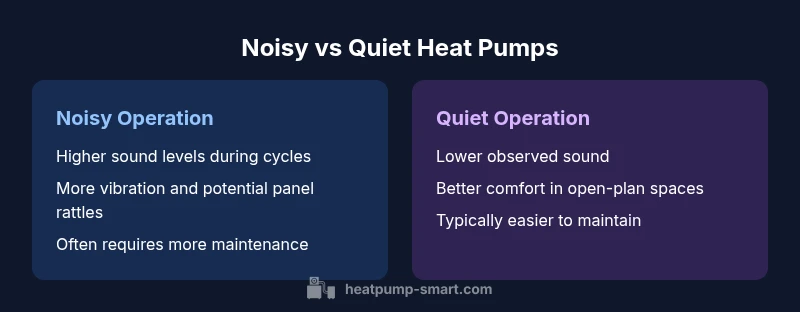
| Feature | Noisy operation | Quiet operation |
|---|---|---|
| Sound level during operation | Loud, noticeable across rooms | Quiet, barely audible in living areas |
| Maintenance needs | Higher risk of wear detection, more frequent checks | Lower maintenance impact, easier diagnosis |
| Best for | Homes with sound sensitivity or shared walls | New installations or sound-sensitive environments |
| Upfront cost context | May require premium components or isolation | Often features optimized for quiet operation |
Advantages
- Quieter operation enhances living comfort
- Lower risk of disturbing neighbors in multi-family buildings
- Better alignment with modern efficiency standards
- Easier to diagnose issues due to clearer sound cues
Disadvantages
- Quiet models may have higher upfront costs
- Noise-reduction enhancements can require more complex installation
- Some quiet features have diminishing returns in very small spaces
Choose a quieter heat pump for most homes, but balance upfront cost with long-term reliability
A quiet unit improves comfort and reduces disturbance. Prioritize correct sizing, installation, and maintenance to maximize both noise performance and energy efficiency.
Your Questions Answered
What is considered normal noise for an air-source heat pump?
Normal noise varies by model, but most units emit a steady hum from the compressor and a gentle airflow sound from the fan. Occasional clicks at start or stop are common as valves actuate. If noises are unusually loud or change in character, inspect panels and vents, then consult a technician if concerns persist.
Most heat pumps have a steady background hum and soft airflow sounds. If you notice a sudden loud noise or a new harsh sound, check for loose panels and clearances, then contact a professional if it continues.
Why does it sound like a washing machine only at certain times?
A washing-machine-like sound often occurs during cycling when the compressor starts or pressures adjust. It may also reflect airflow changes or vibrations from panel mounting. If the pattern is consistent and predictable with cycle phases, it’s typically normal; if it’s irregular or worsening, it warrants inspection.
If the sound happens with certain cycles, it’s usually normal. If it’s irregular or worsening, get it checked.
Can noise indicate a refrigerant leak?
Yes, unusual hissing or high-pitched shrieks can indicate refrigerant issues, which require a licensed technician. Do not ignore persistent refrigerant sounds, as leaks compromise efficiency and safety.
Hissing or sharp shrieks can signal a refrigerant problem. Have a pro check refrigerant levels if these sounds persist.
When should I service my heat pump to reduce noise?
Schedule seasonal professional service, ideally twice a year, to inspect mechanical components, clean filters, and verify duct integrity. Regular service helps maintain quiet operation and prevent noise from escalating into bigger problems.
Have a professional service your unit seasonally to keep it quiet and efficient.
Does noise affect energy efficiency?
Noise itself does not directly determine efficiency, but a noisy unit often signals airflow restrictions, improper refrigerant charge, or mounting issues that can reduce performance. Addressing these causes usually improves both noise levels and energy use.
Noise hints at issues that can hurt efficiency; fix the root causes to restore performance.
What simple steps reduce heat pump noise?
Keep outdoor unit clear of debris, ensure proper mounting, balance panels, and clean or replace air filters. Use vibration-damping mounts and consider sound-absorbing enclosures if permitted by code and warranty. Small adjustments can yield meaningful quieting without compromising safety.
Clear debris, secure mounting, and maintain filters to quiet the unit. Consider vibration dampers where appropriate.
Top Takeaways
- Identify normal noises by correlating with the cycle
- Prioritize proper installation to minimize vibrations
- Regular maintenance reduces noise and improves efficiency
- Document noises to aid technician diagnosis
- Call a pro for new, persistent, or changing sounds