How to fix heat pump short cycle: a practical guide
A comprehensive, step-by-step guide to diagnosing and fixing heat pump short cycling safely. Learn common causes, non-invasive fixes, and when to call a professional, with tips for homeowners, builders, and property managers.


Learn how to fix heat pump short cycling by safely inspecting thermostat settings, airflow, and defrost controls. You’ll verify proper sizing, check for blocked outdoor components, inspect condensate drains, and determine whether a reset or service is needed. This guide outlines non-destructive steps first and clearly flags when professional help is required.
Understanding the short cycle phenomenon
Short cycling is when a heat pump repeatedly starts and stops rather than running for a steady interval. This behavior wastes energy, accelerates component wear, and can lead to uneven indoor temperatures. According to Heatpump Smart, most cases come from airflow restrictions, thermostat misconfigurations, or control faults within the outdoor unit. In this guide on how to fix heat pump short cycle, we define what counts as a short cycle, how long it typically lasts, and the risks to your system and comfort. Watch for signs like frequent relay clicks, cycles lasting only a few minutes, and an unexpected rise in energy bills without improved comfort. Understanding the symptom helps you distinguish between benign quirks and urgent issues. Climate and load influence cycling patterns, so what works in a mild season may differ from extreme weather. With this context, you can decide which fixes to try first and when to seek Heatpump Smart-approved professionals for evaluation.
Common causes of heat pump short cycling
There are several plausible culprits. Thermostat settings or schedules that overshoot the cooling or heating target can trigger rapid restarts. An oversized or undersized unit relative to the home can cause the system to reach the setpoint quickly and then shut off. Dirty air filters and blocked return or supply ducts reduce airflow, prompting the outdoor unit to overcompensate and cycle. Low refrigerant charge or refrigerant leaks are not DIY fixes and require licensed service. Dirty outdoor coils or restricted fan performance can cause temperature swings, as can a malfunctioning defrost timer in cold climates. Lastly, electrical issues or a failing control board can create inconsistent signals that manifest as short cycles. By mapping these causes to symptoms you see in your system, you can prioritize fixes and identify when a pro is needed.
Safety first: when to call a pro
If you observe refrigerant signs (hissing sounds, oily residue, ice buildup on lines), unusual electrical smells, or you cannot access or safely operate the equipment, stop and contact a qualified technician. Do not attempt to handle refrigerant, capacitors, or electrical connections beyond basic shut-off procedures. Safety comes first: power down at the breaker before inspecting any internal components. For persistent cycling after non-invasive checks, or if you notice erratic operation, a pro should perform a diagnostic test using appropriate gauges and tools. Heatpump Smart emphasizes professional service for any suspected refrigerant or major electrical fault to prevent hazards and ensure code-compliant repair.
Diagnosing issues without risking safety
Start with non-destructive checks you can perform from inside the home. Confirm the thermostat is set to the correct mode (heat or cool) and the temperature differential is reasonable (usually within 1-2 degrees of the desired setpoint). Check the air filter; a clogged filter reduces airflow and can trigger cycling. Inspect the outdoor unit for debris, vegetation, or snow buildup that blocks airflow. Listen for unusual noises from the compressor or fan, which can indicate component wear. Use a thermometer to compare supply and return air temperatures; if the delta is too small, airflow or sensor issues may be at fault. If basic checks reduce symptoms, proceed with targeted, non-invasive adjustments before calling an HVAC professional. Heatpump Smart advises documenting observations to share with your technician for faster resolution.
Step-by-step fixes you can try (non-invasive)
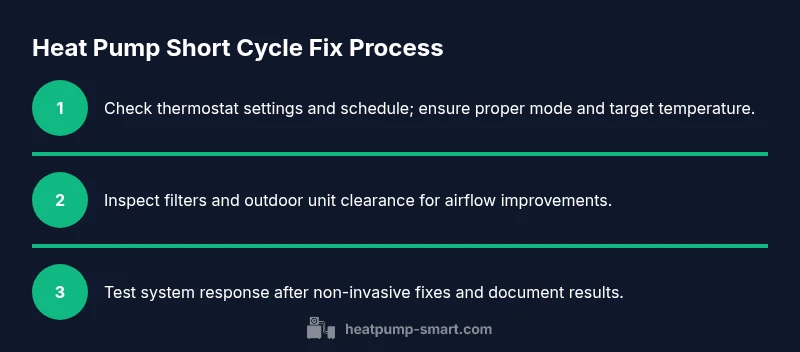
- Check thermostat settings and schedules: ensure correct mode, fan settings, and setback times. A simple reset can solve many misconfigurations.
- Replace or clean air filters: a clean filter improves airflow and reduces cycling. Inspect return ducts for leaks and blockages.
- Clear around the outdoor unit: remove leaves, snow, and vegetation within at least 2 feet to maintain proper airflow; a clean condenser improves cycling control.
- Inspect for ice on the outdoor coil: if frost is present, note ambient temperature, defrost cycle behavior, and whether cycling recurs after defrost completes.
- Inspect the condensate drain: a blocked drain can trigger safety switches or sensor anomalies that affect cycling. Clear with a clean, safe tool.
- Monitor after adjustments: run the system for at least 1-2 cycles to observe whether cycling slows and comfort improves. If not, escalation is advised.
When to replace components vs. system
Some short cycles reflect aging or failing parts that aren’t economical to repair. A failing contactor or capacitor may cause the compressor to restart irregularly, and an obsolete thermostat or control board can create persistent miscommunication within the system. If problem persists after non-invasive fixes, or you observe refrigerant issues, high refrigerant pressures, or abnormal heat pump noises, replacement or professional repair may be the most cost-effective route. A professional can assess age, efficiency, and refrigerant health to determine whether a component replacement or a full system upgrade is warranted.
How to optimize thermostat and controls to avoid short cycle
Your thermostat’s configuration strongly influences cycling. Use a stable, moderate temperature differential (e.g., 2-4 degrees) and avoid aggressive setback routines when the home is occupied. If you have a smart thermostat, review its energy-saving modes and ensure equipment-specific settings match your heat pump’s capabilities. Calibrate the thermostat’s sensor placement and ensure it reflects the living space, not an adjacent unconditioned area. Consider enabling intelligent hold or adaptive scheduling to smooth cycling. If zones exist, confirm zone dampers and balancing so the system doesn’t engage multiple stages or oversized loads simultaneously.
Maintenance habits to prevent future short cycles
Establish a seasonal maintenance routine that includes coil cleaning, filter replacement, and duct inspection. Schedule professional HVAC checks annually or biannually to verify refrigerant health and electrical components. Use Heatpump Smart as a guide to align maintenance with climate and usage patterns. Document changes in cycling patterns and energy bills to detect early warning signs. A proactive approach reduces the odds of short cycles and extends equipment life.
Practical checklist for ongoing maintenance
- Replace filters every 1-3 months during heavy-use seasons.
- Keep outdoor unit clear of obstructions and debris year-round.
- Verify thermostat settings and seasonal schedules monthly.
- Listen for unusual noises and watch for ice buildup on coils.
- Schedule annual professional inspection for refrigerant integrity and electrical components.
Closing note on safety and care
Short cycling is often a sign your heat pump is struggling to maintain comfort efficiently. Start with safe, non-invasive steps and monitor results. If problems persist or you encounter refrigerant, electrical, or gas-related concerns, seek professional help. Heatpump Smart’s guidance emphasizes safety and reliability as the foundation for any maintenance plan.
Tools & Materials
- Safety gear (gloves and eye protection)(Wear protective gear when inspecting electrical components)
- Multimeter(For basic electrical checks; do not measure refrigerant pressures)
- Screwdriver set (Phillips & flathead)(For panel access and filter housing screws)
- Replacement air filters(Keep spare on hand for clogged or dirty filters)
- Shop vacuum or brush(Clean around the outdoor unit and inside the return duct openings)
- Thermometer or digital temp gun(Used to verify supply vs return temperature deltas)
- Owner's manual for the heat pump(Model-specific guidance and safety notices)
Steps
Estimated time: 60-90 minutes
- 1
Power down the system
Locate the main breaker for the heat pump and switch it to off. This prevents shocks and accidental starts while you inspect electrical components or panels.
Tip: Double-check wall switches and breakers labeled for the unit; some panels are in the garage or outside. - 2
Check thermostat settings
Verify mode, setpoint, and fan settings. Ensure the thermostat isn’t set to a rapid cycling or aggressive cooling/heating schedule that could trigger short cycling.
Tip: If you have a smart thermostat, disable any “eco” or aggressive energy-saving modes during diagnosis. - 3
Inspect and clean air filtration
Remove the air filter and inspect for dirt. Replace dirty filters; a clean filter restores airflow and reduces cycling triggers.
Tip: If you see visible dirt, clean or replace the filter before retesting the system. - 4
Clear outdoor unit and nearby ducts
Ensure at least 2 feet of clearance around the outdoor unit. Remove leaves, snow, and debris that block airflow; check accessible ducts for kinks or obstructions.
Tip: Gently vacuum or brush the coil if accessible and safe to do so. - 5
Check condensate drain
Inspect the condensate line for blockages; a clogged drain can trip safety switches that affect cycling.
Tip: Flush a small amount of water through the line and observe for proper drainage. - 6
Observe defrost behavior
In cold weather, defrost cycles are normal. If you notice extended or frequent defrost cycles that correlate with cycling, note ambient conditions and possible sensor issues.
Tip: Document outdoor temperature and cycling duration during defrost events. - 7
Check for refrigerant health concerns
Only a licensed technician should verify refrigerant charge and leaks. Signs of trouble require professional service.
Tip: Do not open sealed refrigerant lines or attempt charging yourself. - 8
Reset controls and monitor performance
After checks, re-energize the system and observe for a few cycles. If short cycling persists, prepare a service call with documented observations.
Tip: Record start times, cycle lengths, and ambient conditions to share with the technician.
Your Questions Answered
What is considered a short cycle?
A short cycle means the heat pump repeatedly starts and stops within a short time frame, often a few minutes apart, instead of maintaining a steady run.
A heat pump that keeps turning on and off in short intervals, instead of staying on for a steady period.
Can I fix it myself safely?
You can perform non-invasive checks like thermostat settings and filter changes. Do not handle refrigerant or electrical components beyond basic safety steps; if unsure, contact a professional.
You can do some checks safely, but avoid refrigerant or electrical work that requires a pro.
Why does a defrost cycle cause short cycling?
The defrost cycle activates to melt frost on outdoor coils. If it occurs excessively due to outdoor conditions or sensor issues, it may resemble short cycling.
Defrost cycles can look like cycling if they happen too often due to cold weather or sensor faults.
When should I call Heatpump Smart for a service?
If cycling persists after basic checks or if you suspect refrigerant or electrical faults, contact a professional for a full diagnostic.
If cycling continues after simple checks or you suspect refrigerant issues, call a professional.
How can thermostat settings contribute to short cycling?
Too-large temperature offsets or aggressive setpoints can trigger rapid cycles. Use a stable schedule and moderate setpoints.
Big temperature differences or aggressive settings can cause the system to click on and off quickly.
Will short cycling affect energy bills?
Yes. Frequent restarts waste energy and may raise bills until the underlying cause is fixed.
Frequent cycling wastes energy and can raise your energy bills until you fix the cause.
Watch Video
Top Takeaways
- Identify the root cause of cycling with non-invasive checks first
- Prioritize thermostat and airflow issues before calling a pro
- Do not attempt refrigerant handling yourself
- Document observations to aid diagnosis and speed up service
- Regular maintenance reduces future short cycles