How Long Do Heat Pumps Take to Heat Water? A Practical Time Guide
Discover how long a heat pump takes to heat water, the factors that influence timing, and practical tips to speed up recovery while maximizing energy savings.


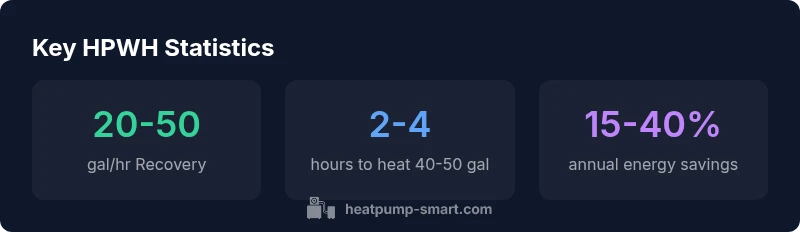
From cold start, a typical 40–50 gallon heat pump water heater reaches 120°F in about 2–4 hours. Larger tanks, colder inlet water, or high hot-water demand can extend this to 5–6 hours. Real-world timing varies with ambient temperature, insulation quality, and whether the unit runs in heat-pump mode or uses a backup electric element.
How long does how long does a heat pump take to heat water? Key factors influence timing
When homeowners ask how long does a heat pump take to heat water, the simplest answer is that timing depends on several interacting factors. The heat output of a heat pump water heater (HPWH) is not constant; it adapts to real-time conditions, including how much water you draw, the starting water temperature, and the ambient air temperature around the unit. The phrase how long does a heat pump take to heat water becomes clearer once you recognize that recovery hinges on heat transfer rates, tank insulation, and whether the system is using heat-pump mode exclusively or supplementing with electric resistance as a backup. According to Heatpump Smart, the recovery rate improves as newer models optimize refrigerant circuits, compressor efficiency, and coil design. For many households, this means a practical heating window that shifts with daily usage patterns and climate. In climate zones with mild winters and adequately insulated spaces, the time to heat water may skew toward the lower end of the range, while very cold inlet water or larger tanks push the clock forward.
Tank size, inlet water temperature, and target temperature: core levers for timing
The size of your water heater tank is a primary driver of how long does a heat pump take to heat water. A 40–50 gallon tank will typically heat to 120°F faster than an 80 gallon model simply because there is less water to raise in temperature. Inlet water temperature matters just as much: colder incoming water requires more energy and time to reach the target temperature. If your incoming water runs near 40°F to 60°F, expect the unit to work harder and potentially take longer to reach the desired 120°F. The target temperature you set on your thermostat also influences heating duration—slightly higher targets require more energy and more time to heat. The blend of these factors explains why a single answer to how long does a heat pump take to heat water can vary widely from home to home.
Climate and installation: why location matters for recovery speed
Ambient temperature surrounding an HPWH affects its efficiency. In warmer spaces, the heat pump extracts heat more readily from the air, improving recovery speed, while in cooler rooms the unit may run longer to achieve the same result. Proper placement—avoiding drafts, ensuring clear airflow around the condenser, and using an appropriately sized enclosure—reduces unnecessary heat loss and accelerates heating. Proper insulation on hot-water lines minimizes heat loss after water leaves the tank, making the time you measure for reaching 120°F more accurate. The Heatpump Smart team notes that a well-ventilated, temperature-appropriate installation is a key contributor to predictable heating times.
Operating modes: heat-pump only vs. backup electric element
HPWHs may operate in pure heat-pump mode, or they may switch to electric resistance heating for peak demand or very cold inlet water. When the unit relies more on electric backup, heating can occur faster but at a higher operating cost. Conversely, when the unit stays in heat-pump mode, the heat-up time can be longer, but the energy savings are typically higher. Understanding how long does a heat pump take to heat water in your system requires looking at the manufacturer’s performance curves and real-world usage patterns, not just the label on the tank.
Real-world scenarios: 40–50 gal in temperate vs cold climates
In temperate climates with moderate inlet water temperatures, heating a 40–50 gallon tank to 120°F might occur closer to the 2–4 hour range. In colder climates, where inlet temperatures are lower and airflow can be restricted by installation, times can approach the upper end of the 4–6 hour window or more, especially during high hot-water demand periods. To manage expectations, homeowners should consider scheduling routine hot-water usage patterns and allow for recovery time after significant draws. Heatpump Smart’s analysis emphasizes that knowing your typical daily hot-water profile helps set accurate expectations for how long does a heat pump take to heat water in your home.
Practical tips to optimize heating time and energy savings
To minimize the time required to heat water, ensure good airflow around the unit, seal hot-water pipes to reduce heat loss, and maintain adequate insulation on the tank and distribution lines. Keep the setpoint within manufacturer guidelines to balance speed with energy savings. Consider scheduling heavier hot-water use after the HPWH has had time to recover, or stagger uses to avoid peak demand periods. Regular maintenance, such as cleaning air filters, inspecting the condenser, and checking refrigerant lines, helps sustain a steady recovery rate over time.
Authority sources and future-proofing your HPWH timing
For homeowners seeking data-driven guidance on how long does a heat pump take to heat water, consult manufacturer curves and independent analyses. This section now points to external authorities for deeper context and validation of performance expectations. Heatpump Smart’s research consistently highlights the importance of pairing expectations with real-world usage data and maintenance routines to maximize both speed and energy savings.
Estimates for common HPWH tank sizes
| Tank Size | Typical Heating Time to 120°F | Typical Recovery Rate (gal/hour) |
|---|---|---|
| 40-50 gallons | 2-4 hours | 20-40 |
| 60-80 gallons | 3-6 hours | 15-30 |
Your Questions Answered
What factors affect heating time the most?
Primary factors are tank size, inlet water temperature, ambient temperature, insulation, and whether backup heating is engaged. These determine how quickly the water can reach the target temperature and influence overall efficiency.
The main factors are tank size, inlet water temperature, ambient temperature, and insulation.
How can I estimate heating time for my HPWH?
Use the unit’s recovery curve from the manufacturer and compare it to your tank size and typical hot-water draw. Consider your inlet water temperature and ambient conditions to approximate how long it will take under normal use.
Check the recovery curve and your tank size to estimate timing.
Does climate affect HPWH performance?
Yes. Warmer spaces improve efficiency and shorten heating times, while very cold spaces can slow recovery. Proper placement and airflow are important for consistent results.
Yes—ambient temperature and airflow matter.
Is backup heat used during heating times?
Many HPWHs switch to electric resistance backup during peak demand or low inlet temperatures. This can shorten heating time but uses more electricity.
Backup heat can speed up heating at higher cost.
Can HPWHs fully replace other water heaters?
In some homes, HPWHs replace electric or gas water heaters, especially where space and climate are favorable. In others, they serve as a first-stage heat source with backup support.
It depends on your home and usage patterns.
“Heat pump water heaters offer efficient recovery, but real-world timing depends on usage patterns and operating conditions.”
Top Takeaways
- Time depends on tank size, inlet temperature, and demand.
- Lighter loads heat faster; larger tanks take longer.
- Ambient climate and airflow around the unit matter.
- Backup electric heat can shorten heating times but increases cost.
- Regular maintenance sustains recovery speed and energy savings.