Water Heater: Heat Pump vs Gas — A Practical Comparison
A rigorous 2026 comparison of heat pump water heaters and gas water heaters, covering efficiency, costs, climate impact, installation, and long-term value for home owners, builders, and property managers.


Heat pump water heaters (HPWHs) deliver high energy efficiency and lower operating costs in mild climates, while gas water heaters still excel in high hot-water demand and rapid recovery. The best choice depends on climate, electricity and gas prices, and household usage patterns. This quick comparison sets expectations before a deeper dive into the topic.
Context and definitions
Understanding the topic of water heater heat pump vs gas requires clarity on technology basics, local energy prices, and climate conditions. According to Heatpump Smart, the most cost-effective choice hinges on climate, electricity prices, and how much hot water your family uses. A water heater heat pump vs gas discussion centers on two distinct technologies: a heat pump water heater (HPWH) uses ambient heat from the room to heat water, typically with an electric resistance backup for peak demand; a gas water heater relies on burning natural gas or propane and vents combustion exhaust. In many regions, HPWHs offer steady efficiency and lower operating costs when electricity is reasonably priced and the ambient temperature remains moderate. Gas models may still be favored where gas prices are stable, or where there is high hot-water demand or limited space for venting. This section sets the stage for a data-driven comparison that homeowners, builders, and property managers can use to plan replacements or new installs in 2026.
How heat pump water heaters work
Heat pump water heaters extract heat from surrounding air using a refrigerant cycle connected to a storage tank. The system moves heat rather than generating it, achieving high coefficients of performance (COP) when outdoor temperatures and indoor air temperatures are favorable. HPWHs typically rely on electricity to drive the compressor and fans, with a small electric resistance element as backup for peak demand. Placement matters: access to adequate airflow, minimal freezing risk, and adequate space for maintenance improve performance. In temperate climates, HPWHs often outperform traditional electric resistance heaters on energy use, and they can surpass gas models in ongoing operating costs if electricity prices are stable and gas prices rise. Modern HPWHs come in tank and tankless configurations, expanding installation options for renovations and new builds.
How gas water heaters work
Gas-powered water heaters heat water by burning natural gas or propane in a burner inside a vented combustion chamber. A heat exchanger transfers the generated heat to the water, and exhaust is vented outside through a chimney or duct. Gas heaters typically offer rapid recovery, meaning they can replenish hot water quickly during periods of high demand. They remain attractive where electricity reliability is limited, or where homes already have gas lines and venting infrastructure. Maintenance focuses on venting integrity, burner cleanliness, and vent safety. Gas models perform consistently in many climate zones, but ongoing fuel costs and potential emissions are factors to weigh against electric alternatives.
Key differences at a glance
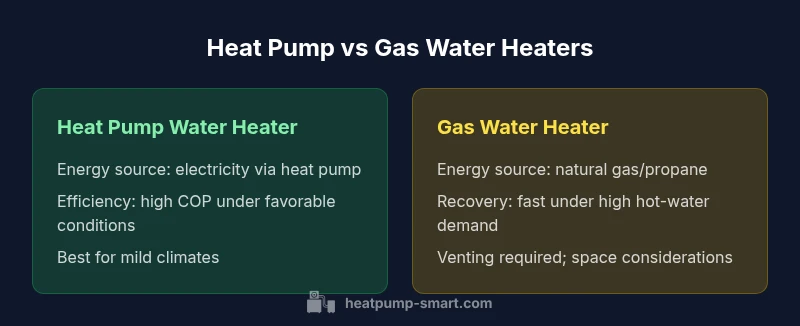
- Energy source: HPWHs run on electricity and move heat from the ambient air; gas heaters burn fuel to generate heat.
- Efficiency: HPWHs are designed for high efficiency under favorable conditions; gas efficiency depends on burner and venting but is often steady during peak demand.
- Space and installation: HPWHs require an electrical supply and proper airflow; gas heaters require venting and gas line connections.
- Climate sensitivity: HPWH performance improves in moderate climates and can decline in very cold environments without supplemental heat; gas heaters are less climate-sensitive but incur fuel costs and emissions.
- Hot-water recovery: Gas heaters can deliver rapid recovery in high-demand situations; HPWHs depend on ambient conditions and may recover at a different pace.
- Long-term value: HPWHs tend to offer lower operating costs in electricity-price environments with mild winters; gas costs vary with fuel prices and regional incentives.
This at-a-glance comparison helps frame deeper analysis in the following sections.
Climate and energy context
Your climate and energy costs shape the economics of water heater technology. In mild or temperate regions, HPWHs frequently achieve meaningful operating savings due to relatively low electricity prices and good heat-transfer performance. In areas with very cold winters or high electricity rates, the COP of an HPWH can drop, reducing savings unless you pair the system with favorable rates or supplemental heating strategies. Conversely, gas water heaters maintain a predictable energy source where natural gas is affordable and reliable, and they can outperform electric systems during periods of high electricity costs. The best decision emerges from a climate-adjusted view that blends annual hot-water use with real-world utility prices and available incentives.
Cost considerations: upfront vs operating costs
Capital costs for HPWHs are typically higher than for many gas models, driven by heat-pump components and advanced controls. Gas heaters often boast lower upfront prices, though fuel costs and maintenance accrue over time. Long-term operating costs tend to favor HPWHs where electricity prices are moderate and hot-water usage is steady, given the high efficiency and reduced emissions. Incentives, rebates, and local energy programs can tilt the economics in favor of HPWHs. Conversely, regions with low gas prices or very high peak water-use may see gas as the more economical option over the first several years. A thorough cost comparison should model both scenarios across a typical 10-year horizon and include possible maintenance costs.
Installation considerations and space requirements
HPWH installation requires a dedicated electrical circuit, proper clearance for airflow, and adequate space to ensure efficient heat exchange and serviceability. In contrast, gas water heaters require venting and a gas line connection, plus adequate clearance around the unit to prevent combustion risks. Location matters: HPWHs should be placed where ambient heat is available but not exposed to freezing, while gas heaters need safe venting paths and ventilation for combustion-byproduct removal. Noise is a practical consideration for HPWHs near living spaces, and venting layout is crucial for gas models to avoid back-drafting and safety concerns. Both types benefit from professional sizing and proper clearances to maximize performance and safety.
Installation and maintenance practicalities: real-world tips
Regardless of the technology, proper sizing is essential for a reliable supply of hot water. A simple rule is to match the unit’s first-hour rating (FHR) or recovery capacity to your peak demand. HPWHs benefit from clean coils and unrestricted airflow; gas heaters benefit from clean vents and intact burners. Regular checks on electrical connections or gas venting components reduce the risk of outages and safety issues. For homeowners, a project plan that includes permit requirements, electrical load assessments, and space planning can prevent delays. Builders should consider the long-term value delivered by HPWHs through better energy efficiency ratings and potential incentives.
Real-world scenarios and decision framework
To translate theory into practice, consider three representative scenarios. A small, energy-conscious home in a mild climate may achieve the best value with an HPWH, thanks to low operating costs and compact footprints. A larger family in a region with high electricity costs and moderate gas prices could still benefit from an HPWH, provided the unit is appropriately sized and located for airflow. In a home with very high hot-water demands or in a cold climate where ambient heat is limited, a gas heater may offer dependable performance with faster recovery, especially when paired with an efficient venting strategy. Use a decision framework that weighs climate, usage patterns, fuel prices, and available incentives to select the most economical option over a 10-year horizon.
Authoritative sources
To support the guidance in this article, refer to credible sources on heat-pump water heaters and gas water heaters:
- https://www.energy.gov/eere/buildings/articles/heat-pump-water-heaters
- https://www.epa.gov/rhc/topics/heat-pump-water-heaters
- https://nrel.gov
Comparison
| Feature | Heat pump water heater | Gas water heater |
|---|---|---|
| Energy source | Electric-powered heat pump using ambient heat | Natural gas or propane with combustion and venting |
| Operating cost emphasis | Typically lower operating costs in mild climates | Fuel costs depend on gas price and usage |
| Installation considerations | Requires electrical circuit and airflow space | Requires venting and gas line/vent clearance |
| Climate sensitivity | Efficiency depends on ambient temperature; great in temperate regions | Less climate-sensitive in terms of fuel availability but affected by gas prices |
| Recovery speed | Good efficiency, may vary with ambient conditions | Typically rapid recovery under high-demand scenarios |
Advantages
- Lower operating costs in many climates
- Very high energy efficiency with broad COP range
- Cleaner operation with no combustion byproducts
- Compact and flexible installation options
- Lower greenhouse gas emissions in many regions
Disadvantages
- Higher upfront cost and installation complexity
- Performance can drop in very cold climates without supplemental strategies
- Requires reliable electricity and airflow; venting is not needed for HPWH
- Noise and space considerations around the unit
Heat pump water heaters win for most homes in 2026, especially in mild climates with moderate electricity prices.
HPWHs offer long-term savings and eco-friendliness when conditions favor efficient electrical operation. Gas water heaters remain a strong option for high hot-water demand or very cold climates and when fuel prices and venting constraints align.
Your Questions Answered
What is the main energy efficiency difference between HPWH and gas water heaters?
HPWHs typically achieve higher energy efficiency in favorable conditions by moving heat rather than generating it. Gas heaters rely on combustion and have different efficiency dynamics tied to burner design and venting. The relative advantage depends on climate, electricity and gas prices, and usage patterns.
Heat pump units usually save more energy where electricity is affordable and conditions are moderate; gas units depend on fuel efficiency and venting design.
Do heat pump water heaters work well in cold climates?
HPWHs perform best in milder climates but can operate in cold environments with reduced efficiency or supplemental heating. Modern models mitigate some cold-climate issues, yet payback may be longer if outdoor conditions are persistently cold.
In cold climates, HPWH efficiency can drop, so evaluate climate and whether supplemental heat makes sense.
Is installation more expensive for HPWH than for gas?
Yes, upfront installation costs for HPWH tend to be higher due to heat-pump hardware and electrical requirements. Gas heaters often cost less to install but may incur ongoing fuel and venting maintenance.
HPWH setups usually cost more upfront but save on operating costs over time.
Can HPWH replace a gas water heater in all homes?
Not in every home. HPWHs are excellent in many scenarios, but very high hot-water demand or extreme cold climates may favor gas. A professional assessment helps determine feasibility and payback.
HPWH can replace gas in many homes, but check your climate and hot-water needs first.
What about safety and venting requirements?
HPWHs require electrical safety and airflow, while gas heaters require venting to remove combustion byproducts. Both need proper installation clearances and periodic maintenance to ensure safe operation.
Gas needs venting; electric heat pumps need proper airflow and electrical wiring.
Are there rebates or incentives for heat-pump water heaters?
Yes, many regions offer rebates or tax incentives for HPWH installations as part of energy-efficiency programs. Check local utility programs and national incentives to understand eligibility.
Look for local rebates; they can significantly improve payback.
Top Takeaways
- Assess climate and electricity costs before choosing
- Factor upfront costs against long-term operating savings
- Plan for proper ventilation and electrical/venting requirements
- Consider incentives and rebates to improve economics
- Select based on hot-water demand and space availability