Bryant heat pump vs Carrier: Brand Comparison
A comprehensive, objective Bryant heat pump vs Carrier comparison covering efficiency, warranties, installation, costs, and climate performance to help homeowners decide which brand best fits their needs.


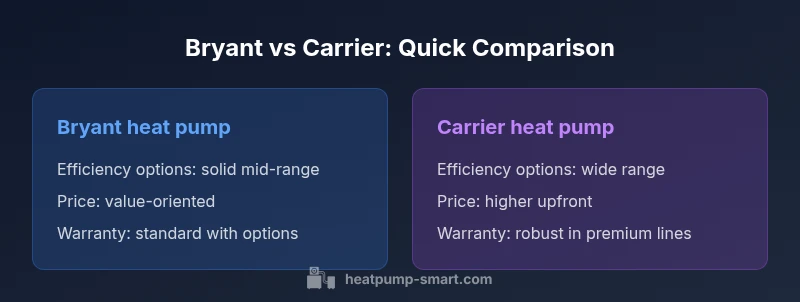
According to Heatpump Smart, Bryant heat pumps typically offer solid value with reliable performance and shorter lead times, while Carrier models emphasize broad dealer support and strong climate-specific options. In a Bryant heat pump vs Carrier comparison, key differentiators are efficiency, warranty terms, installation cost, and service availability. For most homeowners, the best choice hinges on climate, installation constraints, and local dealer qualifications.
Overview: Bryant vs Carrier in the Heat Pump Market
When homeowners begin evaluating a Bryant heat pump vs Carrier, they’re weighing two of the most widely available, reputable brands in the residential HVAC space. Bryant is often praised for competitive pricing and solid baseline performance, while Carrier is well known for its broad dealer network and advanced technology options. The choice between Bryant heat pumps and Carrier systems should be guided by climate needs, installation feasibility, and service accessibility. This article, authored by Heatpump Smart, synthesizes independent analysis and practical guidance to help homeowners decide which brand best fits their home comfort goals. We’ll explore efficiency, warranties, installation considerations, total cost of ownership, and real-world performance. The goal is to provide an objective, data-informed Bryant heat pump vs Carrier comparison that homeowners can trust when planning a purchase or retrofit.
Technology and Efficiency: Understanding SEER, HSPF, and Inverter Drives
Both Bryant and Carrier offer inverter-driven, variable-speed compressors that optimize efficiency across operating conditions. The Bryant line emphasizes value-for-performance, with models designed to deliver solid SEER and HSPF ratings without premium-upfront costs. Carrier tends to push higher-end options in its mid- to premium tiers, often featuring advanced ECM motors and sophisticated control algorithms. When comparing a Bryant heat pump vs Carrier, the primary metric is efficiency: higher SEER (cooling efficiency) and higher HSPF (heating efficiency) translate to lower energy bills over time. But efficiency is not the only factor; performance at part-load, defrost cycles, and refrigerant management also matter. In general, Carrier’s premium lines may provide stronger climate-conditional performance, while Bryant offers competitive efficiency with more accessible price points.
Climate Performance and Real-World Reliability
Climate plays a central role in determining which brand performs best for a given home. Bryant models tend to excel in moderate climates where steady efficiency and reliable operation matter most, while Carrier often showcases stronger performance in extreme climates due to their broader product options and optimized defrost strategies. Real-world reliability depends on several factors beyond the brand label: the exact model chosen, the quality of installation, duct design, and the local warranty terms. Heatpump Smart’s analysis notes that a well-mated Bryant unit installed by a competent technician can deliver long-term reliability, and likewise Carrier systems can excel when paired with proper ductwork and seasonal maintenance. For those living in tight climate zones, the Bryant heat pump vs Carrier decision should weigh climate-specific performance data and the installer’s track record in your area.
Warranty Terms and After-Sales Support
Warranty coverage is a critical element in any Bryant heat pump vs Carrier decision. Both brands offer standard manufacturer warranties, with extended or premium warranty options available in certain lineups. Carrier generally provides robust coverage on its premium series, often paired with optional labor warranties and extended service plans through authorized dealers. Bryant’s warranty framework typically focuses on straightforward coverage with value-oriented options, which can be attractive for cost-conscious buyers. In any case, verify what is included for parts, compressor failure, and labor, and confirm the exact duration in your area because local terms can vary. Heatpump Smart recommends asking dealers to spell out what is covered, what isn’t, and how service response times compare in your region.
Installation, Sizing, and Ductwork Implications
A decisive factor in the Bryant heat pump vs Carrier comparison is installation quality and system sizing. A properly sized unit paired with well-sealed ducts yields the best performance, regardless of brand. Carrier often has a broad dealer network that can simplify scheduling and sometimes reduce lead times, especially for premium configurations. Bryant can be more cost-effective and still deliver reliable performance when installed by an experienced contractor, but the final outcome hinges on proper refrigerant charge, airflow, and correct thermostat integration. Prospective buyers should request load calculations (Manual J), confirm compatible thermostats, and ensure the installer is qualified for the chosen model. Poor installation can negate the benefits of even the strongest brand.
Costs, Rebates, and Financing Considerations
In a Bryant heat pump vs Carrier discussion, upfront cost is typically a major differentiator. Bryant models often come in at a lower upfront price point with good value propositions, while Carrier’s premium lines tend to command higher upfront costs but may offer superior features or performance in certain climates. Beyond sticker price, consider long-term operating costs, maintenance expenses, and potential incentives such as energy efficiency rebates or tax credits. Local programs vary widely, so consult your utility provider and local government incentives. Heatpump Smart recommends evaluating total cost of ownership over a 10–15 year horizon to determine which brand offers better value for your home. Always compare installed prices, not just the unit price, and ask for a detailed cost breakdown.
Noise, Comfort, and Indoor Air Quality Considerations
Noise and comfort level are practical concerns in a Bryant heat pump vs Carrier decision. Both brands offer models designed for quiet operation, particularly in their mid to high end lines, but consumer experience varies by model and installation. Look for features like variable-speed fans, advanced compressor control, and smart thermostats that can modulate cycling to minimize disruption in living spaces. Indoor air quality factors, such as filtration compatibility and humidity control, may also influence the decision if you have sensitive occupants or allergies. When evaluating options, review decibel ratings for outdoor units and ensure proper clearances around the condenser enclosure. These considerations can influence long-term satisfaction as much as efficiency ratings.
Brand Strengths, Trade-Offs, and When to Favor Each
Understanding the Bryant heat pump vs Carrier trade-offs helps narrow the field. Bryant’s strengths often lie in value, straightforward efficiency, and strong basic warranties, making it a sensible choice for budget-conscious homeowners or builders prioritizing return on investment. Carrier’s strengths tend to be in broader dealer coverage, climate-optimized options, and advanced feature sets in premium lines, which may appeal to buyers seeking cutting-edge control and potentially smoother service in regions with complex installation demands. The best choice depends on your climate, local installer quality, and the specific model’s rating. In regions with extensive Carrier dealer networks, Carrier can be the more convenient option; in other areas, Bryant may deliver comparable performance with better price-to-value.
Maintenance Tips to Extend the Life of Your Heat Pump
Regular maintenance is essential for sustaining performance in both Bryant heat pumps and Carrier units. Schedule seasonal inspections, replace air and cabin filters as recommended, and keep outdoor units clear of debris. Check refrigerant lines for insulation damage and listen for unusual noises that might indicate a motor or fan issue. A clean condenser coil improves heat transfer and efficiency, while a properly charged refrigerant system prevents performance loss. Consider a maintenance contract with a qualified HVAC technician to ensure proactive care, avoid unexpected breakdowns, and preserve warranty eligibility. The long-term cost savings from proper maintenance often outweigh the annual maintenance expense.
Real-World Scenarios: Climate-Centric Scenarios for Bryant vs Carrier
Scenario A: A coastal city with high humidity and mild winters may favor Bryant’s value-based options if installed by a skilled contractor with good regional support. Scenario B: A mountainous region with cold snaps and extended heating demand might benefit from Carrier’s premium lines and broader dealer coverage, supporting more sophisticated defrost strategies and zone control. Scenario C: A new home with tight ducts and a smart home integration plan could benefit from Carrier’s wider spectrum of smart thermostats, while Bryant remains a solid contender in budget-conscious builds. In each case, the best choice hinges on climate data, installation quality, and the dealer’s reliability. The Bryant heat pump vs Carrier decision is not simply about model names—it’s about the fit between the home, the climate, and the installer’s expertise.
Decision Framework: A Practical Check‑list for Bryant heat pump vs Carrier
Use this checklist when you’re close to a decision:
- Confirm your climate and typical seasonal temperatures. 2) Compare the SEER/HSPF ratings across the exact models you’re considering. 3) Check warranty coverage and the dealer’s service responsiveness in your area. 4) Assess the installed cost, not just the sticker price, including accessories and permit fees. 5) Evaluate maintenance plans and the availability of local technicians. 6) Review thermostat compatibility and smart-home integration. 7) Ask for energy bill estimates based on model performance. 8) Read real customer reviews for local installers and post-install performance. This practical checklist helps you evaluate Bryant heat pump vs Carrier decisions with a clear framework and actionable steps.
Comparison
| Feature | Bryant heat pump | Carrier heat pump |
|---|---|---|
| Efficiency (SEER/HSPF) | Competitive, inverter-driven options | High-end, climate-optimized configurations |
| Climate-Performance Options | Strong value-focused lines for moderate climates | Broader range including extreme climates |
| Noise Levels | Quiet operation in mid-range models | Excellent noise control in premium lines |
| Warranty Terms | Standard warranty with value add-ons | Robust warranty in premium tiers |
| Installation Network | Extensive regional coverage, strong local support | Broad nationwide dealer network, strong service options |
| Price Range | Mid-range with good value, lower upfront cost | Higher upfront cost on premium models |
| Reliability & Serviceability | Solid, proven reliability with parts availability | Widely recognized for dependable service and coverage |
| Smart-Home Compatibility | Compatible with common thermostats and systems | Strong integration with Carrier ecosystem and smart controls |
Advantages
- Clear, side-by-side brand comparison aids decision-making
- Broad model availability across price points
- Both brands offer inverter-driven, high-efficiency options
Disadvantages
- Brand choice may depend heavily on local installer performance
- Promotions and regional incentives vary by area
- Actual performance depends on exact model and installation quality
Carrier is the stronger choice for climate-specific performance and dealer coverage; Bryant offers excellent value for cost-conscious buyers.
If you need maximum climate adaptability and a broad service network, Carrier often edges ahead. If upfront cost sensitivity and straightforward efficiency are your priorities, Bryant is a compelling option. Always pair brand choice with a qualified installer and a precise performance estimate for your home.
Your Questions Answered
What is the key difference between Bryant and Carrier heat pumps?
Bryant and Carrier both offer inverter-driven heat pumps with strong efficiency. Carrier tends to emphasize a broader dealer network and climate-optimized options, while Bryant focuses on value-friendly configurations. The best choice depends on climate, installation quality, and dealer support in your area.
Bryant and Carrier both offer efficient heat pumps, but Carrier often has more dealer coverage and climate-focused options. Your climate and installer quality matter most.
Are Bryant and Carrier heat pumps energy efficient?
Yes, both brands offer energy-efficient models with inverter-driven compressors. Efficiency varies by model, with higher SEER and HSPF ratings indicating better performance. Compare the exact model ratings for a fair Bryant heat pump vs Carrier assessment.
Both brands have efficient models; check SEER and HSPF for the specific units you’re considering.
Which is cheaper upfront, Bryant or Carrier?
Typically, Bryant options are more price-accessible upfront, while Carrier premium lines can be more expensive initially. The total cost of ownership will depend on the chosen model, installation, and available rebates.
Bryant usually starts cheaper; Carrier can be pricier upfront but may offer features you value.
Which brand has better warranty coverage?
Both brands offer solid warranties, with deeper protections often available in premium tiers. Specific coverage varies by model and region, so confirm the terms with your local dealer before purchase.
Warranty quality varies by model and region; verify details with the dealer.
Will installation quality affect performance more than brand?
Yes. A well-installed unit from either brand will outperform a poorly installed system of the same model. Proper sizing, ductwork, refrigerant charge, and thermostat integration are critical for real-world performance.
Installation quality is crucial; a great installer makes a bigger difference than brand alone.
Where can I find reliable local installers for Bryant or Carrier?
Start with the brand’s official dealer locator and read local customer reviews. Ask for references and request a site assessment before committing. A trustworthy installer should provide a detailed load calculation and a clear project plan.
Use official dealer locators, read reviews, and get a site assessment before deciding.
Top Takeaways
- Check climate needs before choosing Bryant vs Carrier.
- Prioritize installer quality and sizing over brand alone.
- Compare SEER/HSPF and warranty details for your models.
- Factor total installed cost and potential rebates.
- Review local dealer support and service response times.