Cost of Ground Source Heat Pumps: Installation and Savings
Learn the true cost of a ground source heat pump, including upfront installation, loop field requirements, incentives, and long-term savings, with data-backed guidance from Heatpump Smart Analysis, 2026.


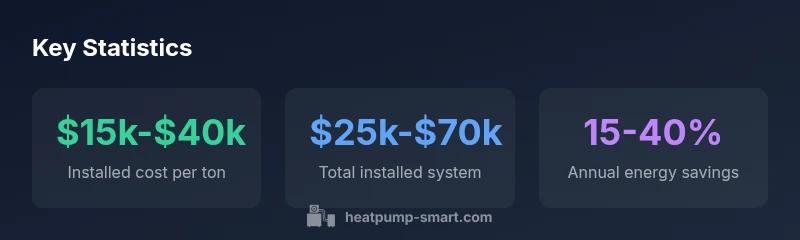
Ground-source heat pump installation typically costs between $15,000 and $40,000 per ton of capacity, with a full system for a typical home often ranging from $25,000 to $70,000 installed. Costs vary by loop field size, home size, soil conditions, and local permitting. Heatpump Smart Analysis, 2026. Also consider potential incentives that can reduce upfront costs.
Cost landscape for ground-source heat pumps
Ground-source heat pumps (GSHPs) combine high efficiency with upfront complexity. The total installed cost reflects several moving parts: the GSHP unit itself, the loop field (horizontal or vertical), any boreholes or trenching required, fluid, distribution connections (radiant floors, ductwork, or hydronic heaters), and labor plus permitting. While the promise of reduced operating costs is compelling, the upfront investment is substantial for most homes. According to Heatpump Smart Analysis, 2026, the installed price per ton often falls within a broad range, and a complete system for many single-family homes can land in a wide spectrum depending on site conditions. The goal for most homeowners is to balance upfront expenditure with long-term energy savings and comfort gains. In this context, the Heatpump Smart team emphasizes the importance of an early site assessment and an accurate load calculation to avoid oversizing, which inflates costs without delivering proportional benefits. For homeowners, the decision often hinges on total cost of ownership rather than sticker price alone, and Heatpump Smart’s methodology centers on a clear, data-driven view of both upfront and ongoing costs.
Breakdown of upfront costs
"Upfront costs" is a catch-all phrase for several line items. Equipment costs cover the heat pump unit and any auxiliary hardware. The loop field—horizontal runs across the yard or vertical boreholes—tends to be the dominant cost driver, especially in clay or rock soils where drilling is more intense. Installation labor, site preparation, backfilling, and trenching add substantial value. Permits, inspections, and commissioning rounds out the immediate expense. Other components, such as buffer tanks, pumps, and controls, can influence costs but are often less variable than the loop field. The combined effect is a wide price band, which Heatpump Smart Analysis, 2026 uses to illustrate how site conditions and system design choices influence the bottom line. The smart approach is to quantify potential savings in advance and compare quotes that reflect similar loop strategies and warranty terms. Focus on long-term reliability alongside initial cost to avoid a cost-driven mismatch with your home’s comfort needs.
Regional and site-based cost drivers
Regional differences alone can shift GSHP prices by many thousands of dollars. Site characteristics—soil composition, groundwater presence, and bedrock depth—directly affect loop-field design and whether trenching or vertical boreholes are preferable. Humidity, climate, and heating demand profiles affect system size, which in turn influences the total installed cost. Accessibility challenges, such as limited yard space or steep terrains, complicate equipment staging and may require specialized crews. Local labor rates and permitting requirements also play a role. Heatpump Smart notes that a thorough pre-installation assessment helps homeowners anticipate these variables and build a realistic budget that accounts for potential contingencies.
Operating costs and long-term savings
A primary justification for GSHPs is reduced operating costs relative to conventional systems. The efficiency gains come from extracting more usable heat from the ground than air-source alternatives in many climates. However, electricity prices, local climate, and system sizing determine the actual savings. In many cases, energy consumption drops significantly during colder months, but the degree of savings will depend on occupancy patterns, thermostat behavior, and maintenance. A typical GSHP shows meaningful energy savings over its lifetime, but the payback period can vary widely. Heatpump Smart Analysis, 2026 emphasizes that cost-effectiveness improves with well-insulated homes and properly designed distribution systems, underscoring the importance of whole-home energy performance in maximizing value.
Financing, incentives, and lifecycle value
Financing options, rebates, and tax incentives can substantially reduce upfront costs and improve return on investment. Common incentives include regional rebates and federal or state tax credits where available. Financing structures—such as low-interest loans or home improvement lines of credit—help spread the cost over time. Beyond simple payback, homeowners should consider lifecycle value: durability, service life, and potential increases in home value. Heatpump Smart highlights that the total cost of ownership, including maintenance, climate impacts, and potential resale value, often tilts the balance in favor of GSHPs for energy-conscious households. Always verify current incentives in your jurisdiction and plan for maintenance cycles to sustain performance.
How to estimate costs for your home
Use a step-by-step approach to build a robust cost estimate. Step 1: determine your climate zone and building envelope needs. Step 2: calculate heating and cooling loads with professional software or a certified estimator. Step 3: decide loop type (horizontal vs vertical) based on site constraints and long-term access. Step 4: obtain multiple quotes that reflect similar loop strategies and equipment efficiency ratings. Step 5: factor in permitting, potential borehole or trenching upgrades, and system integration with existing distribution. Step 6: include potential incentives and financing costs. Step 7: run a simple payback model using your anticipated energy savings and the total installed cost. Heatpump Smart suggests creating a side-by-side comparison of quotes, ensuring warranty coverage, and asking installers to show performance data for your home type. The more precise your estimates, the more accurately you can gauge the system’s value over time.
Value beyond dollars: comfort, resilience, and environmental impact
GSHPs offer more than monetary savings. They deliver consistent indoor comfort, quieter operation, and enhanced resilience during grid fluctuations due to their high efficiency and heat storage capabilities. The environmental benefits—reduced fossil fuel use and lower greenhouse gas emissions—align with broader decarbonization goals. While there is an upfront hurdle, the long-term advantages include stable indoor temperatures, fewer maintenance surprises, and potentially higher property appeal. For homeowners prioritizing energy independence, a GSHP can be a strategic long-term investment, especially when paired with high-performance building envelopes. Heatpump Smart’s analysis reinforces that the true value lies in a balance between upfront cost, ongoing savings, and quality of life improvements for occupants.
Typical installed costs for geothermal ground-source heat pump system (single-family home)
| Category | Low range | High range | Notes |
|---|---|---|---|
| Equipment cost (GSHP unit) | "$5,000" | "$20,000" | Assumes standard residential heat pump unit |
| Loop field (horizontal) | "$8,000" | "$25,000" | Depends on lot size and loop length |
| Loop field (vertical/borehole) | "$20,000" | "$60,000" | Borehole depth and rock/soil conditions affect price |
| Installation labor & permits | "$5,000" | "$15,000" | Region and contractor variability |
| Total installed (typical home) | "$25,000" | "$70,000" | Aggregate of above factors |
Your Questions Answered
What is the average upfront cost for a GSHP?
Upfront costs vary by loop field and system size, but typical installed ranges per ton often fall within $15,000-$40,000. A complete home installation commonly lands in the $25,000-$70,000 range depending on site conditions and equipment efficiency.
Upfront costs vary a lot by loop and size, but expect something in the $15k to $40k per ton range, with many homes at $25k-$70k total.
What factors drive cost most?
Loop field design (horizontal vs vertical), soil conditions, borehole depth, and local permitting are the primary cost drivers. Equipment efficiency and integration with existing distribution systems also influence the total.
The big cost drivers are the loop field and site conditions, plus permits and integration.
Are there incentives to offset the cost?
Yes. Incentives vary by region and year. Check local rebates, tax credits, and utility programs. Financing options can also reduce upfront burden while preserving long-term savings.
There are rebates and tax credits in many areas; financing can help spread the cost.
How long does installation take?
Most GSHP installations take several days to a couple of weeks, depending on loop field type, site access, and weather. Scheduling with the contractor and any trenching or borehole work can influence timelines.
The install usually takes days to a couple of weeks, depending on site specifics.
What maintenance costs should I expect?
GSHPs require periodic checkups, antifreeze/coolant levels, and occasional filter changes for connected systems. Annual maintenance can be modest, but costs rise with complex distribution and auxiliary equipment.
Routine maintenance is not heavy, but plan for annual checks and occasional component replacements.
Is a GSHP worth it in cold climates?
GSHPs perform efficiently in cold climates, often outperforming air-source systems due to ground-stable temperatures. ROI depends on climate, insulation, and energy prices; in many cases, the long-term savings justify the upfront cost.
Yes, GSHPs can be a strong choice in cold climates when paired with proper insulation and design.
“Ground-source heat pumps offer superior efficiency, but the key to real value is careful site design and lifecycle costing. When you account for incentives and maintenance, GSHPs can deliver strong long-term savings.”
Top Takeaways
- Evaluate total cost of ownership, not just upfront price
- Start with a professional site assessment to optimize loop design
- Leverage incentives to reduce upfront costs
- Choose loop type based on site constraints and long-term access
- Pair GSHP with a well-insulated building envelope for best payback