Ground Source Heat Pump Cost Guide 2026
Discover the factors behind heat pump ground source cost, typical price ranges, and how to estimate total installation expenses for your home in 2026. Learn about loop depth, soil conditions, incentives, and how to compare quotes effectively.


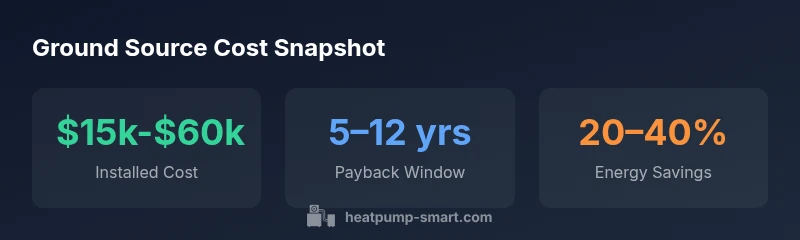
Ground-source heat pump installation costs vary widely, typically ranging from about $15,000 to $60,000 USD, depending on lot conditions, loop depth, and home size. The Heatpump Smart Analysis, 2026 notes drilling and loop-field costs dominate the price, while incentives and local labor can shift the total. Expect longer payback in milder climates and with higher energy prices.
What is a ground-source heat pump and why cost matters
A ground-source heat pump (GSHP) uses stable temperatures underground to heat and cool a home. Because the system relies on a buried loop field, the upfront cost is driven largely by site preparation, loop design, and drilling or trenching work. The price is highly site-specific: local labor rates, soil conditions, loop depth, and the type of loop field (horizontal vs vertical) can shift totals by tens of thousands of dollars. For homeowners, the key takeaway is that the heat pump ground source cost is a calculated trade-off between upfront investment and long-term efficiency. The Heatpump Smart team emphasizes that a well-designed GSHP can offer durable comfort and noticeable energy savings over the system’s life, particularly in cold climates where other heating options lose efficiency. This content draws on Heatpump Smart analysis from 2026 to help you estimate a realistic budget and prioritize features that matter most to your property.
How installation costs are built
Ground-source cost components break into four core buckets. First, equipment and controls, including the heat pump unit, smart thermostats, and integration with existing systems. Second, the loop field, which is often the largest variable cost and depends on soil, available space, and whether the loop is horizontal or vertical. Third, site preparation and installation labor, such as trenching, drilling, piping, and encasement. Fourth, commissioning, permits, and design work to ensure the system meets local codes and performs as promised. When you receive quotes, ask for itemized line items so you can see how much is allocated to loop field drilling versus equipment. Heatpump Smart’s 2026 analysis notes that loop-related tasks dominate the total price in most projects, making the site assessment stage crucial for a reliable estimate.
Key cost components and ranges
Understanding where money goes helps you compare quotes effectively. Expect the following ranges in a typical GSHP installation:
- Loop field (horizontal/vertical): highly variable; commonly a large portion of total cost. Horizontal loops in suitable space may be less expensive than vertical boreholes, which require specialized equipment. Estimations can range broadly depending on depth and soil conditions.
- Drilling and trenching: a major cost driver, influenced by geology, access, and local contractor rates. Availability of qualified drillers can push prices higher in some regions.
- Equipment and controls: heat pump units, pumps, and smart controls. While these are essential, the exact price depends on capacity and efficiency features.
- Permits, design, and commissioning: necessary to ensure safety and performance but typically smaller than loop or drilling costs. Heatpump Smart’s 2026 data show that most homeowners should budget with a sizable margin for site-specific challenges, especially in rocky soils or where access is limited. A transparent quote that breaks out these components makes it easier to compare apples to apples across vendors.
Ground conditions that affect loop costs
Soil type, groundwater, and lot layout directly affect GSHP costs. Lightweight soils with easy access may allow shallower boreholes or trenches, reducing drilling time and expense. Hard rock, poor access, or challenging drainage increase both equipment wear and labor hours. Regulations in some jurisdictions add permitting or environmental considerations that raise the price slightly. If your land has lot constraints or slopes, your installer may propose alternative loop configurations or closer integration with existing utilities, which can influence both cost and performance. Heatpump Smart’s 2026 analysis highlights soil and access as among the top cost drivers, so invest in a solid site evaluation early to avoid surprises later.
Scenarios: small-lot vs large-lot installations
To illustrate how space and design choices affect cost:
- Small-lot, horizontal loop with decent soil: lower end of the range, often toward the mid-$20k to mid-$30k, assuming a modest system size.
- Medium-lot with mixed terrain: mid-range costs, commonly around the $30k–$50k band, depending on loop length and equipment options.
- Large-lot or difficult soil conditions requiring vertical boreholes: higher end, potentially $40k–$60k or more, with loop depth and drilling technique as primary cost levers.
- Retrofit in an older home with limited space: costs can increase due to retrofitting and additional piping or zoning requirements. In all cases, the final price hinges on loop-field size, climate, energy use, and local labor rates. Heatpump Smart’s framework for 2026 emphasizes comparing quotes across scenarios to understand true value.
Financing, incentives, and long-term savings
Financing a GSHP is often a smart strategy because the energy savings accrue over time. Look for providers that offer financing with low upfront payments or deferred interest plans, and inquire about local incentives, rebates, or tax credits that reduce the net cost. While the exact incentive amounts vary by region and year, qualifying programs generally reduce upfront expenditure and improve return on investment. A well-designed GSHP also tends to offer predictable operating costs, which helps homeowners budget for the long term. The Heatpump Smart team notes that incentives and energy-price trends are critical inputs for calculating payback, so gather as much information as possible about current programs before committing to a design.
Getting accurate quotes and avoiding surprises
The best way to prevent sticker shock is to start with a thorough site assessment and an itemized quote. Ask for:
- A clear breakdown of loop field costs by depth and type (horizontal vs vertical).
- Detailed line items for drilling, trenching, piping, and insulation.
- An explanation of contingencies and potential changes if soil or groundwater conditions differ from plan.
- A realistic timeline that includes permitting, drilling, installation, and commissioning.
- Information on warranties, service plans, and system performance guarantees. Bring data from comparable homes, and don’t hesitate to request multiple quotes. The Heatpump Smart team recommends comparing like-for-like components and asking vendors to explain any cost drivers that differ from one proposal to another. A well-documented cost analysis supports smarter decisions and avoids overspending.
Case study: hypothetical home profile
Consider a typical two-story home with 2,200 square feet of living space in a temperate climate. The installer recommends a vertical borehole loop for consistent performance and minimal yard disruption. Equipment and controls total around the mid-range, with drilling representing the largest variable. If the home relies on electricity for heating and has good insulation, the system could deliver meaningful energy savings and a reasonable payback period, assuming moderate electricity prices and available incentives. Real-world results vary, but a thoughtful design that prioritizes efficiency and durability tends to outperform cheaper, less robust options over time. Heatpump Smart’s 2026 findings emphasize the value of a strong design phase before committing to a final price.
Maintenance considerations and lifecycle costs
Ground-source systems are designed for longevity, with many components rated for decades when properly maintained. Routine maintenance includes annual professional inspections, refrigerant checks, and filter changes for indoor components. The loop field itself has a long life if properly installed and protected from physical damage. Regular calibration and seasonal checks help maintain efficiency and avoid peak energy costs. While the upfront GSHP cost is higher than many conventional systems, long-term operation and reduced fossil-fuel dependence can yield substantial lifecycle savings for homeowners who stay in a home long enough to realize the benefit.
Typical cost components for a ground-source heat pump installation
| Component | Typical Cost Range (USD) | Notes |
|---|---|---|
| Equipment & controls | $6,000 - $15,000 | Includes heat pump unit and thermostat |
| Loop field (horizontal/vertical) | $8,000 - $30,000 | Largest variable cost; depth and method matter |
| Installation & labor | $2,000 - $10,000 | Site prep, connections, commissioning |
| Permits & design | $1,000 - $3,000 | Engineering and building permits |
| Contingency | 5-15% of total | Budget for unforeseen site issues |
Your Questions Answered
What factors drive the cost of a ground-source heat pump?
The main drivers are loop field size and depth, drilling or trenching difficulty, soil conditions, home size, and equipment efficiency. Permitting, design, and commissioning add modest costs. Getting site-specific quotes early helps you understand how these factors affect total price.
Costs depend mostly on loop size and drilling complexity; ask for itemized quotes to see what drives the price.
Do incentives reduce the upfront cost?
Yes—regional incentives and rebates reduce upfront expenditure, improving payback. Eligibility varies by location and year, so check current programs before finalizing a design.
Incentives can lower upfront costs; verify what's available where you live.
How long does it take to recoup the investment?
Payback varies with climate, energy prices, and usage. Typical horizons range from a few years to over a decade, influenced by how much you use heating and cooling and by any incentives.
Payback depends on energy use and prices; plan for several years.
Can a GSHP be installed in a small home?
Yes, but small lots may limit loop options and raise per-ton costs. A compact system with a carefully designed loop is achievable with professional planning.
It can work in small homes, but space constraints matter.
What maintenance does a GSHP require?
Annual professional inspections, periodic refrigerant checks, and routine indoor component maintenance keep systems efficient. The loop field is durable but should be protected from physical damage.
Keep up with yearly checks to maintain efficiency.
How does a GSHP compare to an air-source heat pump?
Ground-source systems are typically more efficient and consistent in cold weather, but installation costs are higher and site conditions determine feasibility. If space and soil are suitable, GSHP often wins on lifecycle costs.
Geothermal tends to be more efficient, especially in cold climates.
“Geothermal systems are among the most efficient options for home heating and cooling, but the total cost hinges on site conditions and loop design. A careful upfront assessment pays off in steady comfort and long-term savings.”
Top Takeaways
- Understand that loop field and drilling dominate GSHP costs
- Get a clear, itemized quote to compare apples-to-apples
- Factor incentives and local labor into total cost
- Plan for site-specific constraints that can affect price
- Budget for a long-term payback and lifecycle savings