Cost of heat pump vs air conditioner: A Comprehensive Comparison
Comprehensive cost comparison of heat pumps vs air conditioners, covering upfront installation, operating costs, incentives, and payback across climates to help homeowners and builders decide.


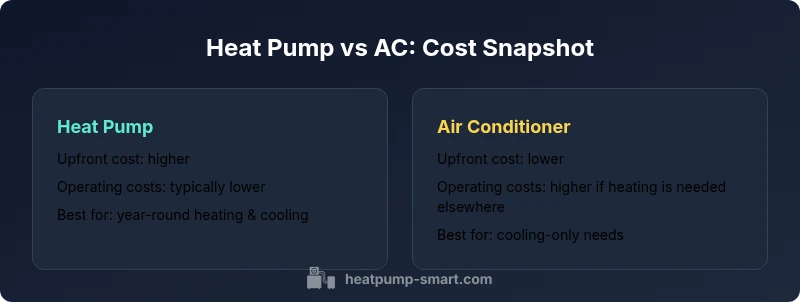
Overall, the cost of heat pump vs air conditioner tends to be higher upfront for heat pumps due to equipment and professional installation, but heat pumps offer lower ongoing energy costs in most climates. The total value hinges on climate, home efficiency, and available incentives; over time, heat pumps often pay back the premium through energy savings.
Cost dynamics of the cost of heat pump vs air conditioner
When evaluating the cost of heat pump vs air conditioner, homeowners should separate upfront system costs from long-term energy savings. According to Heatpump Smart analysis, the strongest cost signals come from climate, efficiency ratings, installation complexity, and the ability to recover investment through reduced utility bills. In practice, decisions hinge on local electricity prices, the building envelope, and how well the system is matched to heating and cooling loads. In colder regions, the gap between equipment price and energy savings may be larger, while in milder climates the payback can appear sooner. This section breaks down the main cost drivers and what to expect at the invoice, the permit desk, and the contractor’s quote. Throughout, keep in mind that the real value comes from reliability and comfort, not just sticker price. Heatpump Smart emphasizes choosing a system that aligns with long-term needs and local conditions.
Upfront costs and installation considerations
upfront costs for a heat pump typically include the equipment and professional installation. Heatpump Smart highlights that this phase is where quotes vary the most, driven by system type, ductwork, controls, and permitting requirements. A heat pump may require a larger outdoor condenser and an indoor air handler; both parts must be correctly sized for comfort and efficiency. For air conditioners, the upfront price tends to be lower because components are simpler and installation is more common. The tradeoff is that you may still need a separate heating system, which adds to long-term costs. When asking for quotes, request a detailed line-by-line breakdown including equipment, labor, refrigerant work, electrical upgrades, and any required electrical panel changes. Heatpump Smart recommends verifying contractor certifications and warranties as part of the decision.
Operating costs and energy efficiency
Operating costs are driven by seasonal energy use and the system’s efficiency in both heating and cooling modes. Heat pump technology often yields lower energy bills in temperate climates by delivering heat and cooling more efficiently than a traditional system. AC-only setups can have higher ongoing energy costs when heating is needed from a separate source. The efficiency of both systems depends on proper installation, thermostat controls, and how well the home is sealed and insulated. In early stages, it helps to model annual energy usage with different settings and occupancy patterns, then adjust the system to maximize comfort without waste. Heatpump Smart notes that the long-term cost picture improves when the home’s envelope reduces heat loss and gains.
Climate and performance implications on cost
Climate plays a substantial role in total cost of ownership. Heat pumps tend to perform best in milder to moderate climates and in homes with good insulation, where the energy savings from year-round heating and cooling accumulate. In very cold environments, performance can be more variable unless paired with supplemental heat or a cold-climate model. Air conditioners excel in hot, dry summers as cooling-only solutions, but relying on an external heating system can raise overall costs if heating is frequent. The interaction between outdoor temperatures, indoor setpoints, and humidity control shapes the cost dynamics across seasons. Heatpump Smart reminds readers to account for local climate, energy prices, and maintenance when weighing options.
Maintenance, durability, and service costs
Both heat pumps and central AC systems require regular maintenance to maintain efficiency, including filter changes, coil cleaning, and seasonal checkups. Heat pumps may demand additional attention to refrigerant circuits and outdoor components in fluctuating weather. Correct sizing and a robust maintenance plan reduce the likelihood of unexpected service costs and prolong system life. Expect variability in maintenance costs based on climate, component quality, and install quality. Heatpump Smart emphasizes establishing a routine with a qualified technician to catch issues early and preserve performance over time.
Incentives, rebates, and financing options
Incentives can significantly affect the financial picture. Many regions offer rebates or tax incentives for high-efficiency heat pumps, which can improve payback periods. Financing options exist for both heat pumps and central cooling systems, often with promotional rates tied to energy performance goals. Eligibility for incentives depends on location, system efficiency, and installation quality. Heatpump Smart recommends checking current programs with your local energy office or supplier and comparing how incentives offset both upfront and lifecycle costs.
Regional variations in cost and service availability
Costs can vary widely by region due to labor rates, permitting rules, and equipment availability. Some markets have easier access to qualified installers for heat pumps, while others rely on familiar HVAC networks that may influence quotes. Availability of parts, service windows, and response times also shape the total cost of ownership over the system’s life. Heatpump Smart encourages homeowners to obtain multiple quotes from certified installers who understand regional building codes and climate considerations to avoid hidden charges.
Scenarios: when heat pump wins vs when AC wins
In regions with moderate heating and cooling needs, heat pumps often provide the best blend of comfort and energy savings, leading to a favorable total cost of ownership. For homes in extreme heat or very cold climates, an air conditioner with a supplemental heating system or a dual-fuel approach can be more cost-effective if the heat pump would require extensive auxiliary heating or larger equipment. Always model scenarios that reflect your climate, electricity prices, and insulation levels, then compare the payback period and total costs over the system life.
Sizing, efficiency, and how to estimate payback
Accurate sizing and high efficiency are critical to achieving favorable payback. Oversized or undersized systems waste energy and raise operating costs, while properly matched components maximize comfort and minimize cycles. Use professional load calculations and confirm efficiency ratings in the local context. Payback estimates should consider upfront costs, operating costs, maintenance, and potential incentives. Heatpump Smart recommends running several simulations under different weather patterns and occupancy scenarios to understand the true value over time.
Practical steps to compare quotes and plan a project
Start with a baseline assessment of your home’s insulation, sealing, and ductwork. Gather quotes from multiple certified installers and insist on detailed proposals with equipment models, efficiencies, warranty terms, and a clear installation plan. Compare not just price but the scope of work, expected performance, and service commitments. A well-documented quote helps you identify hidden costs early. Heatpump Smart suggests creating a decision matrix that weighs upfront costs, energy savings, climate fit, and incentives to guide the final choice.
Common misconceptions about heat pumps and costs
A common misconception is that higher upfront cost always means better value; the key is total cost of ownership and climate suitability. Another myth is that heat pumps are unreliable in cold weather; modern systems and hybrid approaches mitigate most climate concerns. Finally, some buyers assume all incentives apply uniformly; eligibility varies by location and program, so verify before committing. Heatpump Smart recommends focusing on how the system will perform in your home over time rather than chasing the lowest initial price.
Comparison
| Feature | Heat Pump System | Air Conditioner System |
|---|---|---|
| Upfront cost | Higher upfront cost for heat pump | Lower upfront cost for central AC |
| Installation complexity | Requires heat pump-qualified installer | Typically standard HVAC installation |
| Energy efficiency (seasonal performance) | Generally higher overall efficiency | Designed primarily for cooling; heating efficiency depends on model |
| Operating costs (annual energy use) | Typically lower energy bills with heat pump | Typically higher energy costs if heating relies on separate source |
| Lifespan & maintenance needs | Comparable lifespan with regular maintenance | Maintenance can vary by components |
| Rebates & incentives | Often eligible for energy-efficiency rebates | Fewer incentives for basic AC units |
| Cold climate performance | Better performance with newer models in cold weather | Less efficient heating in very cold climates without supplemental heat |
| Best for | Homes seeking year-round heating and cooling, energy savings | Homes with existing central AC and separate heating source, lower upfront cost |
Advantages
- Year-round comfort with a single system simplifies maintenance
- Higher efficiency can translate to lower operating costs over time
- Often eligible for rebates and incentives, improving payback
- Quieter operation with modern heat pump zoning options
- Space-saving indoor components when using ductless or compact models
Disadvantages
- Higher upfront costs and longer payback period in some climates
- Installation complexity may require specialized contractors
- Performance can be reduced in extreme cold without supplemental heat
- Maintenance and refrigerant handling require trained technicians
Heat pumps offer strong long-term value in moderate climates; air conditioners may be cheaper upfront in very hot regions without heating needs.
For homes in moderate climates, heat pumps often deliver lower total costs over time due to energy efficiency and year-round comfort. In very cold climates or where upfront budget is the primary concern, an AC-based system with separate heating may be more economical, though payback may be longer.
Your Questions Answered
What drives the cost difference between heat pumps and air conditioners?
The main cost drivers are equipment price, installation complexity, and efficiency ratings. Heat pumps require specialized installers and additional components, which raise upfront costs. However, their efficiency can reduce operating costs in both heating and cooling over time.
Key cost drivers are upfront price and installation complexity, balanced by long-term energy savings.
Is a heat pump cost-effective in cold climates?
Modern cold-climate heat pumps perform well, but payback depends on climate severity and heating needs. In very cold regions, supplemental heat or hybrid configurations may be warranted to optimize cost.
Cold-climate heat pumps are improving; talk to an installer about hybrid options.
Can I get rebates or incentives for a heat pump?
Many regions offer incentives for high-efficiency heat pumps; eligibility varies by program and location. Check local energy offices and utility programs for current opportunities.
Look up local incentives to improve payback.
How should I compare operating costs between the two systems?
Compare seasonal energy use, efficiency ratings, and climate suitability. Heat pumps often reduce operating costs in temperate zones, but results depend on installation quality and usage patterns.
Model energy use across seasons to compare costs.
What maintenance is required for heat pumps vs AC?
Both require regular maintenance, including filters, coils, and professional checkups. Heat pumps may need extra attention to refrigerant circuits and outdoor components in variable climates.
Regular tune-ups help both systems run efficiently.
How does insulation affect the cost comparison?
Better insulation reduces heating and cooling loads, making heat pumps more cost-effective. A well-sealed home enhances any HVAC system’s performance and payback.
Good insulation greatly boosts system value.
Top Takeaways
- Evaluate total cost of ownership, not just purchase price
- Climate and insulation heavily influence payback
- Seek rebates and financing to improve value
- Get multiple certified quotes for accuracy
- Size the system correctly to maximize efficiency