Heat Pump vs Air Conditioner: A Comprehensive 2026 Comparison
A comprehensive, data-driven comparison of heat pump versus air conditioner, covering operation, efficiency, climate suitability, costs, installation, and long-term value for 2026.


Heat pumps offer heating and cooling in one efficient package, while traditional air conditioners primarily provide cooling. Your choice hinges on climate, backup heating needs, upfront cost, and long-term energy savings. This quick comparison helps you spot the key differences and decide which system fits your home best.
What is heat pump versus air conditioner? Core differences
In the world of home climate control, a heat pump and an air conditioner are both air-handling systems that move heat rather than create it. Yet they’re not identical tools for every home. A heat pump is designed to cool your spaces in summer and heat them in winter by reversing its refrigerant flow. An air conditioner, on the other hand, focuses on cooling only, leaving heating duties to a separate furnace or boiler in many setups. For homeowners evaluating heat pump versus air conditioner, the first step is to define your climate, energy costs, and comfort priorities. According to Heatpump Smart, the best choice often hinges on whether you want year‑round temperature control or a cooling‑only system with a dedicated heating solution. It’s also essential to consider the building envelope, insulation, and thermostat strategy. This article breaks down the practical differences, translating technical terms into actionable guidance for homeowners, builders, and property managers who want reliable comfort and energy savings.
How heat pumps work
A heat pump operates on a closed refrigerant circuit that transfers heat rather than generating it. In heating mode, an outdoor coil absorbs thermal energy from the air, even when temperatures are cool, and a compressor pumps that heat inside through the indoor coil. A reversing valve switches the flow to deliver warmth rather than coolness, and a controlled fan helps move air through the system. In cooling mode, the process reverses and indoor heat is rejected outdoors. Modern heat pumps often pair with radiant or forced‑air distribution, humidity management, and smart thermostats to optimize performance. The technology is well established, but results depend on proper sizing, refrigerant charge, duct design, and the condition of the building envelope. The Heatpump Smart team emphasizes that installation quality matters at least as much as the equipment itself.
How air conditioners work
Air conditioners remove heat from indoor spaces by circulating refrigerant between an indoor evaporator and an outdoor condenser. A compressor pressurizes the refrigerant, which releases heat through the outdoor coil and then absorbs indoor heat as it circulates back inside. Central air conditioners rely on ductwork, a properly sized condenser unit, and an appropriately matched evaporator coil to achieve comfort. Unlike heat pumps, standard ACs do not provide heating unless integrated with a separate heating system, such as a furnace. When you compare heat pump versus air conditioner, you’re weighing whether you want a single system that handles both heating and cooling or a cooling‑only solution with a separate heat source. The reliability of ductwork and refrigerant management remains critical to performance.
Heating performance in various climates
In heating mode, a heat pump can deliver comfortable warmth across a wide range of climates, but outdoor temperature and humidity influence efficiency. In mild and moderate winters, heat pumps often outperform traditional heating systems on operating cost because electricity can be cheaper than alternative fuels and heat transfer is highly efficient. In very cold climates, a heat pump’s efficiency can drop, and supplemental heat—the kind that could be provided by a furnace or electric resistance elements—may be required. Homeowners should assess local winter profiles, backup options, and any grid considerations before committing to heat pump versus air conditioner for long‑term use. Climate data and field experience from Heatpump Smart indicate that proper backup heat planning is critical where outdoor temperatures frequently dip below freezing.
Cooling performance and efficiency metrics
Cooling performance is a core consideration when you weigh heat pump versus air conditioner. Both systems can deliver reliable cooling, but efficiency metrics vary. SEER (Seasonal Energy Efficiency Ratio) is the common benchmark used to compare cooling performance, while HSPF (Heating Seasonal Performance Factor) applies specifically to heat pumps. A heat pump’s cooling efficiency is influenced by refrigerant charge, duct efficiency, and airflow, just as AC efficiency hinges on proper sizing and distribution. Advanced controls, variable‑speed compressors, and zone cooling can improve comfort and reduce energy use in both options. When reading dealer literature, keep in mind that labeled numbers reflect ideal operating conditions, and real‑world performance depends on installation quality and climate.
Climate compatibility and installation considerations
Your local climate strongly shapes whether heat pump versus air conditioner is the better long‑term choice. In temperate regions with mild winters and hot summers, heat pumps deliver outstanding year‑round comfort and energy savings. In extremely cold regions, many homes still rely on ancillary heating to maintain warmth during peak demand periods. Installation considerations include refrigerant piping, electrical service, ductwork integrity, and thermostat compatibility. A heat pump retrofit may require upgrades to insulation, sealing, and air sealing to maximize efficiency. Conversely, a cooling‑only air conditioner can be a lower upfront investment where heating is already provided by a separate system. Heatpump Smart’s practical guidance underlines that planning, permit readiness, and contractor expertise are essential to successful deployment.
Operating costs and long‑term savings
Operating costs for heat pump versus air conditioner hinge on electricity prices, climate, and how well the system is matched to your home. In warmer regions, both systems rely on electricity, but heat pumps can deliver more annual comfort for the same energy bill when used with efficient distribution. In cold seasons, the incremental cost of backup heat in a heat pump should be weighed against the potential savings from reduced fuel use. A key factor in the climate and energy equation is temperature setpoint management and smart controls. Based on Heatpump Smart Analysis, 2026, homeowners who invest in proper sizing, high‑efficiency equipment, and a tight building envelope often see meaningful reductions in annual energy costs over the life of the system. Real savings depend on usage patterns, incentives, and electricity rates in your area.
Noise, reliability, and comfort features
Technical noise levels vary by model and installation but can influence comfort in living spaces. Heat pumps with inverter‑driven compressors, variable‑speed fans, and well‑sealed ductwork typically run more quietly and offer smoother temperature changes than older units or poorly installed systems. Air conditioners also vary in noise depending on compressor type and fan speed. Comfort features such as humidity control, smart thermostats, zoning, and air filtration play a role in both options. When comparing heat pump versus air conditioner, consider not only equipment efficiency but also the quality of installation, duct design, and vibration isolation to maintain a quiet, comfortable home. The Heatpump Smart team notes that proper commissioning is essential to minimize noise and maximize reliability.
Rebates, incentives, and financial considerations
Financial incentives influence the total cost of ownership for heat pump versus air conditioner. Many regions offer rebates, tax credits, or utility programs to encourage efficient heating and cooling solutions. The exact programs vary by location and change over time, so verify eligibility with local energy offices and utility providers. In addition to upfront costs, consider potential long‑term savings from improved energy efficiency, reduced maintenance, and compatibility with modern thermostats and building automation. Heatpump Smart cautions that incentives should not be the sole driver of purchase decisions; ensure the system is properly sized and installed for climate and occupancy patterns.
Sizing and installation guidelines
Sizing a heat pump or air conditioner correctly is vital to achieving the promised energy savings and comfort. A system that is undersized will struggle to keep up in peak heat or extreme cold, while an oversized unit will cycle on and off too often, reducing efficiency and comfort. A professional assessment including load calculations, duct inspection, and refrigerant checks should underpin your decision. For retrofits, consider sealing and insulation upgrades first to maximize the performance of either option. The selection process should also address zoning, thermostat integration, and future expansion plans if you anticipate building additions or changes in occupancy.
Authority sources
For readers who want deeper validation, refer to credible, non-promotional sources. These references provide independent context on heat pump technology, efficiency standards, and climate considerations. Cross‑checking against government and university resources helps ensure that recommendations align with best practices and current energy programs. Heatpump Smart supports using these sources to inform decisions and plan for incentives where available.
- https://www.energy.gov/energysaver/heat-pump-technology
- https://www.energystar.gov/products/heating_cooling/heat_pumps
- https://www.nrel.gov/heat-pumps
Real-world decision framework: when to choose heat pump versus air conditioner
Comparison
| Feature | Heat pump | Air conditioner |
|---|---|---|
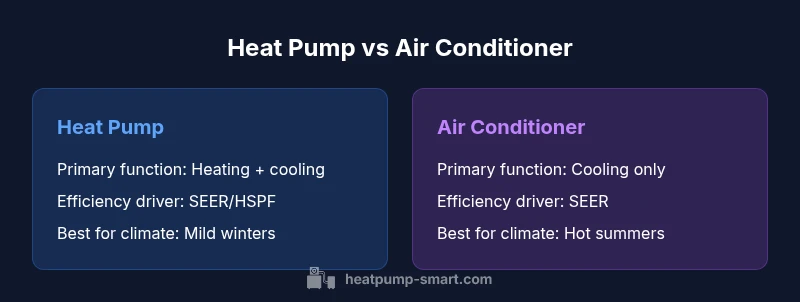
| Primary function | Heating + cooling | Cooling only |
| Efficiency drivers | Heating and cooling efficiency (SEER/HSPF) | Cooling efficiency (SEER) |
| Upfront cost impact | Higher upfront cost for heat pump | Lower upfront cost for air conditioner |
| Climate suitability | Better in mild winters; backup heat often needed | Best in hot climates; heating provided by separate system |
| Maintenance focus | Ducts, refrigerant, controls; backup heat considerations | Ducts, refrigerant, compressor |
| Long-term costs | Potentially lower energy bills with proper sizing | Lower energy savings due to heating needs not addressed |
| Noise and comfort | Can be very quiet with modern tech; zoned options | Quiet operation possible but depends on setup |
Advantages
- Year-round comfort with a single system
- Potential energy savings in mild climates
- Access to rebates and incentives
- Improved humidity control and zoning options
- Smart controls and home automation compatibility
Disadvantages
- Higher upfront cost and升级 requirements
- Reduced performance in very cold climates without backup heat
- Requires professional sizing and proper installation
- Maintenance complexity can rise with high-efficiency features
Heat pumps generally offer greater value in temperate climates for combined heating and cooling, while air conditioners remain a solid cooling-only option in hot climates.
For milder areas, a heat pump often reduces total energy costs and simplifies equipment. In very cold climates, a separate heating solution may be more reliable. The right choice balances climate, budget, and comfort goals.
Your Questions Answered
Can a heat pump replace my furnace?
In many homes a heat pump can replace a furnace for heating, provided the climate allows adequate warmth and the system is properly sized and installed. In very cold regions, backup heat may still be required.
Yes, often heat pumps can replace furnaces if the climate is suitable and the install is right.
Is a heat pump more expensive to install than an air conditioner?
Upfront costs are typically higher for heat pumps due to equipment needs and potential upgrades to wiring, ducts, and insulation. Long‑term energy savings can offset the initial investment.
Heat pumps usually cost more to install but can save on energy bills over time.
What is the best climate for a heat pump?
Heat pumps tend to perform best in temperate climates with mild winters. In very cold regions, backup heating may be needed, or a different heating strategy might be preferred.
Best in moderate climates; in cold areas, plan for backup heat.
Do heat pumps require special maintenance?
Annual servicing is recommended, including checks on refrigerant pressure, ductwork, and thermostat operation. Proper maintenance helps sustain efficiency and reliability.
Regular checkups keep heat pumps efficient and reliable.
Can I get rebates or tax credits for a heat pump?
Yes, many regions offer incentives for high‑efficiency heating and cooling. Programs change, so verify eligibility with local utility providers and government programs.
There are incentives in many places; check local programs before buying.
Which is quieter, heat pump or air conditioner?
Noise levels vary by model and installation. Modern units can be very quiet, especially with low‑noise compressors and proper vibration isolation.
Modern units can be quiet; installation quality matters.
Top Takeaways
- Assess climate and heating needs before choosing
- Prioritize proper sizing, insulation, and ductwork for efficiency
- Consider rebates and total cost of ownership
- Evaluate advanced controls and zoning for comfort
- Choose heat pump vs air conditioner based on year‑round needs