Cost of Heat Pump vs Furnace: A Practical Comparison
Compare upfront costs, operating expenses, and long-term value of heat pumps versus furnaces. Learn which option fits your climate, energy goals, and budget.


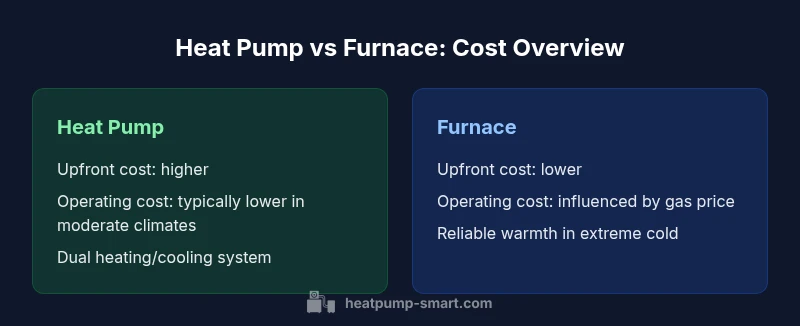
The cost of heat pump vs furnace hinges on upfront investment, operating efficiency, climate, and incentives. In moderate climates with affordable electricity, heat pumps often deliver lower annual energy costs and provide cooling in one system, though the initial price is higher. Furnaces usually cost less to install and can be economical where gas is cheap or electricity is expensive, depending on your location.
Cost drivers: upfront, operating, and long-term value
When you're weighing the cost of heat pump vs furnace, three categories matter most: upfront price to purchase and install, ongoing operating costs, and long-term value influenced by efficiency, reliability, and incentives. According to Heatpump Smart, the total cost picture goes beyond sticker price. A heat pump may require a larger initial investment due to outdoor equipment, specialized refrigerants, and potential electrical upgrades, while a gas furnace is often cheaper to buy and may connect to existing gas lines with minimal changes. However, the long-term economics hinge on climate, electricity and gas prices, and how you value cooling functionality in summer. In many regions, upgrading to a heat pump is a two-for-one proposition: you get heating, cooling, and often improved indoor comfort in a single system. Heatpump Smart’s analysis emphasizes looking at the full life cycle: upfront costs, annual energy use, maintenance frequency, potential rebates, and the system’s expected lifespan. The cost of heat pump vs furnace is not a single number; it unfolds across seasons and years, making a careful plan essential for homeowners, builders, and property managers who want predictable comfort and resilient budgets.
Upfront costs and installation considerations
Upfront costs for heat pumps are typically higher than for traditional gas furnaces. The outdoor unit, refrigerant lines, and, in some cases, electrical upgrades or dedicated circuits can increase initial expenses. Ductwork compatibility is another variable; homes with existing forced-air ducts may see a smoother conversion, while homes without ducts may require new ductwork or a different system configuration. Gas furnaces generally involve lower sticker price and simpler installation when an existing gas line and venting are in place. However, changes to gas service or retrofit work can add to the bill. A strategic option in some markets is a hybrid setup that combines a heat pump with a gas furnace to balance upfront costs with climate-appropriate performance. Heatpump Smart notes that local labor rates, permit costs, and contractor availability significantly influence the final upfront price.
To minimize surprises, obtain multiple written quotes that clearly itemize equipment, labor, permits, and any required electrical work. Also consider potential rebates or incentives that can offset the upfront cost, which can vary by region and eligibility.
Operating costs and efficiency in practice
Operating costs for heat pumps are driven by electric consumption, climate, and usage patterns. A heat pump converts electricity into heat with high efficiency, and it usually reduces energy use compared with resistance heating. In milder climates, heat pumps can deliver substantial savings on heating and cooling bills, especially when paired with a smart thermostat that optimizes operation. Gas furnaces burn fuel, so their operating costs depend on current gas prices and furnace efficiency. In some regions, gas can be cheap enough to make a furnace economically attractive, particularly in homes with high heating demand during long, cold winters. Weather-sensitive factors, such as the number of heating degree days and thermostat settings, shape annual energy costs. Heatpump Smart’s perspective is that homeowners should model a typical year for their home to compare annual energy spend rather than rely on upfront price alone. A comprehensive analysis also accounts for electricity price volatility and potential demand charges during peak periods.
Climate adaptability and performance expectations
Climate plays a central role in determining the true cost of heat pump vs furnace. In moderate and transitional climates, heat pumps often deliver strong total-cost performance because they provide both heating and cooling, improving overall comfort and potentially lowering annual energy use. In very cold environments, heat pumps may rely on auxiliary resistance heat during extreme cold snaps, which can raise operating costs if electricity rates are high or if climate conditions persist. In such cases, many homeowners opt for hybrid approaches or fuel-switching strategies to hedge against temperature extremes. Furnaces tend to deliver consistent warmth in harsh winter conditions, with predictable performance if properly sized and maintained. The Heatpump Smart team emphasizes evaluating local climate data and typical winter temperatures to forecast yearly energy use and to assess whether a heat pump’s efficiency gains offset any auxiliary heat needs.
Incentives, rebates, and financing options
Incentives and rebates can substantially affect the cost of heat pump vs furnace. Many regions offer incentives for upgrading to heat pumps, improving the financial feasibility of higher upfront costs. Financing options—such as low-interest loans or energy-efficiency mortgages—can also ease the purchase burden. It’s important to verify program eligibility, as some incentives require contractor participation, certain equipment standards, or proof of energy savings. Heatpump Smart notes that programs vary year to year, so check current offerings with local utility providers and government agencies. Even when incentives are modest, they can shorten the payback period and improve overall return on investment for both homeowners and property managers.
Life-cycle cost perspective and payback concepts
A comprehensive decision compares life-cycle costs rather than upfront price alone. Life-cycle cost considers initial investment, annual operating costs, maintenance cycles, expected system lifespan, and potential resale value or energy savings. Payback period estimates hinge on energy price trajectories, climate, and usage. In many markets, heat pumps offer a favorable life-cycle cost when electricity prices are stable and the climate supports efficient operation. In other regions, gas-favored economics or very cold winters may tilt the balance toward a furnace, especially if the gas price remains affordable and the furnace maintains high efficiency. Heatpump Smart advises evaluating both single-year costs and long-term budgets to understand total financial impact.
Real-world scenarios: small home vs large home
For a small single-family home, a heat pump can be attractive due to compact equipment, reduced need for separate cooling systems, and potential rebates. In larger homes or multi-zone layouts, the cost of extending ductwork and adding zones can increase upfront and installation complexity. A furnace may be simpler and cheaper to install in homes already wired for gas heating, particularly when a homeowner prioritizes immediate comfort and reliable winter warmth. For property managers overseeing multiple units, a heat pump can simplify mechanical systems by offering both heating and cooling in one solution, but the reliability and availability of qualified installers across multiple units should be considered. Heatpump Smart highlights the value of tailoring system choice to building size, insulation levels, and occupancy patterns to minimize lifecycle costs over time.
A practical decision framework for your home
Start with a climate assessment and a baseline energy bill estimate for both options. Gather multiple quotes and compare not only equipment price but also the cost of ductwork, electrical upgrades, and permits. Consider how you use space—if cooling is important, a heat pump may offer additional value. Evaluate incentives and financing options to determine the real net cost. Finally, model your annual energy spend under a mid-range scenario for electricity and gas to estimate long-term costs. The Heatpump Smart team recommends collaborating with a reputable contractor who can perform a precise load calculation, verify duct efficiency, and help you explore hybrid configurations if appropriate.
Comparison
| Feature | Heat pump (air-source) | Furnace (gas) |
|---|---|---|
| Upfront cost | Higher upfront cost due to outdoor unit, refrigerant lines, and potential electrical work | Lower upfront cost with standard gas furnace installation |
| Installation complexity | Outdoor unit, possible duct adjustments, and electrical upgrades | Gas line, venting, and possibly simpler installation if existing gas service is set |
| Energy efficiency | Very high efficiency in heating mode; cooling is an added benefit | High efficiency depending on AFUE rating; strong winter performance |
| Operating costs | Typically lower in moderate climates with affordable electricity; may rise with auxiliary heat | Often favorable when gas is cheap or electricity is expensive; steadier in extreme cold |
| Climate suitability | Best in moderate to transitional climates; may require supplemental heat in cold snaps | Reliable in very cold winters; robust heating performance in extreme cold |
| Maintenance | Fewer moving parts overall, but professional service for refrigerant and electrical components | Annual furnace maintenance is common; simpler refrigerant needs but venting checks |
Advantages
- Potentially lower operating costs over time due to high efficiency
- Provides cooling in addition to heating, improving overall home comfort
- Can qualify for rebates and incentives that reduce net cost
- One system for heating and cooling simplifies maintenance in some homes
Disadvantages
- Higher upfront costs and installation complexity
- Performance depends on electricity prices and climate; auxiliary heat may be needed in very cold weather
- Rebates and incentives vary by region and year, which can affect payoff timing
Heat pumps win for many homes in moderate climates; furnaces stay attractive in very cold regions or where upfront budget is tight
For most homes in temperate zones, a heat pump offers better lifecycle economics and dual heating/cooling. In extreme cold or when upfront cost is a major constraint, a gas furnace may be the practical choice.
Your Questions Answered
How does the initial cost of a heat pump compare to a furnace?
Initial cost for a heat pump is typically higher due to the outdoor unit and potential electrical work. A furnace usually costs less to install, especially if the existing gas line and venting are in place. Both options depend on home size, ductwork, and local labor rates.
Heat pumps often require a higher upfront investment due to outdoor equipment and wiring; furnaces are usually cheaper to install if gas lines and vents are already in place.
Do heat pumps save money on energy bills compared to furnaces?
In many climates, heat pumps reduce annual energy use because of their higher efficiency, especially for heating and cooling. Gas furnaces depend on fuel prices and system efficiency, which can keep operating costs competitive in some regions. A local energy assessment helps determine which option will be cheaper over time.
Heat pumps can lower energy bills in moderate climates, while furnaces' running costs depend on gas prices and efficiency.
Will a heat pump work well in very cold climates?
Heat pumps can operate effectively in cold climates, but may rely on auxiliary heat during very cold periods. This can raise operating costs if electricity prices are high. In such cases, a hybrid approach or keeping a gas furnace as a backup improves reliability.
In very cold climates, heat pumps may need supplemental heat; a hybrid setup can help ensure steady comfort.
Are there incentives or rebates available for heat pump installations?
Many regions offer incentives for heat pump installations, reducing net costs. Availability and amounts vary by program and year, so check with local utilities and government agencies. Incentives often require installation by certified contractors and certain efficiency standards.
There are often rebates for heat pumps, but programs change—consult local utility programs and government portals.
What maintenance is required for heat pumps vs furnaces?
Heat pumps require regular outdoor unit cleaning, refrigerant checks, and annual professional service. Furnaces need annual combustion checks and venting inspections, plus filter changes. Regular maintenance helps maintain efficiency and reliability for both systems.
Heat pumps need refrigerant and outdoor-unit care; furnaces require annual combustion and vent checks.
How long does installation typically take?
Installation duration varies with system type, existing infrastructure, and permit timelines. A straightforward furnace installation may be quicker than a new heat pump setup, especially if ductwork or electrical upgrades are needed. A professional contractor provides a precise schedule.
Furnace installs are usually faster when no ductwork upgrades are needed; heat pumps can take longer with outdoor unit and electrical prep.
Top Takeaways
- Evaluate climate first to determine meaningful efficiency benefits
- Factor in upfront costs alongside long-term operating costs
- Consider incentives and financing to lower net price
- Model energy bills for a typical year to compare payback
- Consult with a qualified installer for an accurate load and cost assessment