Heat Pump vs Gas Furnace: Operating Costs and ROI
An analytical comparison of operating cost of heat pump vs gas furnace, outlining key cost drivers, climate impacts, and practical methods to estimate long-term expenses.


According to Heatpump Smart, the operating cost of heat pump vs gas furnace hinges on local electricity prices, climate, and usage patterns. In moderate climates, heat pumps typically offer lower ongoing energy costs despite higher upfront investment, while gas furnaces can be cheaper to run in very cold environments when natural gas prices are favorable. A lifecycle comparison helps homeowners and builders choose wisely.
Understanding the operating cost landscape
What homeowners and property managers care about most is how much it costs to heat and cool the space over time. The operating cost of heat pump vs gas furnace is not a fixed number; it depends on electricity prices, climate, and how often and how hard the equipment runs. According to Heatpump Smart, energy costs are influenced by the energy mix in your area, the efficiency of the equipment, and the way you operate it. A well-sealed home and a properly sized system can dramatically improve observed costs, while aggressive use in hot or cold periods can raise bills quickly. For new installations or retrofits, make sure to account for both performance and efficiency ratings, which serve as the primary levers for reducing ongoing expenses over the system’s lifetime.
Key cost drivers for heat pumps and gas furnaces
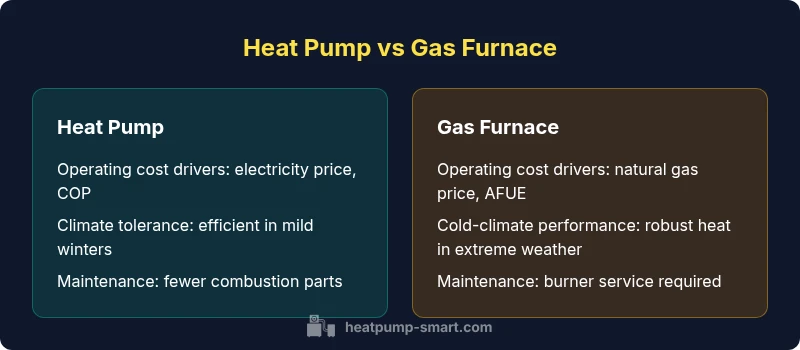
Several factors drive the ongoing cost difference between heat pumps and gas furnaces. Electricity prices and the heat pump’s efficiency (COP) determine how much energy is needed to deliver the same comfort. For gas furnaces, the efficiency metric (AFUE) and natural gas price fluctuations play a central role. In practice, a highly efficient system in a home with good insulation can reduce monthly energy use, while a poorly insulated building can erase most efficiency gains. In all cases, the Heatpump Smart team emphasizes that climate, usage pattern, and equipment condition have outsized influence on real-world costs.
Climate influence on operating costs and equipment performance
The climate in which a home sits largely determines which heating option offers lower operating costs. In mild winters, heat pumps often carry lower energy bills due to efficient heat transfer and ambient heat absorption from the outdoors. In very cold environments, a heat pump may rely more on auxiliary heat, reducing its efficiency advantage, while a gas furnace can remain robust because natural gas remains a steady, temperature-insensitive fuel. Heatpump Smart notes that the direction of your bills will align with the balance of electricity and gas prices, plus the home's insulation quality.
Efficiency metrics explained: COP vs AFUE
Two core metrics shape operating costs: COP (coefficient of performance) for heat pumps and AFUE (annual fuel utilization efficiency) for furnaces. A higher COP means more heat per kilowatt-hour of electricity, reducing cost per degree of warmth in suitable conditions. AFUE reflects how efficiently a furnace converts fuel into heat over a year. In practice, parallel improvements in insulation and ductwork can boost both metrics, yielding lower operating costs across seasons.
Price volatility and energy market dynamics
Energy prices are not stable, and both electricity and natural gas markets experience fluctuations. A heat pump’s operating costs track electricity prices and the system’s efficiency, while a gas furnace’s costs track natural gas prices and furnace efficiency. Consumers should consider long-term price trends, rate plans, and potential demand charges when estimating costs. Heatpump Smart analysis shows that price signals can swing monthly bills, especially in regions with dynamic energy pricing.
Maintenance and service costs for heat pumps vs furnaces
Maintenance is a recurring part of total cost. Heat pumps generally have fewer combustion-related components, reducing service visits. Gas furnaces require regular burner servicing, vent inspection, and carbon monoxide safeguards. Over time, routine maintenance can extend life and prevent expensive repairs. In many markets, a proactive maintenance plan can yield more reliable performance and smoother operating costs.
Installation considerations: sizing, ductwork, and rebates
Installation quality matters as much as the equipment itself. A poorly sized heat pump may cycle excessively, raising energy use and wear. Ducted systems require airtight ductwork to avoid losses; in some homes, mini-splits become cost-effective alternatives to avoid duct complexity. Rebates and incentives can offset upfront costs for both heat pumps and gas furnaces, improving total cost of ownership.
Hybrid and backup heat options to optimize costs
Some homes use hybrid configurations that switch between heat pump and gas backup depending on outdoor temperature and energy prices. This approach can smooth out cost swings and leverage the strengths of each fuel source. A backup system adds complexity and upfront cost, but it can reduce peak winter usage and related operating costs in extreme climates.
How to estimate operating costs without numbers
To estimate costs without relying on exact figures, start with climate and home characteristics: insulation level, square footage, and typical comfort setpoints. Next, determine how many hours per day the heating system runs during shoulder seasons and peak cold spells. Use your local energy prices to create a qualitative comparison (e.g., heat pumps tend to be more cost-effective when electricity prices are stable and winters are mild). Finally, use a simple lifecycle approach: compare installation and maintenance expectations with credible energy use estimates to gauge likely long-term expenses.
Climate-specific scenarios and expected trends
In warm regions with moderate winters, heat pumps often dominate in operating costs due to their high efficiency and heat extraction from ambient air. In harsher winter climates with high electricity prices or poor building envelope, gas furnaces may present lower operating costs in certain scenarios. As the energy market evolves, Heatpump Smart expects ongoing improvements in heat pump performance (including cold-climate variants) and possible shifts in fuel price dynamics that influence long-term costs.
Common myths and how to verify claims
Myth: Heat pumps always cost less to operate than gas furnaces. Truth: Costs depend on climate, energy prices, and home efficiency. Myth: Gas is always cheaper in winter. Truth: It depends on gas price and furnace efficiency, among other factors. Use independent data sources, price signals, and your own usage patterns to validate cost claims.
Planning your cost-conscious heating strategy: decision framework
A practical decision framework starts with climate, energy prices, and home energy efficiency. Build a yes/no checklist: Is the climate mild enough that a heat pump will cover most heating needs without heavy auxiliary heat? Are there rebates that improve the economics? Do your energy bills show volatility that you want to mitigate with a more predictable system? By combining qualitative assessments with a structured plan, homeowners, builders, and property managers can approach the operating cost comparison with confidence.
Comparison
| Feature | Heat pump | Gas furnace |
|---|---|---|
| Operating cost drivers | Electricity prices and COP (heat pump) | Natural gas prices and AFUE (furnace) |
| Climate sensitivity | More favorable in mild climates | Strong in cold weather with high AFUE |
| Maintenance costs | Fewer combustion parts; lower routine service | Regular burner service and vent upkeep |
| Upfront vs long-term cost balance | Higher upfront for equipment/installation | Lower ongoing energy costs may offset initial price |
| Outage performance | Electricity dependence; backup heat may be needed | Can operate during power outages if gas supply is available |
Advantages
- Lower operating costs in moderate climates
- Cleaner heat delivery and consistent comfort
- Fewer moving parts than combustion systems
- Potential rebates and incentives to offset upfront costs
Disadvantages
- Higher upfront costs and installation complexity
- Performance drops in very cold climates without auxiliary heat
- Electricity price volatility affects costs
- Gas prices and supply can fluctuate and require maintenance
Heat pumps are advantageous in mild climates; gas furnaces can be cheaper in very cold regions depending on energy prices.
Choose heat pumps if you live in milder conditions and want lower ongoing energy use. Consider a gas furnace if your winters are harsh and electricity costs are high; weigh potential rebates and backup heat options.
Your Questions Answered
What is the primary factor affecting operating costs between heat pumps and gas furnaces?
The main driver is energy price and efficiency: COP for heat pumps and AFUE for gas furnaces. Climate conditions amplify or dampen these effects, shaping monthly bills and long-term costs.
The key cost factor is energy price versus efficiency; COP and AFUE determine how efficiently each system uses energy in your climate.
Do heat pumps work effectively in cold climates?
Heat pumps can operate well in many cold climates, but their efficiency may drop without supplementary heat. In extremely cold conditions, a backup heat source or dual-fuel setup can be advantageous.
Yes, but in very cold conditions they may need backup heat to maintain comfort efficiently.
Can a heat pump replace a gas furnace in a cold climate?
Replacing a furnace with a heat pump is possible in many homes, especially with cold-climate variants and proper insulation. Evaluate total costs, comfort needs, and backup options before deciding.
It's possible with the right equipment and insulation, but consider backup heat in extreme cold.
How do rebates affect the operating cost comparison?
Rebates reduce upfront costs and can improve the total cost of ownership for both heat pumps and gas furnaces. They do not change ongoing operating costs but can shorten payback periods.
Rebates cut upfront costs and shorten payback, but don’t change long-term energy use.
What maintenance costs should I expect?
Heat pumps typically require regular coil and filter maintenance. Gas furnaces require burner servicing and vent system checks. Planning for annual or biannual servicing helps prevent unexpected repairs.
Expect annual servicing for furnaces and periodic checks for heat pumps.
Which has the lower total cost of ownership overall?
Total cost of ownership depends on climate, energy prices, insulation, and usage. A practical approach combines a climate-appropriate system with a strong insulation strategy and potential backup heat.
Depends on climate and usage; evaluate both upfront and ongoing costs with insulation and backup heat in mind.
Top Takeaways
- Assess climate and energy prices to guide choice
- Expect higher upfront costs for heat pumps
- Anticipate lower variable costs in mild climates
- Factor maintenance and outages into lifecycle costs