Heat Pump and Air Conditioner: A Practical Comparison
A detailed, analytical comparison of heat pump and air conditioner systems, covering operation, climate suitability, costs, installation, maintenance, and best-use scenarios for homeowners, builders, and property managers.


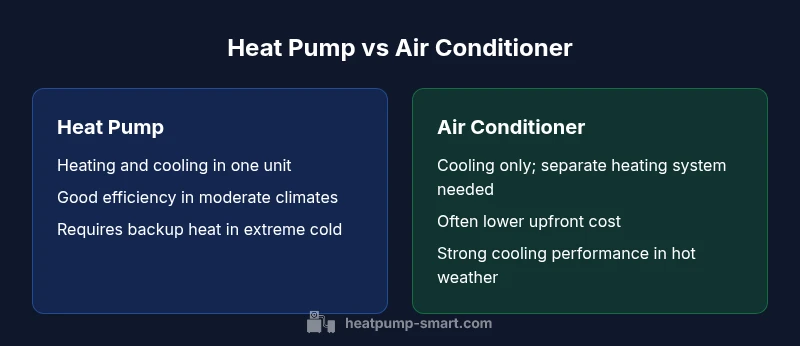
Heat pumps offer both heating and cooling, while traditional air conditioners cool only. In climate contexts with year round heating and cooling needs, a heat pump often provides better long term value, especially when paired with smart controls and proper sizing. The best choice depends on climate, electricity costs, and existing infrastructure.
Defining heat pump and air conditioner
This article compares heat pump and air conditioner systems in terms of operation, efficiency, and practical use for homes and multi unit buildings. The phrase heat pump and air conditioner is common in discussions about home climate control, and readers want to know if a single dual purpose unit can replace separate heating and cooling equipment. According to Heatpump Smart, the key distinction lies in heating capability: a heat pump can move heat both into and out of a space, providing year round comfort, while an air conditioner focuses on cooling. In practical terms, a heat pump can often replace a furnace or boiler when paired with supplemental heat, delivering warmth in winter and cooling in summer with a single system. This upfront choice affects installation, electrical requirements, ductwork, and long term operating costs. Homeowners, builders, and property managers should evaluate climate, insulation, and desired control strategies to determine if a heat pump and air conditioner decision is best for their project.
Climate and performance: how weather shapes outcomes
The efficiency and reliability of heat pump and air conditioner systems are heavily climate dependent. In temperate regions, heat pumps tend to deliver heating and cooling with a single unit, reducing equipment footprint and simplifying maintenance. In very cold winters, performance may require auxiliary heat sources to meet peak loads, which can affect operating costs and comfort consistency. Conversely, traditional air conditioners excel at cooling in hot weather but require a separate heating system for warmth. The Heatpump Smart team notes that the real world value comes from pairing equipment to local weather patterns and home insulation levels. Seasonal temperature swings, humidity, and occupancy patterns influence running costs and comfort. In warmer seasons, both systems benefit from efficient airflow and properly sealed ducts. Heatpump Smart analysis shows that well designed ductwork and accurate thermostat control are essential to unlock energy savings and stable comfort across seasons.
Heating and cooling capabilities in practice
A heat pump uses a reverse cycle to extract warmth from outdoor air and move it indoors for heating, and reverses direction for cooling. This dual capability makes heat pumps versatile for year round comfort, particularly in moderate climates. An air conditioner, by contrast, is designed primarily to remove heat from indoor air and does not provide heating without an additional heat source. In practice, a heat pump can deliver comfortable temperatures with fewer separate pieces of equipment, while AC systems may rely on furnaces or boilers to provide heat in winter. When evaluating a retrofit, consider existing ductwork, wiring, and space for a combined heating and cooling solution. In homes with good insulation and well sealed envelopes, heat pumps can deliver reliable comfort with lower energy use compared with resistance heating, while maintaining simple maintenance and zoning options where available.
Energy efficiency and running costs
Energy efficiency and running costs for heat pumps and air conditioners depend on climate, equipment efficiency ratings, and usage patterns. A heat pump that includes cold climate capability and sensible control strategies can lower energy use for heating and cooling, especially when combined with smart thermostats and zone control. An air conditioner remains efficient for cooling in warm weather but does not address heating, which shifts some costs to the heating system. In planning, account for electricity prices, insulation quality, and potential rebates or incentives that apply to heat pump installations. The Heatpump Smart analysis highlights that climate optimized equipment selection and professional temperature balancing are central to achieving meaningful energy savings over time.
Installation considerations and upfront costs
Upfront costs for heat pumps can be higher due to the need for refrigerant lines, electrical service adjustments, and sometimes ductwork modifications. If an existing ducted system exists, a heat pump retrofit can be straightforward, though some homes require upgrades to electrical panels or zoning components. Air conditioners typically have lower initial costs if paired with a separate heating system, but the total cost depends on the heating source used. When planning a project, assess electrical capacity, ductwork condition, and space for any outdoor equipment. Proper sizing and professional installation are essential to prevent short cycling, noise, and comfort gaps. The decision should balance the upfront investment with anticipated energy savings and the value of unified heating cooling control over the system's lifetime.
Maintenance and reliability
Maintenance expectations differ between heat pumps and air conditioners. Heat pumps require regular checks of refrigerant levels, outdoor unit cleanliness, and defrost cycle performance, especially in shoulder seasons when temperature fluctuations occur. Air conditioners require routine condenser coil cleaning, airflow checks, and refrigerant integrity, with fewer components involved in heating. Regardless of choice, a professional service plan that includes annual checks, coil cleaning, filter changes, and thermostat calibration helps ensure steady performance and reduces the risk of unexpected outages. Proper installation and periodic maintenance support longer equipment life and more predictable energy use.
Rebates, warranties, and lifespan
Rebates and warranties vary by region and program availability, but heat pumps often qualify for energy efficiency incentives, especially when paired with high efficiency components and smart controls. Warranties typically cover mechanical components and compressor life, with coverage durations depending on the manufacturer and installer. Heat pump lifespan is influenced by climate, usage patterns, and maintenance quality; well maintained units can deliver reliable service for many years. Air conditioners may have similar warranty structures focusing on cooling components, while the associated heating system’s coverage may differ. When evaluating a project, compare warranty terms, installation quality, and program eligibility to maximize long term value.
Comparison
| Feature | Heat pump | Conventional air conditioner |
|---|---|---|
| Operation principle | Dual heating and cooling via reversible cycle | Cooling only; relies on separate heat source for heating |
| Best climate | Moderate climates with year round heating and cooling | Hot climates with minimal heating interactions |
| Upfront cost | Higher upfront due to dual function and installation | Lower upfront in cooling-focused setups |
| Installation complexity | May require ductwork upgrades and electrical enhancements | Often simpler if existing ducts are compatible |
| Backup heat needs | Auxiliary or supplemental heat may be required in cold weather | No built in heating; needs separate heat source |
| Maintenance requirements | Regular refrigerant checks and defrost cycle maintenance | Condenser and coil maintenance primarily for cooling |
| Lifespan & reliability | Comparable lifespans with proper maintenance | Comparable lifespans with appropriate care |
| Rebates & incentives | Often eligible for energy efficiency programs | Incentives vary; not always aligned with heating needs |
Advantages
- Single system for heating and cooling reduces equipment footprint
- Potential long term energy savings with efficient operation
- Smart controls and zoning can enhance comfort and efficiency
- Rebates and incentives are often available for efficient heat pump setups
Disadvantages
- Higher upfront cost and potential electrical upgrades
- Performance can decline in extreme cold without supplemental heat
- Installation requires professional sizing and sometimes ductwork changes
- Not all homes or climates are ideal for heat pump only solutions
Heat pumps generally fit homes needing year round heating and cooling, especially in moderate climates.
When climate and insulation favor a single all season system, a heat pump offers comfort and efficiency. If you live in extreme cold or rely on a very simple cooling setup, a traditional air conditioner with an auxiliary heater may be more straightforward.
Your Questions Answered
Can a heat pump replace an air conditioner entirely
Yes in many cases a heat pump can replace a separate air conditioner for cooling, while also providing heating. Ensure proper sizing and climate suitability and plan for any backup heating needs in cold weather.
Yes, a heat pump can replace an air conditioner for cooling when sized correctly and aligned with climate needs.
Do heat pumps work well in cold climates
They can work well in cold climates with appropriate cold climate features and backup heat. In very cold periods, the system may rely more on auxiliary heat which affects efficiency.
Heat pumps can work in cold climates with proper features and backup heat.
Is installation more expensive for a heat pump
Upfront costs are typically higher for heat pumps due to dual heating cooling capability and possible ductwork or electrical upgrades. Long term savings may offset initial costs.
Yes, initial costs are higher, but long term savings can offset the difference.
What maintenance do heat pumps require
Regular service includes refrigerant checks, filter changes, outdoor unit cleaning, and thermostat calibration. Schedule annual professional checkups for reliability.
Annual professional checkups and regular cleaning keep heat pumps reliable.
Are rebates available for heat pumps
Rebates and incentives are often available for efficient heat pump installations, depending on location and program rules. Check local energy programs and warranties.
Yes, there are often rebates for efficient heat pump systems.
How should I size a heat pump versus an air conditioner
Professional sizing uses climate data, home insulation, and space planning. An oversized or undersized unit can lead to comfort gaps and inefficiency.
Get a professional size assessment to ensure proper performance.
Top Takeaways
- Assess climate and insulation before choosing
- Consider a heat pump for year round comfort in temperate regions
- Budget for potential upfront electrical or ductwork upgrades
- Utilize smart thermostats and zoning to maximize efficiency
- Check rebates and warranties to maximize value