Difference Heat Pump and Air Conditioner: A Practical Comparison
Learn the difference heat pump and air conditioner, how each system works, their efficiency, installation considerations, and real-world use cases. A practical, data-driven comparison from Heatpump Smart for homeowners and pros.


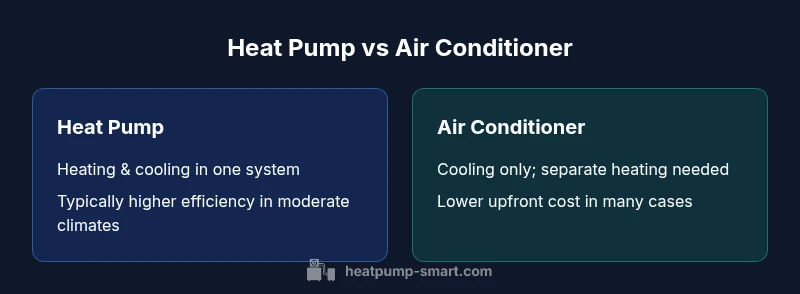
If you are deciding between a heat pump and a traditional air conditioner, the quick takeaway is that heat pumps provide both cooling and heating, while air conditioners mainly cool. Heat pumps are generally more energy-efficient for year-round comfort, especially in moderate climates, but upfront costs and climate-specific performance vary. This quick comparison sets the stage for a deeper dive.
Understanding the difference heat pump and air conditioner
The phrase difference heat pump and air conditioner captures a fundamental distinction in home climate control: a heat pump delivers both cooling in hot months and heating in cold months, while a traditional air conditioner focuses on cooling. From Heatpump Smart's perspective, the core idea is that a heat pump moves heat rather than generating it, enabling year‑round comfort with a single system. The key advantage is versatility—in moderate climates, a heat pump can replace a separate furnace or boiler for heating. In contrast, a standard air conditioner excels at cooling and relies on a separate heating source, or an electric-resistance back‑up, in winter. When homeowners look at energy costs, the heat transfer efficiency and the seasonal performance of a heat pump typically translate to lower operating costs over the year in many scenarios, though climate and usage patterns matter. As you compare options, remember the distinction is not just heating vs cooling; it is one system that handles both tasks with optimized energy use.
How a heat pump works (with heating and cooling modes)
A heat pump uses a refrigerant cycle, driven by a compressor, to transfer heat between indoors and outdoors. In cooling mode, it extracts heat from inside your home and dumps it outside; in heating mode, it reverses the cycle, pulling heat from outside air (even when it’s cool) and delivering it indoors. The outdoor unit, the indoor air handler, and a reversing valve are the essential components. Because a heat pump moves heat rather than generating it, there’s less energy loss compared with electric resistance heating. This mechanism underpins the energy savings associated with the difference heat pump and air conditioner when used for year-round comfort. For many households, a heat pump replaces both cooling and heating equipment, simplifying maintenance and reducing space requirements. The Heatpump Smart team notes that performance hinges on outdoor temperature, system sizing, and proper installation.
How a conventional air conditioner works
A traditional air conditioner focuses on cooling. It uses a refrigerant cycle to absorb indoor heat and release it outside, with the indoor air being cooled by a fan-assisted coil. Heat is not generated or transferred indoors in winter—that’s why a separate heating system is needed. This separation can simplify repairs and maintenance for cooling-only setups but may increase total ownership costs if a separate furnace or boiler is required later. In terms of energy use, modern air conditioners can be efficient, but they cannot provide heating without an auxiliary system, which is a critical part of evaluating the difference heat pump and air conditioner in residential planning. The Heatpump Smart analysis emphasizes that climate compatibility and future needs shape long-term value.
Heating performance in real homes
In heating mode, heat pumps draw heat from the outside air, even at lower temperatures, to warm the indoors. The effectiveness depends on the outdoor temperature, unit efficiency, and the home’s insulation. In well-insulated houses, heat pumps deliver comfortable warmth with modest energy use. In colder climates, some users opt for a supplemental heating source. By comparison, air conditioners cannot provide reliable heating unless paired with a separate heating system. This is a core reason many homeowners evaluate the difference heat pump and air conditioner before installation. Heatpump Smart’s perspective is to match climate, home design, and energy goals with a system that can minimize seasonal energy costs while maintaining comfort.
Cooling performance and comfort
Both heat pumps and air conditioners can deliver effective cooling. Modern heat pumps use sophisticated compressors and refrigerants to maintain steady indoor temperatures, humidity control, and consistent airflow. The benefit over a cooling-only AC is the integrated system’s ability to dehumidify while cooling, which can improve comfort in humid environments. When comparing the difference heat pump and air conditioner for cooling alone, air conditioners may offer lower upfront costs and simpler service, but lack heating capability. Heat pump cooling performance in summer tends to align with energy-efficient expectations, provided the unit is correctly sized and maintained. The Heatpump Smart guidance emphasizes system matching and ductwork quality as decisive factors for achieving the best cooling comfort.
Energy efficiency explained: SEER, SCOP, and running costs
Energy efficiency metrics matter in the comparison between heat pumps and air conditioners. SEER measures cooling efficiency, while SCOP captures heating efficiency for heat pumps. A higher SCOP indicates better performance in heating mode, which, combined with seasonal energy use, can reduce running costs. Heat pumps can outperform air conditioners in many climates on a year-round basis, particularly when used for both heating and cooling. However, installation costs, climate, and electricity prices influence total cost of ownership. Heatpump Smart notes that choosing a model with high efficiency ratings and a proper blower can drive long-term savings without compromising comfort.
Climate considerations: when a heat pump shines and when it struggles
Heat pumps are often a strong choice in temperate climates with moderate heating needs. In moderate winters, a heat pump provides consistent comfort at lower energy costs than resistance heating. In very cold climates, performance can drop, and homeowners may rely on supplemental heat, which affects efficiency and cost. The decision in the difference heat pump and air conditioner becomes climate-driven: heat pumps excel where heating demand is modest or well-insulated, while traditional systems may be preferable where extreme cold or seasonality demands specialized heating solutions. Heatpump Smart’s guidance underlines the importance of climate analysis and load calculations as fundamental steps in the selection process.
Sizing, installation, and maintenance: key steps
Correct sizing is essential for any climate control system. An oversized or undersized unit reduces efficiency and comfort. A professional load calculation considers insulation, windows, orientation, and occupancy patterns. Installation quality—air sealing, duct integrity, refrigerant charge—directly affects performance. For heat pumps, outdoor unit placement, defrost cycles, and proper refrigerant routing are particularly important. In contrast, air conditioners rely on precise duct work and indoor coil condition. Regular maintenance, including filter changes, coil cleaning, and system checkups, keeps both systems performing well. Heatpump Smart emphasizes an upfront, professional assessment to avoid common mistakes and ensure the chosen solution aligns with long-term energy goals.
Costs and return on investment: upfront vs operating costs
Upfront costs for a heat pump can be higher than a cooling-only air conditioner, especially when factoring in the heating component. Over time, energy savings from year-round operation can offset higher initial costs. The exact ROI depends on climate, electricity prices, and system efficiency. Homeowners should consider incentives, rebates, and financing options as part of the total cost of ownership. In evaluating the difference heat pump and air conditioner, it’s important to translate ongoing energy costs into real-world dollars and to balance comfort, reliability, and long-term value. Heatpump Smart recommends a detailed cost-of-ownership analysis as a core part of the decision process.
Real-world case studies and scenarios
In practice, many households opt for heat pumps when replacing aging cooling systems and adding heating capacity. A well-insulated home in a mixed climate can achieve significant energy savings with a heat pump, especially if the family spends substantial time at home during shoulder seasons. In contrast, properties in very cold regions or with extreme winter heating demands may still benefit from a dedicated furnace or boiler in conjunction with cooling. The difference heat pump and air conditioner becomes a framework for evaluating how lifestyle, energy prices, and building envelope intersect. Real-world uses show that properly sized heat pumps deliver comfort, efficiency, and simplicity when installed with the right auxiliaries and controls.
Choosing a model: heat pump vs air conditioner types
There are several heat pump types to consider, including air-source, ground-source (geothermal), and dual-fuel configurations. For air conditioners, you’ll typically compare central AC vs mini-split systems if ducting is limited. Evaluating the difference heat pump and air conditioner requires weighing efficiency, climate compatibility, and installation feasibility. A building with limited space may benefit from ductless mini-splits, while a well-insulated home could justify a traditional air-source heat pump with a responsive thermostat. Heatpump Smart advises specifying climate zone, insulation quality, and future heating needs to guide model selection and to maximize long-term value.
Maintenance reminders and seasonal readiness
Maintenance matters for both systems. Regular filter replacement, coil cleaning, and system diagnostics help sustain efficiency and comfort. For heat pumps, periodic checks of refrigerant levels, defrost cycles, and defector coil cleanliness ensure reliable heating performance in shoulder seasons. Air conditioners require similar coil and refrigerant health checks to maintain cooling efficiency. In both cases, scheduling professional service at least once a year can prevent small issues from becoming costly repairs. Heatpump Smart highlights a proactive maintenance mindset as a cornerstone of sustained performance and customer satisfaction.
Practical tips for homeowners: optimizing energy use
To maximize efficiency, combine a well-sealed building envelope with a properly sized system and smart controls. Use programmable thermostats, set appropriate temperature setbacks, and leverage zoning where possible. In climates where heating dominates, choosing a heat pump with a high SCOP can reduce operating costs. For cooling-focused seasons, a high SEER rating translates to lower electricity use during hot months. The difference heat pump and air conditioner is most evident when you tailor system features to your home’s needs, occupancy patterns, and energy goals. Heatpump Smart’s practical tips provide a clear path to better comfort and lower bills.
Rebates, incentives, and financial considerations
Many regions offer incentives for energy-efficient heating and cooling, including heat pump installations. Rebates and tax credits can offset upfront costs and improve payback periods. When evaluating incentives, compare eligible equipment, installation requirements, and the total energy savings you expect to see over the system’s life. As you consider the difference heat pump and air conditioner, your financial picture should factor in warranty terms, maintenance costs, and potential increases in home value via upgraded comfort and efficiency. Heatpump Smart recommends consulting local programs and obtaining documentation during planning.
What Heatpump Smart recommends for homeowners
In typical residential settings, Heatpump Smart favors a heat pump when you want year‑round comfort, energy efficiency, and a reduced equipment footprint. For homes in very cold climates, a heat pump may be complemented by a backup heat source to guarantee reliability during deep winter conditions. A cooling-only air conditioner still makes sense for budget-conscious upgrades where heating needs are minimal or where supplemental heating is already in place. The difference heat pump and air conditioner becomes a decision about how you value year‑round comfort, energy costs, and long-term home performance. Heatpump Smart emphasizes a holistic assessment, including climate, insulation, and future energy needs, to guide your choice.
Comparison
| Feature | Heat pump | Air conditioner |
|---|---|---|
| Heating capability | Yes (year-round heating) | No (cooling only) |
| Cooling capability | Yes | Yes |
| Energy efficiency focus | High overall efficiency with heating and cooling | Strong cooling efficiency, no heating efficiency |
| Upfront costs (roughly) | Higher upfront costs (equipment + installation) | Lower upfront costs |
| Maintenance needs | Similar maintenance; heat pumps require defrost and refrigerant checks | Similar maintenance for cooling components |
| Climate suitability | Best in temperate to mild winter climates | Best in cooling-dominant or warm climates |
Advantages
- Year-round comfort with a single system
- Potentially lower operating costs over time
- Space-saving compared with separate heater and AC
- Improved humidity control in many setups
- Can qualify for energy rebates and incentives
Disadvantages
- Higher upfront cost and installation complexity
- Performance in extreme cold may require supplemental heating
- Requires proper sizing and professional installation
- Potential for higher service complexity than cooling-only systems
Heat pumps generally offer better year-round value, especially in temperate climates, but may require more upfront planning.
If you prioritize heating and cooling in one package and have suitable climate, a heat pump is often the best choice. In very cold areas, a traditional AC with a separate heater may suit budget and reliability needs better. Overall, the heat pump option tends to deliver greater long-term efficiency and comfort when correctly sized and installed.
Your Questions Answered
What is the fundamental difference between a heat pump and a traditional air conditioner?
The main difference is that a heat pump can both heat and cool a space, transferring heat between indoors and outdoors, while a traditional air conditioner is designed for cooling only. In heating season, the heat pump can be more energy-efficient than electric resistance heating if conditions allow.
Heat pumps do heating and cooling, unlike air conditioners that only cool. They can be more energy-efficient for year-round comfort if installed correctly.
Can a heat pump work well in cold climates?
Heat pumps can operate in cold climates, but efficiency decreases as outdoor temperatures drop. In very cold areas, homeowners may use a supplemental heat source to maintain comfort during the coldest days. The right model, insulation, and installation matter for maintaining performance.
They work in cold weather, but you might need a backup heat source in very cold conditions.
What affects the cost of installing a heat pump versus an air conditioner?
Costs depend on unit type, size, ductwork or installation layout, and whether it replaces or augments existing heating. While heat pumps may have higher upfront costs, long-term energy savings and rebates can improve total cost of ownership.
Installation costs depend on the system and setup; heat pumps can be pricier upfront but save on energy bills over time.
Are there rebates or tax credits for heat pumps?
Many regions offer incentives for energy-efficient heat pumps, which can reduce upfront costs. Check local programs and ensure the equipment and installer meet eligibility requirements.
Yes, there are often rebates or credits—check local programs to maximize savings.
Which is better for humidity control, heat pump vs air conditioner?
Heat pumps typically provide better humidity control because they regulate both temperature and latent heat in heating and cooling cycles, contributing to a more comfortable indoor climate.
Heat pumps usually handle humidity better thanks to their heating and cooling cycle.
Is a ductless mini-split a good option when replacing an AC with a heat pump?
Ductless mini-splits offer flexible installation and are ideal for homes without ductwork. They can provide efficient heating and cooling in zone-based layouts but may have different upfront costs and maintenance needs.
Ductless options are great if you don’t have ducts and want targeted comfort.
Top Takeaways
- Choose heat pump for year-round climate control
- Assess climate and insulation before deciding
- Consider up-front costs vs long-term energy savings
- Look for high SCOP/SEER ratings and proper installation
- Explore rebates and financing options to boost ROI