Is heat pump better than air conditioner? An in-depth comparison
A comprehensive, data-driven comparison of heat pumps and air conditioners, covering efficiency, climate suitability, costs, installation, and longevity to help homeowners decide which system fits their home. Learn from Heatpump Smart’s expert analysis.


Heat pumps typically outperform air conditioners for both cooling and heating, delivering higher overall efficiency and lower operating costs over time. The advantage depends on climate: in very cold areas, performance can drop unless a cold-climate model is used. Upfront costs are higher, but longer-term savings and year-round comfort often make heat pumps the better choice, according to Heatpump Smart.
Is heat pump better than air conditioner for home comfort?
The central question for most homeowners is: is heat pump better than air conditioner for home comfort? In this analysis, Heatpump Smart evaluates performance, energy use, and lifecycle costs to help you decide. Heat pumps combine cooling and heating in one package, offering year-round climate control with a single heat source. This guide will compare the two technologies across climate zones, usage patterns, and installation scenarios, highlighting when a heat pump delivers clear advantages and when a traditional AC might be sufficient. According to Heatpump Smart, the answer isn’t one-size-fits-all; the choice hinges on climate, insulation, and how you value convenience versus upfront cost.
How heat pumps work compared with traditional air conditioners
Both devices move heat, but heat pumps can transfer heat in both directions. An air conditioner moves indoor heat outside to cool a space. A heat pump uses a reversing valve and refrigerant loop to provide cooling in summer and heating in winter, often with indoor air handlers or ducts. The result is a single system that delivers year-round comfort. The Heatpump Smart team notes that installation quality and proper sizing are crucial to realize the full benefits of either system, especially in retrofit homes where space constraints exist.
Efficiency benchmarks: SEER, HSPF, and COP explained
Efficiency metrics help you compare cooling and heating performance. SEER measures cooling efficiency, HSPF gauges heating performance, and COP indicates energy conversion effectiveness. Heat pumps generally achieve high SEER and HSPF ratings due to reversible operation, while air conditioners focus on cooling efficiency alone. When evaluating units, prioritize a model with strong COP values across temperature ranges and verify consistency in both cooling and heating modes. Heatpump Smart highlights that performance is climate-dependent and that rating systems translate differently across manufacturers.
Climate considerations: heating in winter and defrost cycles
In moderate climates, heat pumps excel by delivering efficient heating alongside cooling. In colder regions, performance can wane as outdoor temperatures drop, triggering defrost cycles and supplemental heat sources. Cold-climate heat pumps exist to mitigate this issue, but installation quality, duct design, and home insulation influence outcomes. The Heatpump Smart analysis indicates that pairing a heat pump with an efficient backup system can maintain comfort during extreme cold while preserving energy savings.
Operating costs and long-term value
Operating costs depend on electricity prices, usage patterns, and whether heating or cooling dominates monthly energy consumption. Heat pumps tend to reduce overall electricity usage compared with cooling-only systems when heating is part of the climate equation, especially with modern variable-speed compressors and smart thermostats. Air conditioners may have lower upfront costs but lack a heating function, which limits their value in homes that require warmth in winter. Heatpump Smart emphasizes modeling your annual energy profile to understand true lifetime costs.
Installation considerations: ducted, ductless, and retrofits
Choosing between ducted or ductless configurations affects cost, space, and zoning. Heat pumps can be installed as split systems, mini-splits, or integrated with existing ductwork. Retrofits may require updating duct design, insulation, and electrical capacity, which can raise upfront costs. Air conditioners often benefit from simpler retrofits when existing ductwork is in good condition. The Heatpump Smart team recommends a professional load calculation and a review of existing electrical service before committing to equipment changes.
Maintenance and reliability: what to expect
Both heat pumps and central AC units rely on clean coils, refrigerant integrity, and proper airflow. Heat pumps require regular refrigerant checks, filter changes, and occasional reversing-valve service. Air conditioners also need coil cleaning and refrigerant checks but lack heating components. Regular professional servicing extends system life for both, with heat pumps needing slightly more attention to defrost mechanisms and auxiliary heat controls in winter.
Smart controls and home integration
Modern heat pumps integrate with smart thermostats, occupancy sensors, and zone controls to optimize performance. AI-enabled scheduling can pre-warm spaces when temperatures predict a drop, while weather data helps minimize unnecessary heating calls. Air conditioners with smart controls offer many conveniences too, but heat pumps’ year-round operation unlocks broader energy-management opportunities for homeowners and property managers seeking efficiency gains.
Myths, caveats, and a decision framework
A common myth is that heating with electric systems is inherently expensive; in many homes, heat pumps reduce energy bills when heating is frequent. Another misconception is that cold winters always defeat heat pumps; with the newest cold-climate models and backup heat, performance remains practical. Use a decision framework that compares climate, energy prices, insulation, and desired comfort levels to determine whether a heat pump or AC-first approach best meets your needs.
How to compare models and obtain quotes
Start by listing required heating and cooling capacities for your space, then evaluate efficiency ratings (SEER, HSPF, COP). Check warranties, service availability, and noise ratings for outdoor units. Request a site assessment from multiple installers to compare installation costs, ductwork needs, and expected energy savings. A well-planned comparison helps avoid overpaying for features you won’t use and ensures the chosen system aligns with your home’s insulation and climate.
Practical takeaways for homeowners
- Focus on year-round climate needs rather than cooling-only performance.
- Prioritize models with cold-climate ratings if winters are chilly.
- Ensure electrical service and ductwork can support the new system before buying.
Comparison
| Feature | heat pump | air conditioner |
|---|---|---|
| Heating capability | Yes; provides heating | No; cooling only |
| Cooling capability | Yes; cooling | Yes; cooling |
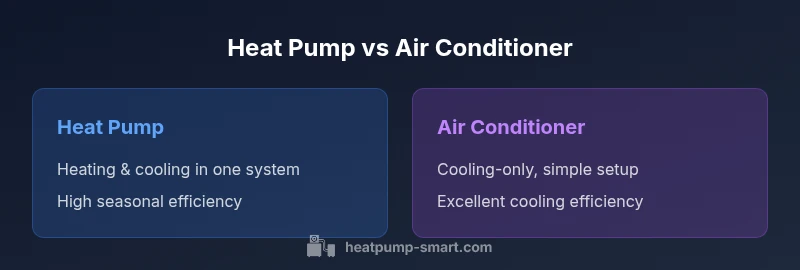
| Energy efficiency (seasonal) | High overall efficiency across seasons | Excellent cooling efficiency, no heating efficiency |
| Upfront installation cost | Higher upfront due to dual-function system | Lower upfront (cooling-only) |
| Operating costs | Typically lower overall (with heating) | Typically higher when heating is required |
| Maintenance needs | Moderate maintenance; regular checks for refrigerant and reversing valve | Standard AC maintenance; no heating-related components |
| Noise considerations | Outdoor unit noise comparable to AC; modern units quiet | Outdoor compressor noise standard; newer models quieter |
| Space/installation footprint | Requires outdoor unit plus indoor handler; possible ducting | Outdoor unit with ducts; no indoor heat exchange |
| Ideal climate | Best in moderate to mild climates; year-round use | Best for hot climates where heating isn’t needed |
Advantages
- Year-round heating and cooling in one system
- Generally lower operating costs over the life of the system
- Better integration with smart thermostats and home automation
- Reduced carbon footprint in many scenarios
- Eligible for rebates and incentives in many regions
Disadvantages
- Higher upfront purchase and installation costs
- Performance can drop in very cold climates without cold-climate models
- More complex repairs due to reversible cycle and refrigerant handling
- Requires adequate electrical capacity and good home insulation
Heat pumps are the better overall choice for most homes.
For homes that need both heating and cooling, heat pumps typically offer superior year-round efficiency and comfort. In extremely cold climates, you may need a cold-climate model or supplemental heat. If you only need cooling and live in a hot climate, a high-efficiency AC can be a viable option, but heat pumps still provide broader capabilities and often better long-term value.
Your Questions Answered
Can a heat pump replace my furnace?
Yes, in many homes a heat pump can provide the primary heating, with a supplemental heat source if extreme cold occurs. The suitability depends on climate, home insulation, and system sizing. A qualified installer can perform a load calculation to confirm feasibility.
Yes, a heat pump can replace a furnace in many homes, especially in temperate climates; a professional assessment will confirm if you need supplemental heat.
Are heat pumps more expensive to install than air conditioners?
Installation costs for heat pumps are typically higher because they handle heating and cooling and may involve ductwork or mini-splits. However, long-term energy savings and potential rebates can offset the upfront difference.
Yes, they usually cost more to install, but you may recoup the difference over time through energy savings and rebates.
Do heat pumps work well in cold climates?
Modern cold-climate heat pumps perform well down to specific outdoor temperatures, often with supplemental heat if needed. Look for units rated for cold-weather performance and consider your backup heating options.
In cold climates, choose a cold-climate heat pump and be prepared for occasional backup heating.
What should I look for when comparing heat pumps?
Review SEER, HSPF, COP ratings, climate suitability, warranty, noise levels, and installation requirements. Ensure the unit matches your home's insulation and ductwork, and verify service availability.
Compare ratings, climate suitability, and warranties to pick the right model for your home.
Are there rebates or incentives for heat pumps?
Rebates and incentives vary by region and program. Check local and national programs, and consult your installer for current offers.
There may be rebates or incentives depending on where you live; your installer can help you find them.
Top Takeaways
- Assess climate before choosing; heat pumps excel in mixed-use climates
- Prioritize lifetime costs, not just upfront price
- Choose cold-climate rated heat pumps for cold winters
- Plan for installation space, ductwork, and electrical capacity