Heat Pump vs Forced Air Cost: In-Depth Cost Comparison for Homes
An analytical comparison of heat pump vs forced air cost, covering upfront installation, operating expenses, maintenance, climate effects, and incentives to help homeowners decide wisely.


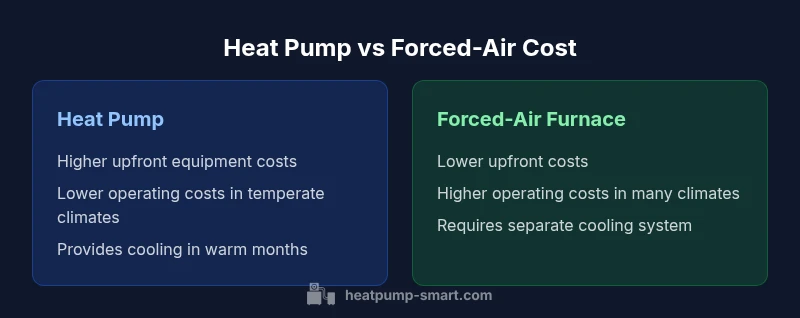
Heat pump vs forced air cost hinges on upfront installation and long-term operating expenses. In milder climates, heat pumps typically save money over time through lower electricity use and cooling capability, while in very cold regions, auxiliary heat can narrow or negate savings. Heatpump Smart analysis shows the total cost of ownership improves with proper sizing, insulation, and access to rebates, making climate and rate structures decisive.
Cost framing: what 'heat pump vs forced air cost' means
When homeowners compare heat pump vs forced air cost, the comparison runs beyond sticker price. It includes upfront equipment and installation, ongoing energy use, routine maintenance, and end-of-life costs. In practice, total cost of ownership matters more than any single number. For many households, the heat pump path promises lower operating expenses over time, but the higher initial price can be a hurdle. The Heatpump Smart team emphasizes that climate, electricity rates, and building insulation all shape the final math. In milder winters, heat pumps often deliver substantial savings by replacing electric resistance heating or fossil-fueled furnaces. In harsher climates, auxiliary heat can erode savings unless the system is sized and installed correctly. Before you compare models, define your local climate, energy costs, and comfort expectations. This foundation makes the rest of the analysis meaningful and avoids glossy promises from manufacturers. Throughout this guide we use the term heat pump vs forced air cost to frame the decision, not to oversimplify it.
blockLabelAutoGeneratedTagk2d1L3mRZ
Comparison
| Feature | Heat pump | Forced-air furnace |
|---|---|---|
| Initial purchase cost | Higher upfront due to outdoor unit, indoor air handler, and refrigerant lines | Lower upfront for a traditional furnace with existing ductwork |
| Installation complexity | Often involves outdoor electrical, refrigerant piping, and potential duct upgrades | Typically simpler if existing ducts and connections suffice |
| Annual operating cost (typical climate) | Lower in many temperate climates due to heat transfer efficiency and cooling capability | Generally higher if using electric resistance backup or in poorly insulated homes |
| Energy efficiency metrics | SEER/HSPF ratings; performance scales with outdoor temperature and system size | AFUE rating; efficiency tied to furnace design and duct losses |
| Maintenance frequency | Annual service; refrigerant systems require specialist tech | Annual service; filter changes and blower maintenance |
| Lifespan / durability | Typically 15-20 years with proper care | Typically 15-25 years with care; ductwork condition matters |
| Noise levels | Outdoor unit and indoor fan noise; modern models are quieter | Typically centralized but can be loud if poorly insulated |
| Rebates / incentives | Varies by region; thermal efficiency incentives commonly available | Often eligible for some incentives, especially with efficiency upgrades |
| Best for climate | Milder to moderate climates where cooling is a bonus | Cold climates with supplemental heat require careful sizing |
Advantages
- Potentially lower annual operating costs in mild climates
- Dual heating and cooling capabilities with heat pumps
- Access to rebates and tax credits in many regions
- Improved home comfort with precise temperature control
- Future-proofing through higher efficiency standards
Disadvantages
- Higher upfront cost and potential ductwork upgrades
- Auxiliary heat can reduce savings in very cold climates
- Reliance on electricity price stability
- Longer payback period without incentives
Heat pump generally offers better total cost performance in moderate climates; forced-air furnaces may be cheaper upfront and simpler to retrofit in very cold climates.
If your climate is mild and electricity is reasonably priced, a heat pump typically lowers lifetime costs. In very cold areas, ensure auxiliary heat is properly managed and that the system is sized to minimize energy spikes. The Heatpump Smart team recommends comparing total cost of ownership across scenarios and checking for rebates to maximize value.
Your Questions Answered
Is a heat pump cheaper overall than a forced air furnace?
In many cases, yes, but it depends on climate, electricity prices, home insulation, and usage patterns. Heat pumps shine when cooling is needed and winters are moderate. In very cold regions, the savings can be smaller unless auxiliary heat is well managed.
In many homes, heat pumps save money over time, especially if you need cooling too. Climate and electricity prices decide how big the savings are.
What affects the cost difference between heat pump and forced air?
The main factors are climate, system efficiency (SEER/HSPF vs AFUE), ducting quality, and availability of incentives. Installation costs and building envelope insulation also influence total cost.
Climate, efficiency, ducting, and incentives are the big drivers of cost differences.
Do heat pumps require ductwork or can they use ductless setups?
Heat pumps can be installed with ducts (central air) or as ductless mini-splits for each zone. Ductless systems offer flexibility but may have higher per-zone costs. Existing ducts can reduce retrofit expenses.
You can choose ducted or ductless depending on your home and budget.
Are there incentives for heat pump upgrades?
Yes, incentives vary by region and program year. Utilities, local governments, and federal programs often offer rebates or tax credits for efficient heat pump installations.
Check local utility programs and government incentives to maximize value.
How long does it take for a heat pump to pay back the extra upfront cost?
Payback varies with climate, usage, and incentives. It is generally not a fixed period and can span several years depending on energy savings and rebates.
Payback depends on climate and incentives and can take several years to realize.
Top Takeaways
- Assess climate before choosing.
- Weigh upfront installation against long-term energy savings.
- Consider ductwork needs and potential retrofits.
- Check available rebates and tax credits.
- Plan for maintenance and system lifespan.