Heat Pump vs Central Air: Comprehensive Comparison for 2026
An objective, in-depth comparison of heat pump vs central air, covering efficiency, climate performance, costs, installation, and long-term value for homeowners, builders, and managers.


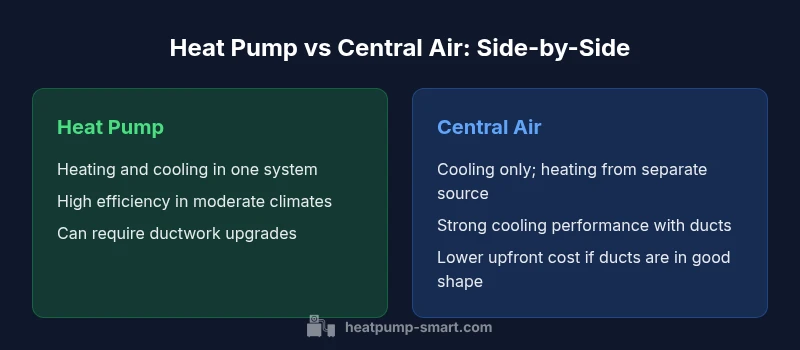
Heat pumps and central air both cool homes, but a heat pump can heat as well in milder climates, making it a versatile alternative. In general, heat pumps win for energy efficiency and year-round comfort in moderate climates, while central air may be cheaper upfront and easier to retrofit in existing homes. Choose based on climate, upfront budget, and long-term operating costs.
Overview: Heat Pump vs Central Air — What You Need to Know
According to Heatpump Smart, the choice between heat pump and central air hinges on climate, home design, and long-term goals. This article provides a detailed map of how the two options compare in practical terms for homeowners, builders, and property managers. Heat pump vs central air is not a one-size-fits-all decision, but a climate and design question that benefits from a structured evaluation. In many projects, the right choice blends system versatility with existing ductwork, insulation quality, and energy-rate considerations. Heatpump Smart's analysis shows that efficiency and comfort often hinge on climate zone, insulation, and electricity rates. Read on to understand the nuances and pick the option that best fits your project scope.
How Each System Works
Heat pumps move heat between indoor and outdoor spaces using a refrigeration cycle, operating in heating mode by extracting heat from outside air and transferring it indoors. They also cool by reversing the cycle. Some heat pumps are designed to work with existing ductwork and air handlers; others require fans and indoor coils for air distribution. Central air systems rely on a dedicated outdoor condenser and an indoor coil connected to ducts, with a separate heating source such as a furnace or boiler. In practice, this means heat pumps can provide warmth in milder winters and cooling in summer, while central air focuses on cooling and relies on the building's heating system for warmth. The performance depends on climate, insulation, duct design, and thermostat controls.
Energy Efficiency and Operating Costs
From an energy-efficiency perspective, heat pumps often outperform traditional air conditioners because they move heat rather than burn fuel. Modern heat pumps optimize COP (coefficient of performance) by leveraging electricity efficiently, especially during shoulder seasons and milder winter days. Central air can be highly efficient when paired with well-sealed ductwork and modern compressors, but heating efficiency depends on the connected heating system. Heatpump Smart analysis shows that in moderate climates, heat pumps tend to deliver meaningful energy savings over time, while the advantage narrows in extreme cold or heat if supplemental heat is required. The overall operating cost also hinges on electricity rates, insulation quality, and how well the system is sized and controlled.
Climate Performance and Heating Capabilities
Temperature ranges and humidity levels influence how well a heat pump delivers comfort. In moderate climates, heat pumps provide effective heating and cooling with consistent comfort and humidity management. In colder climates, some heat pumps require auxiliary heat sources to meet peak demand, which can affect efficiency during very cold days. Central air, while excellent for cooling, relies on its paired heating system for warmth and may be less flexible in shoulder seasons unless paired with a robust furnace or boiler. Brand and model selection matter here: newer cold-climate heat pumps perform much better than older variants, expanding their viable geographic footprint.
Installation Considerations and Costs
Installation logistics differ substantially between the two options. A central-air-only cooling system typically requires ductwork in place, which can lower incremental costs if ducts are already in good condition. A heat pump installation may involve outdoor equipment and an indoor air-handler or coil, and on some homes, ductwork will need updating or redesign. If ducts are in poor condition, sealing and insulation become essential, and retrofit work can raise cost and project duration. Heat pumps often involve electrical upgrades, refrigerant line runs, and thermostat integration. For renovations, the cost picture shifts toward total life-cycle value rather than upfront expenditure alone, particularly when long-term energy savings are a priority.
Installation Footprint: Ducts, Space, and Aesthetics
Duct layout and space planning influence both options. Central air benefits from an established duct network, but the presence of leaky or poorly insulated ducts can erode efficiency. Heat pumps may require outdoor space for the condenser and indoor space for the air handler; if no existing ducts exist, a full ducted system will be installed, or a ductless mini-split approach may be considered. Aesthetics and noise are practical considerations: outdoor units should be placed where they minimize visual impact and noise transmission, while indoor components should fit with room layouts and ceiling heights. Choosing a system with compact, quiet equipment can improve both comfort and satisfaction with daily use.
Maintenance and Durability
Regular maintenance is essential for both systems. Filters require periodic changes, and coils and condensers need periodic cleaning or servicing to maintain performance. Heat pumps add refrigerant considerations and may require more frequent diagnostics to ensure efficient operation, especially in temperate or variable climates. Central air maintenance tends to focus on duct cleanliness and the integrity of the heating source, with fewer refrigerant-handling tasks if the system is well designed. Both systems benefit from professional annual checkups, intelligent zoning, and properly calibrated thermostats to maximize efficiency and comfort.
Comfort, Humidity Control, and Indoor Air Quality
Heat pumps offer integrated humidity control and can provide more balanced dehumidification than traditional air conditioners when paired with modern controls. They enable consistent warmth during shoulder seasons, reducing drafts and temperature swings. Central air provides strong cooling performance, but humidity control depends on moisture removal through the cooling coil and the efficiency of the connected heating system. Indoor air quality improves with well-sealed ductwork, high-quality filters, and proper ventilation strategies. When indoor air is a priority, selecting equipment with good filtration and compatible air-purification accessories matters for long-term health and comfort.
Sizing, Ductwork, and System Design for Your Building
Sizing is a critical factor for both options. Undersized equipment will struggle during peak load, while oversized systems can cycle too quickly and fail to dehumidify effectively. Heat pumps benefit from climate-aware sizing and careful consideration of backup heat strategies for cold days. Central air sizing focuses on cooling loads, but the heating system must be matched to the duct network and the design of the home. A precise load calculation, insulation assessment, and duct sealing plan are essential to achieving comfortable temperatures and efficient operation in any configuration.
Noise, Home Integration, and Aesthetic Considerations
Outdoor-unit noise and indoor equipment placement influence user satisfaction. Modern heat pumps emphasize quieter outdoor units and low-profile indoor components, which helps them blend into residential settings. Central air equipment is often larger due to ducting and the outdoor condenser, which may impact yard space and curb appeal. Integrating smart controls, zoning, and remote monitoring can improve the user experience and optimize performance. Sound ratings and installation geometry should be discussed during early planning stages to minimize disruption and maximize comfort.
Financial Considerations, Incentives, and Payback Potential
Upfront costs vary depending on equipment choice, ductwork needs, and labor. Heat pumps can be more expensive to install than central air when ductwork must be added or upgraded, but long-term operating costs may be lower due to energy efficiency. Incentives, rebates, and tax credits influence total cost and payback timelines. It is important to model total ownership costs, including maintenance and potential electricity-rate changes, to gauge true value over the system’s life. Financing options and utility programs can further affect affordability and project feasibility.
Practical Scenarios: How to Decide in the Real World
- If your home already has a well-sealed ducts network and you live in a region with mild winters, a heat pump can deliver robust year-round comfort with strong energy savings. - If you face very cold winters or limited upfront budgets, central air paired with a conventional furnace or an efficient alternative heat source might be more practical today. - For renovations, assess insulation, air sealing, and existing ductwork before choosing. A careful, climate-informed evaluation helps you avoid over- or under-sizing the system and ensures a smoother installation.
Authority Sources and Quick Reading
To validate this comparison and extend your reading, consult credible sources that emphasize heat-pump technology, efficiency best practices, and government guidance. The Heatpump Smart team references established guidelines and invites you to review trusted materials from government and major publications for additional context and planning support. This section includes direct links to authoritative sources to help you make informed decisions.
Authority Sources
- Energy.gov – Heat Pumps: https://www.energy.gov/energysaver/heat-pumps
- Energy.gov – How Heat Pumps Work: https://www.energy.gov/energysaver/heat-pumps
- Energy Star – Heat Pumps: https://www.energystar.gov/products/heating_cooling/heat_pumps
Quick-start Checklist
- Confirm climate suitability and heating needs before choosing a system.
- Assess ductwork condition and insulation; plan for upgrades if needed.
- Compare long-term operating costs in addition to upfront price.
- Schedule professional load calculations and a system design review.
- Explore incentives and local rebates to improve payback.
Comparison
| Feature | Heat Pump (Air-Source) | Central Air Conditioning |
|---|---|---|
| Energy Efficiency | High (COP-driven performance in moderate climates) | Moderate (depends on ducted system and heating source) |
| Heating Capability | Yes, with ambient-temperature limits; may require backup heat in very cold days | Cooling only unless paired with separate heating source |
| Upfront Installation Complexity | Potentially higher due to outdoor unit and new/updated ductwork | Typically lower if existing ducts are in good condition |
| Operating Costs | Lower in moderate climates with efficient heat transfer | Typically higher or comparable depending on usage and rates |
| Climate Suitability | Best in moderate climates; improved cold-climate options exist | Best for cooling in all climates; heating relies on other systems |
| Noise Levels | Outdoor unit noise varies by model; modern units are quieter | Outdoor noise varies; generally comparable when well chosen |
| Maintenance & Lifespan | Requires regular refrigerant/system checks; comparable lifespan with proper care | Maintenance focused on filters and ducts; similar lifespan when well maintained |
| Space Requirements | Outdoor condenser plus indoor air handler; may require ducts or ductless options | Duct network required for whole-home cooling |
Advantages
- Year-round heating and cooling from a single system
- High potential for energy savings in moderate climates
- Improved humidity control and comfort with modern controls
- Flexible installation options with ductless and ducted variants
Disadvantages
- Higher upfront equipment and installation costs
- Cold-climate performance may require supplemental heat
- Ductwork retrofit can add complexity and cost in older homes
- Electrical upgrades may be needed for certain models
Heat pumps generally offer better year-round comfort and efficiency in moderate climates, while central air remains practical in very cold regions or when upfront cost is the priority.
The Heatpump Smart team recommends evaluating climate, insulation, and expected energy costs before deciding. In moderate climates, heat pumps offer superior efficiency and year-round comfort, while in extreme cold or budget constraints, central air can be the prudent choice.
Your Questions Answered
Can a heat pump replace central air entirely?
Yes, in many homes a heat pump can provide cooling as well as heating. Performance depends on climate, insulation, and ductwork. In very cold regions, assess backup heating needs.
Yes, for many homes a heat pump can replace central air for cooling as well as heating, but climate and ductwork matter.
Do heat pumps work well in cold climates?
Modern cold-climate heat pumps perform well in cool weather, but efficiency drops as outdoor temperatures fall. In very cold regions, you may need supplemental heating.
Yes, many heat pumps work in cool climates, but very cold days may require backup heat.
Are heat pumps more expensive upfront than central air?
Upfront equipment and installation costs for heat pumps can be higher, especially if ductwork must be added. Long-term savings depend on energy efficiency and usage.
Upfront costs can be higher for heat pumps, but long-term savings may offset this.
Which is better for energy savings: heat pumps or central air?
In moderate climates, heat pumps typically offer better energy efficiency and lower operating costs over time, compared with traditional central-air cooling.
Heat pumps often save more on energy in moderate climates.
What maintenance do these systems require?
Both require regular filter changes and periodic coil checks. Heat pumps may have additional refrigerant considerations and diagnostics depending on usage.
Both systems need regular maintenance; heat pumps may require extra refrigerant checks.
Top Takeaways
- Assess climate to prioritize heating needs
- Check ductwork status before choosing heat pumps or central air
- Favor heat pumps for year-round efficiency in moderate climates
- Consider long-term operating costs over upfront price
- Leverage energy-saving incentives when available