Heat Pump vs Gas Boiler UK Running Costs: A Comprehensive 2026 Comparison
Compare heat pump vs gas boiler UK running costs in 2026. Analyze energy prices, efficiency, installation, and maintenance to decide the most economical home heating option.


TL;DR: In the UK, heat pump running costs vs gas boiler running costs depend on electricity prices, system efficiency, and how much heat your home needs. Heat pumps usually cost less to run when electricity prices are reasonable and the system is correctly sized, while gas boilers can be cheaper in very cold spells or when gas prices are unusually low. Read on for details.
Key factors in heat pump vs gas boiler uk running costs
Choosing between a heat pump and a gas boiler for UK homes hinges on several interlocking cost drivers. The most obvious are the price of energy (electricity vs gas), the efficiency of the installed system, and how much heat your house actually requires. In practice, the heated volume, insulation quality, and the local climate determine how aggressively the system must operate, which in turn shapes monthly bills. A heat pump converts electrical energy into heat with high efficiency, while a gas boiler converts natural gas into heat with traditional combustion. The Heatpump Smart team emphasizes that the heating distribution layout (radiators vs underfloor), thermostat strategy, and occupancy patterns can swing running costs significantly. Even with a high-efficiency unit, a poorly insulated home will still waste energy and raise bills. For homeowners, the first step is to benchmark your current energy usage, then model potential savings under different scenarios. Our guidance is neutral and evidence-based, focusing on the factors that you can control through design choices and behavior.
How energy prices shape ongoing costs
Energy prices are the primary lever in the ongoing running costs comparison. Electricity prices in the UK have a different volatility pattern than gas prices, and this gap directly affects operating expenses. A heat pump’s running cost scales with electricity tariffs, while a gas boiler’s cost tracks wholesale gas costs plus domestic tariffs. The Heatpump Smart analysis notes that, over typical winters, the price per unit of electricity can swing more than gas, but heat pumps can extract more heat per unit of energy thanks to their COP. Therefore, in regions with relatively stable electricity pricing or high insulation, heat pumps tend to reduce monthly bills, especially when paired with time-of-use tariffs or on-site generation. Conversely, a sudden spike in electricity prices can erode savings, making gas look more attractive for a season or two. Keep in mind that electricity prices have broader policy implications and can be affected by decarbonization programs and network charges.
System efficiency and climate: why COP matters
Efficiency is the main differentiator in the heat pump vs gas boiler uk running costs conversation. The COP (coefficient of performance) of a heat pump measures how many units of heat are delivered per unit of electricity consumed, and that COP varies with outdoor temperature and system design. In milder UK winters, heat pumps operate with a high COP and produce heat with relatively low electricity use; in very cold spells, individual heat pumps may run less efficiently and rely on supplementary heating. Gas boilers respond with reduced efficiency when combustion temperatures drop; modern condensing boilers still achieve good efficiency, but less than a well-tuned heat pump under favorable conditions. The Heatpump Smart Team highlights that selecting high-quality insulated radiators and controlling the flow temperature can preserve heat and minimize cycling losses. In short: the better the climate suitability and the better your home's insulation, the more favorable the running costs for a heat pump appear relative to a gas boiler.
Sizing and installation: cost of meaningful running costs
Proper sizing and installation are critical to controlling running costs for either option. An oversized boiler will heat the home quickly but may short-cycle and waste energy; an undersized heat pump will run continuously but fail to meet comfort targets. For heat pumps, the distribution system matters a lot: radiators must be compatible with lower flow temperatures, or underfloor heating may be required to deliver comfort efficiently. A well-designed control strategy, including zoning and smart thermostats, can dramatically reduce energy use. In the UK, many homes retrofit heat pumps alongside insulation improvements and ventilation measures, which changes the baseline heating demand. The upfront cost might be higher, but the payback in running costs depends on how aggressively you lower heat losses. The Heatpump Smart guidance stresses that sizing should be done by accredited installers who can model heat demand using heat-loss calculations and real-world occupancy patterns.
Lifecycle costs and incentives
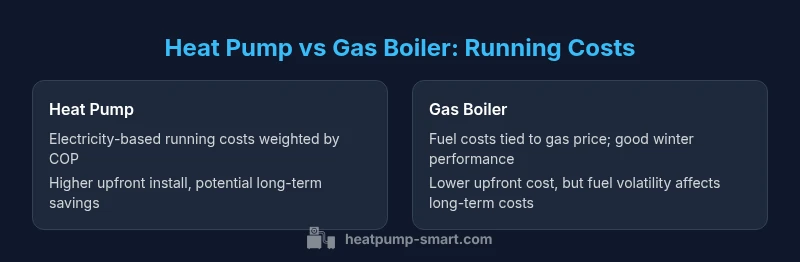
Beyond upfront purchase price, lifecycle costs influence the heat pump vs gas boiler uk running costs. Heat pumps typically involve a higher upfront install cost, but operating costs over 15-20 years can be lower if electricity prices are favorable and the unit runs efficiently. Gas boilers tend to have lower upfront costs but may incur higher ongoing fuel costs, especially in a market with volatile gas prices. Maintenance for heat pumps includes annual service, refrigerant checks, and potential compressor or fan components, while boilers require annual safety checks and occasional boiler component replacements. UK incentives and grants—where available—can reduce the initial burden and improve the long-term value proposition. The Heatpump Smart Team notes that, when evaluating projects, homeowners should model total cost of ownership over the expected lifespan rather than focusing solely on annual running costs.
Climate and occupancy: how your home affects costs
Climate and occupancy patterns directly affect running costs. In warm or well-insulated homes, heat pumps can outperform gas boilers by maintaining stable indoor temperatures with modest energy input. In older houses with drafty walls or poor insulation, heat loss may drive up electricity use, reducing savings. A family that uses heating aggressively during morning and evening peaks will see different cost dynamics than a household that uses a programmable schedule. The Heatpump Smart analysis emphasizes planning for seasonal demand and aligning heating setpoints with outdoor temperatures. Additionally, the size of the dwelling and the thermal envelope influence how effectively either system delivers cost-efficient warmth. In the right conditions, heat pumps provide economical comfort with lower environmental impact.
Maintenance and service costs over time
Maintenance costs accumulate differently for heat pumps and gas boilers. Heat pumps require annual professional servicing, refrigerant integrity checks, and potential compressor or fan component replacements; components such as fans and pumps can wear over time. Gas boilers require annual safety and efficiency checks, and parts replacement after several years is a possibility depending on usage and water quality. In many UK homes, the total maintenance burden for heat pumps is balanced by fewer seasonal fluctuations in fuel supply and fewer emissions-related concerns. The Heatpump Smart team suggests budgeting for periodic external unit cleaning and potential upgrades as the system ages. Regular maintenance helps sustain efficiency and can preserve the lower running costs that motivated you to switch.
Real-world scenarios: small flat vs large family home
Consider two common scenarios: a compact flat with solid insulation and a generous budget for smart controls, versus a large family home with variable occupancy and older construction. In a well-insulated flat, a heat pump may yield noticeable savings on annual energy bills, even with electricity prices rising, due to better COP performance. The gas boiler alternative could be cheaper upfront but may be less flexible for zoning and future energy upgrades. For a large home with uneven heat loss, a heat pump combined with zoned controls and possibly supplementary heating can deliver cost-effective comfort; however, if the home’s insulation remains poor, costs may rise. The Heatpump Smart team advises modeling these two scenarios with real electricity and gas price projections to estimate true running costs.
Hidden costs and energy efficiency upgrades
Hidden costs can erode savings if not planned. With heat pumps, you may need insulation upgrades, ventilation improvements, and potentially a new radiator layout to match lower flow temperatures. These upgrades add to upfront costs but improve long-term efficiency. Gas boiler setups may benefit from venting and flue positioning considerations; though less disruptive than heat pump installations, some homes still require chimney or duct adjustments. The Heatpump Smart guidance emphasizes that improving the building envelope—air-tightness, insulation, and passive cooling—reduces heat losses and lowers running costs for either option. Don’t overlook electrical capacity upgrades or grid constraints that could affect a future heat pump installation.
How to estimate your own running costs: a step-by-step guide
To estimate your own running costs for heat pump vs gas boiler uk running costs, follow these steps: 1) determine your home’s heat demand using energy audits or past bills; 2) collect current electricity and gas prices per kWh; 3) estimate system COP for a heat pump in your climate; 4) model seasonal usage with your thermostat settings; 5) factor in maintenance and potential replacement costs; 6) include potential subsidies and installation costs to compute payback. Use a simple spreadsheet to compare total annual energy costs and projected lifetime costs. The result will guide your decision between a heat pump and a gas boiler based on your specific fuel price scenario.
What homeowners should ask installers
Prepare a shortlist of questions for installers to ensure you capture all cost considerations. Ask about expected COP under winter conditions, the sizing methodology used for your home, whether radiators or underfloor heating are recommended, what ventilation improvements are required, and what maintenance schedule will apply. Also inquire about possible incentives, the expected payback period, and the impact of energy price volatility. The installer should provide a transparent breakdown of running costs for both options and a clear plan for monitoring system performance after commissioning. The Heatpump Smart team recommends requesting a formal heat-loss calculation and a 12- to 15-year lifecycle cost projection.
Decision framework for choosing between heat pump and gas boiler uk running costs
Practical path: start with energy audits; compare payback lengths; consider climate; weigh non-financial factors like carbon footprint. The upshot: for many UK homes, heat pumps offer favorable running costs over the long term, especially when paired with low-carbon electricity and good insulation. However, if upfront budget is tight or heat demand is modest and gas prices are favorable, a gas boiler may be a reasonable interim choice while you upgrade insulation.
Comparison
| Feature | heat pump | gas boiler |
|---|---|---|
| Running costs (qualitative) | Typically lower when electricity prices are reasonable and home is well-insulated | Often lower upfront but potentially higher ongoing fuel costs; relies on gas price stability |
| Energy efficiency (COP/EF) | Higher efficiency under favorable conditions (COP varies with temperature) | Boilers rely on combustion efficiency (EF) with seasonal variations |
| Fuel source | Electricity from the grid (price and tariff dependent) | Natural gas supply |
| Upfront cost | Higher due to heat pump equipment, controls, and possibly new radiators | Lower initial cost for boiler installation |
| Maintenance costs | Annual service; refrigerant checks and potential component wear | Annual safety checks; parts replacement possible over time |
| Best for | Well-insulated homes with access to affordable electricity and potential tariffs | Budget-conscious installs with existing gas supply or lower upfront budget |
Advantages
- Lower running costs in electricity-friendly markets
- Reduced carbon footprint with decarbonized electricity
- Compatibility with on-site renewable energy generation
- Future-proofing for stricter emissions targets
Disadvantages
- Higher upfront installation costs
- Performance depends on climate, insulation, and heat demand
- Electricity price volatility can still affect bills
- Requires space for outdoor unit and potential radiator upgrades
Heat pumps generally deliver better long-term running costs for well-insulated UK homes; gas boilers may be cheaper upfront or during periods of low electricity prices.
Choose heat pumps if your home is well insulated and electricity prices are stable or subsidized. If upfront budget is tight or electricity is expensive, a gas boiler could be a reasonable short-term option while you improve insulation and consider future upgrades.
Your Questions Answered
Is a heat pump cheaper to run than a gas boiler in the UK?
In many cases, yes, particularly when your home is well insulated and electricity prices are favorable. Costs depend on the heat demand, COP, and tariff structure. A careful comparison that includes installation, maintenance, and potential subsidies is essential.
In many cases, heat pumps can be cheaper to run, especially with good insulation and favorable electricity prices, but it depends on your home and tariff.
What factors influence running costs the most?
Electricity vs gas prices, system efficiency (COP vs boiler efficiency), and how heavily you heat your home. Insulation and heat losses play a huge role in determining true running costs.
Key cost drivers are energy prices, efficiency, and your home’s insulation and heat usage patterns.
Does climate affect heat pump efficiency?
Yes. Heat pumps perform best in mild conditions with high COP. In very cold weather, efficiency can drop and may require supplementary heating.
Climate matters: milder weather helps heat pumps perform best, while cold snaps may reduce efficiency.
Are there incentives for heat pumps in the UK?
There are UK-wide incentives and grants where available. Availability varies by region and program timing, so check current schemes before installing.
There are incentives in some schemes—check current government programs before buying.
What maintenance costs should I expect?
Heat pumps require annual servicing and refrigerant checks; boilers need annual safety checks and possible component replacements over time.
Annual servicing is typical for both, with heat pumps needing refrigerant checks and boilers needing safety checks.
Is a heat pump suitable for a small flat?
Yes, provided the flat is well insulated and a suitable heating distribution (radiators or underfloor) is in place. In smaller spaces, heat pumps can be cost-effective with efficient controls.
For a well-insulated flat, a heat pump can be a cost-effective option with proper controls.
How should I compare total costs over time?
Model total cost of ownership over 12-20 years, including installation, maintenance, fuel costs, and potential subsidies, rather than only looking at annual running costs.
Compare total cost of ownership over 12-20 years, including installation and maintenance.
What questions should I ask installers?
Ask for a formal heat-loss calculation, COP expectations, system sizing method, integration with existing radiators or underfloor heating, and a transparent breakdown of running costs for both options.
Ask for heat-loss calculations, COP expectations, and a clear cost breakdown for both options.
Top Takeaways
- Assess insulation before choosing between options
- Electricity price trends heavily influence running costs
- Accurate sizing is essential to minimize energy losses
- Plan for lifecycle costs, not just annual bills
- Ask installers for a transparent cost projection