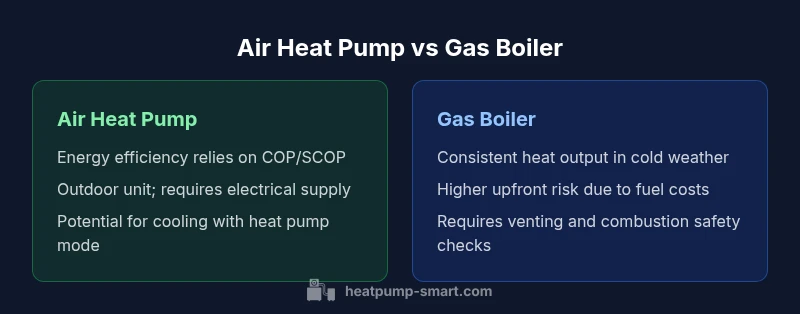
Air Heat Pump vs Gas Boiler: A Comprehensive Comparison
Compare air heat pumps and gas boilers across efficiency, installation, upfront and operating costs, climate performance, and environmental impact. Learn which option best fits your home, budget, and long-term energy goals.


When comparing air heat pump vs gas boiler, the decision hinges on climate, upfront cost, and long-term operating costs. For most homes in moderate climates, an air source heat pump offers higher efficiency and lower emissions, while a gas boiler can be cheaper upfront and perform reliably in very cold conditions. This quick view sets the stage for a deeper, data-driven evaluation.
Defining the air heat pump vs gas boiler
In the discussion of the air heat pump vs gas boiler, homeowners must understand the basic operating principles of each system. An air heat pump (often called an air-source heat pump) uses electricity to move heat from outdoor air into the home, essentially acting as a heat mover rather than a traditional heater. A gas boiler, by contrast, creates heat by burning natural gas to warm water that circulates through radiators or underfloor coils. Both deliver space heating and domestic hot water, but they rely on different energy sources and achieve different performance outcomes. According to Heatpump Smart, the best decisions begin with climate, insulation, and local energy prices, followed by careful assessments of installation feasibility and long-term costs. From there, homeowners can map expected comfort, emissions, and resilience. This framing helps you evaluate the core tradeoffs in the air heat pump vs gas boiler decision set.
Efficiency and performance metrics
Efficiency is not a single number for either option. A heat pump’s performance is typically described with COP (coefficient of performance) and SCOP (seasonal COP), which vary with outdoor temperatures and system sizing. Gas boilers are evaluated by AFUE (annual fuel utilization efficiency) ratings, which reflect efficiency over a heating season. In practice, heat pumps excel in milder weather and well-insulated homes, delivering high COPs that translate to lower electricity use per unit of heat. Boilers can maintain strong output regardless of outdoor temperature, but their fuel-based efficiency is limited by gas prices and combustion losses. Heatpump Smart analysis shows that the real-world choice often depends on winter climate, heating load, and the building’s thermal envelope. The framework should compare COP/SCOP trajectories with AFUE ratings to assess year-round efficiency.
Climate performance: cold weather realities
Cold-climate performance is a critical differentiator. Air heat pumps may experience reduced COP as outdoor temperatures drop, though modern cold-climate models mitigate much of this gap through advanced refrigerants and backup strategies. For homes facing extended sub-freezing periods, a gas boiler can deliver consistent heat at a known output, especially when paired with an efficient distribution system. Heatpump Smart emphasizes evaluating climate data, insulation quality, and the presence of supplementary heating to determine whether an air heat pump can maintain comfort without excessive auxiliary heat. In some locations, a hybrid approach—an air heat pump with a gas boiler backup—offers a balanced solution.
Installation, space, and retrofit considerations
Installing either system involves more than a simple swap. An air heat pump requires outdoor unit placement, refrigerant piping, a compatible electrical service, and compatible radiators or underfloor heating designed for lower-water temperatures. Gas boilers need venting, a gas supply, adequate combustion air, and sometimes upgrades to the home's boiler room. For retrofit projects, check existing radiator sizing, distribution system compatibility, and the potential need for insulation upgrades to maximize efficiency. Heatpump Smart recommends a professional heat-loss assessment to inform equipment sizing and ensure the most effective heat distribution strategy.
Costs: upfront vs operating expenses
Upfront cost considerations often favor gas boilers for some budgets, since installation can be simpler and the equipment price may be lower in certain markets. However, long-term operating costs shift toward heat pumps, particularly when electricity prices are favorable and the home is well-insulated. A rigorous analysis should compare capital expenditure, expected energy bills, and the system’s lifespan. Since energy prices fluctuate, a dynamic financial model that accounts for local electricity and gas rates, as well as maintenance needs, provides the most reliable guidance. Heatpump Smart emphasizes looking beyond sticker price to lifetime cost of ownership and potential rebates.
Environmental impact and incentives
Air heat pumps can substantially reduce direct emissions when the electricity supply has a lower carbon intensity, supporting decarbonization goals. Gas boilers emit CO2 from burning fossil fuel, contributing to a larger carbon footprint unless offset by green gas options. Rebates and incentives vary by region and program, but many jurisdictions offer subsidies for high-efficiency heat pumps and for replacing older fossil-fuel systems. Heatpump Smart highlights the importance of calculating embodied emissions of equipment and the broader environmental impact of each choice, not just annual operating emissions. Consider local incentives, grid decarbonization trajectories, and your home's insulation improvements when weighing the options.
Maintenance, reliability, and service considerations
Maintenance needs differ between the two technologies. Air heat pumps require regular outdoor unit inspections, refrigerant checks, and occasional condenser fan servicing. Gas boilers need annual combustion checks, vent inspection, and water-h piping upkeep. Noise from outdoor equipment is another consideration for heat pumps, particularly in densely populated areas. Reliability often correlates with installation quality and ongoing maintenance; both systems benefit from a planned service schedule and a service provider familiar with the chosen technology. Heatpump Smart notes that reliable maintenance ultimately preserves efficiency and comfort.
Real-world scenarios and decision guidelines
Consider a moderate climate with solid home insulation and a typical annual heating load. In such settings, an air heat pump frequently delivers superior energy efficiency and lower operational emissions, making it a strong long-term value. In regions with very cold winters, or where electricity costs are high, a gas boiler may remain a financially safer choice, especially if installed as part of a hybrid strategy. For older homes with radiators designed for higher water temperatures, upgrading to an air heat pump may require radiator and distribution adjustments. The decision should blend climate data, home envelope quality, and personal priorities for comfort, cost, and emissions.
A practical decision framework: 7 steps to decide
- Gather local climate data and your winter heating demand. 2) Assess your home’s insulation, air leakage, and thermal envelope. 3) Inventory existing heating distribution (radiators, underfloor, or ductwork). 4) Compare estimated annual energy costs and potential rebates. 5) Check electrical service capacity and gas line feasibility. 6) Consider futureproofing goals and climate resilience. 7) Run a staged implementation plan (e.g., hybrid system or phased upgrades) and choose the option that best aligns with your energy strategy and budget.
Comparison
| Feature | Air heat pump | Gas boiler |
|---|---|---|
| System type | air-source heat pump | gas-fired boiler |
| Efficiency metrics | COP/SCOP dependent on outdoor temperature | AFUE ratings vary by model |
| Upfront cost and installation | Typically higher upfront and requires outdoor unit | Often lower upfront with combustion equipment and venting |
| Operating costs | Low electricity use, highly climate-dependent | Gas costs fluctuate with fuel prices |
| Maintenance needs | Annual outdoor unit checks and refrigerant health | Annual combustion inspection and vent maintenance |
| Cooling capability | Can provide cooling with reverse cycle (if specified) | No dedicated cooling unless separate AC is added |
| Lifespan and durability | Typically 15-20 years with proper care | Typically 15-25 years depending on water heating component |
| Rebates and incentives | Often eligible for efficiency and decarbonization programs | May be eligible depending on efficiency upgrades and region |
| Best climate exposure | Moderate to mild climates; performs well with good insulation | Very cold climates may favor boilers or hybrid setups |
Advantages
- Lower long-term energy costs in favorable electricity markets
- Supports decarbonization goals and can reduce emissions
- Fewer on-site emissions with clean electricity when available
- Potential rebates for high-efficiency installations
Disadvantages
- Higher upfront investment and longer payback period
- Performance can drop in very cold weather without backup heat
- Electrical capacity or space for outdoor unit may be limiting
- Heat pumps require compatible distribution system (radiators/underfloor)
Air heat pump generally wins for most homes; gas boiler remains viable in very cold climates or when upfront budget is a constraint
For typical homes in temperate climates, an air heat pump offers better long-term efficiency and lower emissions. The Heatpump Smart team recommends weighing climate, insulation, and energy price trends; in harsh cold or strict budget scenarios, a gas boiler can still be the practical choice, or consider a hybrid approach.
Your Questions Answered
What is the main difference between an air heat pump and a gas boiler?
An air heat pump moves heat using electricity, while a gas boiler creates heat by burning gas. The heat pump relies on outdoor air temperatures and insulation, whereas the boiler depends on fuel costs and venting. Each has distinct implications for efficiency, emissions, and installation.
Air heat pumps pull heat from outside with electricity; gas boilers burn fuel to heat water. The choice hinges on climate, energy prices, and home insulation.
Will an air heat pump work in very cold climates?
Cold climates reduce heat pump efficiency, but modern cold-climate models perform well with backup heating strategies. In extreme cold, a gas boiler or a hybrid setup may maintain comfort more consistently.
In very cold areas, heat pumps may need a backup heat source, such as a gas boiler, for peak demand.
Do rebates apply to both systems?
Rebates and incentives vary by region and program. Both high-efficiency heat pumps and efficient gas boilers can qualify in some programs, especially where decarbonization targets are supported.
Check local programs for incentives on high-efficiency heat pumps and boilers.
What maintenance do these systems require?
Air heat pumps require annual checks of the outdoor unit and refrigerant system; gas boilers require annual combustion and vent inspections. Both benefit from professional servicing to sustain efficiency.
Regular service keeps both systems performing well and safe.
Is a hybrid system ever a good idea?
Yes. A hybrid system combines an air heat pump with a gas boiler to balance efficiency and reliability, especially in regions with wide temperature swings.
A hybrid can give you the best of both worlds in variable climates.
Top Takeaways
- Prioritize climate and insulation when choosing heating tech
- Factor lifetime energy costs over upfront price
- Check local rebates and grid carbon intensity for best value
- Consider a hybrid system in regions with extreme winters
- Ensure your distribution system matches low-temperature heat from heat pumps