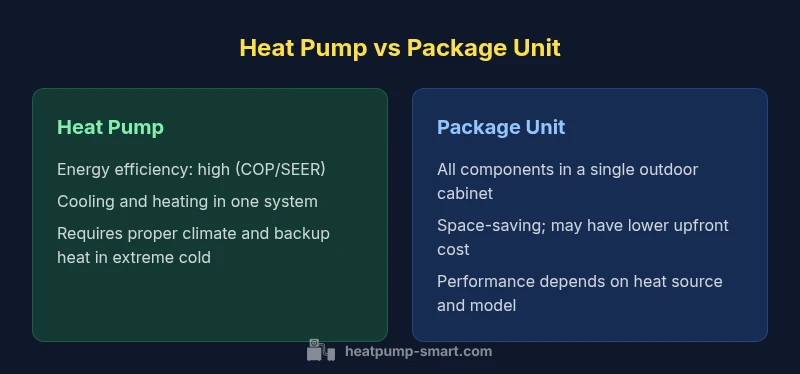
Heat pump vs package unit: An objective comparison
An objective, in-depth comparison of heat pumps and package units, covering efficiency, climate fit, costs, installation, and long-term value to help homeowners decide wisely.


Heat pump vs package unit: In most climates, a heat pump delivers higher overall efficiency and cooling, with lower energy bills over time. A package unit may cost less upfront and install more quickly, especially if your home already has ductwork. The right choice depends on climate, electricity costs, and long-term comfort goals. Heatpump Smart notes consider rebates and insulation for best value.
Defining the comparison: Heat pump vs package unit
For homeowners evaluating a single-system solution, the choice between a heat pump and a package unit matters more than branding. A heat pump is a refrigerant-based system that provides heating and cooling using electricity, often paired with supplemental heat in very cold weather. A package unit is a single outdoor cabinet that contains all heating and cooling components, designed to serve the home without a separate indoor unit. In practice, many homes with existing ductwork can opt for a packaged system that delivers both functions, or a split heat pump with an indoor air handler. This article adopts Heatpump Smart's objective framework to compare them across efficiency, climate fit, cost, and installation implications, avoiding marketing hype and focusing on real-world decision factors.
According to Heatpump Smart, the most important lens is the total cost of ownership: upfront investment, operating costs, maintenance, and potential incentives. This lens helps homeowners balance comfort, reliability, and environmental impact over the system’s lifetime.
How heat pumps work vs package units
A heat pump operates on a reversible refrigerant cycle: it extracts heat from the outside air (even when cold) and moves it indoors for heating, or reverses during cooling. It relies on electricity to run compressors and fans but can achieve high efficiency, especially in moderate climates. A traditional heat-pump-based installation is often split, with an outdoor condenser and an indoor air handler or furnace, connected by ductwork or pipes. A packaged unit, by contrast, places the major components in a single outdoor cabinet (sometimes paired with an indoor air handler), delivering heating and cooling without a separate central furnace. In some markets, packaged units may use electric resistance or gas for supplemental heat. The practical difference is how the heat source is delivered to the home and how the components are arranged for serviceability and duct integration.
Climate considerations and sizing
Climate and insulation heavily influence which option makes sense. Heat pumps excel in moderate to warm climates and can be highly effective when paired with proper insulation and a well-sealed envelope. In colder regions, modern cold-climate heat pumps with supplemental heat can be efficient, but some homes still benefit from a fossil-fuel backup when temperatures drop dramatically. Package units, including gas or electric variants, can deliver predictable heating performance in very cold climates, especially where electricity costs are high or winter temperatures routinely exceed design limits for heat pumps. Sizing matters for both options: a unit that is too small will struggle to maintain comfort during peak demand, while an oversized system can cycle excessively and waste energy. Energy-efficiency labels and professional sizing calculations (like manual J) help determine the better fit.
Energy efficiency and operating costs
Efficiency is a central differentiator. Heat pumps derive their efficiency from the ratio of heat moved to electricity consumed (COP) and the cooling efficiency (SEER). Many models offer higher overall efficiency in heating and cooling compared to traditional fossil-fuel or air-only systems, leading to lower operating costs over time. A packaged unit's efficiency is model-dependent and can be very good, but the heating side may rely on non-electric back-up heat in cold weather, impacting annual energy use. Electricity prices influence operating costs, with heat pumps typically favored when electricity is affordable relative to fossil fuels. Heatpump Smart analysis shows that the long-term savings hinge on climate, insulation, rebates, and how well the system is matched to the home’s heat load.
Installation considerations and ductwork compatibility
If your home already has ductwork, both options can integrate smoothly, but the installation approach differs. A heat pump system may require a new indoor air handler or a small furnace in a split configuration, while a packaged unit consolidates components in one outdoor cabinet and may simplify duct connections. Duct design, sealing, and zoning play major roles in delivering consistent temperatures and comfort. Homes with existing ducts should have a professional perform a load calculation and inspect duct leaks, as even well-rated equipment cannot overcome leaky or poorly designed ducts. In new construction, either option can be tailored to a home’s layout, but package units can save space and reduce indoor equipment counts in compact homes.
Maintenance, reliability, and lifecycle considerations
Both heat pumps and packaged systems require regular maintenance to preserve efficiency and reliability. Heat pumps benefit from refrigerant integrity checks, coil cleaning, filter changes, and annual checks of the compressor and reversing valve. Packaged units require similar maintenance plus attention to outdoor cabinet cleanliness and gas or electric backup heat components if present. In harsh environments, protective enclosures and corrosion-resistant components extend equipment life. A common risk is insufficient annual service, which can degrade performance. Regular professional inspections, air filter maintenance, and thermostat calibrations help maintain comfort and efficiency across both options.
Upfront costs, rebates, and long-term value
Initial cost is a major consideration. Heat pumps generally have higher upfront costs than single-fuel options but can be cost-competitive with fossil-fuel furnaces and air conditioners when rebates and incentives are factored in. Packaged units can offer a lower upfront price than a full split heat pump setup, depending on the model and heat source. The true value emerges from long-term energy savings, reliability, and the presence of incentives such as utility rebates or tax credits. Heatpump Smart recommends comparing installed costs, projected energy savings, and incentive eligibility in your region, then weighing the payback period and local climate needs. Energy costs and insulation quality will significantly influence ROI.
Best-use scenarios and decision criteria
When to choose heat pumps: favorable in moderate climates, strong cooling demand, and homes with good insulation where electricity is affordable relative to fossil fuels. When to consider a packaged unit: limited space, desire for a single outdoor cabinet, or locations where a fossil-fuel backup heat is acceptable or preferred. Decision criteria include climate, energy prices, duct integrity, space constraints, installation complexity, and the availability of rebates. Heatpump Smart emphasizes conducting a professional heat-load calculation, evaluating insulation levels, and considering future energy scenarios to determine which option delivers the best balance of comfort, reliability, and value.
Practical decision-making checklist
- Confirm your climate and typical winter temperatures.
- Get a professional load calculation for both options.
- Compare total installed costs, not just sticker price.
- Check for rebates, incentives, and tax credits.
- Assess ductwork condition and potential for sealing/retrofits.
- Evaluate long-term energy costs using local electric and gas prices.
- Consider future upgrades, like smart thermostats and zoning.
- Plan for maintenance intervals and service access.
Case studies and real-world considerations
Case Study A: A medium-sized home in a mixed climate with good insulation and existing ducts. A heat pump system delivered strong heating and cooling performance with solid energy savings once a proper seasonal efficiency rating was attained, and incentive programs reduced upfront costs. Case Study B: A compact urban home with limited space and older ducts. A packaged unit offered a space-saving, simpler solution with straightforward installation, though heat-related energy costs depended on the unit model and backup heat. These scenarios illustrate how site specifics and incentives shape the best choice.
Comparison
| Feature | Heat pump | Package unit |
|---|---|---|
| Energy efficiency (COP/SEER/HSPF) | Typically higher efficiency overall in heating and cooling | Model-dependent; can be highly efficient but may rely on backup heat in cold weather |
| Climate fit | Strong in moderate climates; cold-climate variants with aux heat | Work well in many climates; heating can depend on backup heat in cold snaps |
| Upfront cost | Higher upfront cost; rebates can improve economics | Often lower upfront than a full heat pump setup, depending on model |
| Operating costs | Lower long-term energy bills in many scenarios | Variable; can be higher if backup heat is used frequently |
| Space and installation | Two-piece systems (outdoor condenser + indoor air handler) | Single outdoor cabinet; simpler installation in compact homes |
| Maintenance | Regular refrigerant checks and coil cleaning needed | Similar maintenance; outdoor environment requires cabinet care |
| Reliability in extreme cold | Effective with cold-climate variants and supplemental heat | Reliable in many conditions, but heating capacity depends on model |
Advantages
- Higher long-term energy efficiency in many climates
- Consolidated technology for heating and cooling with careful design
- Potential incentives and rebates reduce payback period
- Fewer separate indoor units in some layouts
Disadvantages
- Higher upfront cost before incentives
- Performance can drop in extreme cold without auxiliary heat
- Longer payback period if electricity prices are high
- Complexity of refrigerant systems requires qualified technicians
Heat pump is the recommended option for most homes; package units remain viable in space-saving or budget-focused scenarios
Heat pumps typically offer better efficiency and comfort across seasons, with strong long-term value when properly sized and installed. Package units can be a practical alternative where space, upfront cost, or existing ductwork favors a simpler solution. The Heatpump Smart team confirms that rebates and climate context steer the best choice.
Your Questions Answered
What is the main difference between a heat pump and a package unit?
A heat pump uses a reversible refrigerant cycle to heat and cool your home, typically with separate indoor and outdoor components. A packaged unit combines all heating and cooling components in one outdoor cabinet and relies on ductwork inside. The choice depends on climate, space, and installation preferences.
Heat pumps heat and cool using one system, while packaged units put components in a single outdoor unit. The right choice depends on your home and climate.
Are heat pumps cost-effective in cold climates?
Heat pumps can be very efficient in cold weather when paired with modern cold-climate models and supplemental heat. Efficiency depends on outside temperatures, insulation, and how well backup heat is integrated. In some very cold areas, a fossil-fuel backup may be preferred for consistent comfort.
In cold climates, heat pumps can still work well with proper models and backup heat.
Can I upgrade my existing ducts for a heat pump or package unit?
Yes, ductwork often determines performance for either option. Leaky or undersized ducts reduce efficiency. A professional audit with duct sealing and appropriate sizing ensures your system delivers the expected comfort and energy savings.
Ducts matter—have them inspected and sealed to maximize efficiency.
Do rebates apply to both heat pumps and packaged systems?
Rebates and incentives are commonly available for both heat pumps and packaged systems, depending on local utility programs and energy policy. A contractor can help identify applicable programs and estimate net-installed costs.
Rebates can reduce the upfront cost for both options, depending on your area.
Is a heat pump better than a package unit for cooling only?
If cooling is the primary goal, both can perform well, but heat pumps typically offer higher integrated efficiency for cooling as part of a single system. For homes that don’t require heating, a high-efficiency air conditioner with appropriate design could be simpler and cost-effective.
For cooling-focused setups, both work, but heat pumps often deliver better overall efficiency.
What maintenance is required for these systems?
Regular maintenance includes filter changes, coil cleaning, and periodic professional inspections. Refrigerant levels in heat pumps should be checked by a licensed technician, and outdoor condensers require cleaning to prevent efficiency loss.
Keep filters clean and schedule annual checkups for best performance.
Top Takeaways
- Prioritize climate, insulation, and utility rates in your decision
- Evaluate total cost of ownership, not just upfront price
- Leverage incentives to shorten the payback period
- Ensure professional sizing to avoid comfort and efficiency losses