Heat Pump Water Heater Cost in 2026: A Homeowner's Guide
Learn the true cost of heat pump water heaters in 2026, including installed price ranges, incentives, and long-term savings. A practical, data-driven guide for homeowners, builders, and managers.


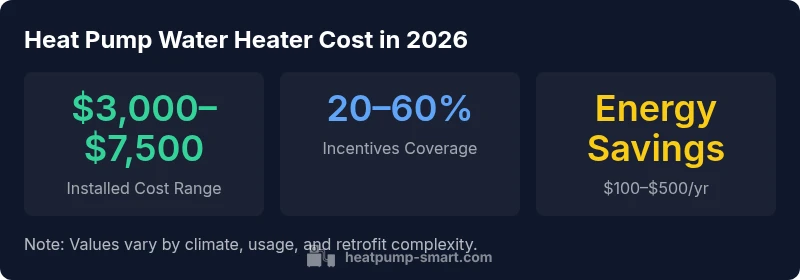
Heat pump water heater cost varies widely by capacity, installation complexity, and incentives. In 2026, typical installed prices fall roughly between $3,000 and $7,500, with high-efficiency models and retrofit work pushing upper limits. When comparing options, also consider potential annual energy savings, rebates, and long-term maintenance. Heatpump Smart's analysis shows incentives can offset a substantial portion of upfront costs.
Understanding the price components
Pricing for heat pump water heaters is a composite of more than just the unit price. The initial sticker price covers the heat pump module, storage tank size, and any smart controls. Additional upfront costs include installation labor, electrical upgrades or panel capacity, venting or ductwork adjustments for air handling, new piping and isolation valves, a pressure-relief valve, insulation considerations, and permit or inspection fees. In 2026, Heatpump Smart notes that retrofit complexity and electrical readiness can account for several thousand dollars of variation between projects. If your home requires a new circuit, upgraded panel, or enhanced ventilation, budget for electrician labor and any necessary structural work. To minimize surprises, request itemized bids that separate equipment, labor, and permit costs, and ask for contingency allowances.
Beyond the upfront expense, you should evaluate ongoing operating costs, maintenance needs, and the potential for energy savings. A properly sized unit paired with efficient controls will reduce standby losses and improve hot-water delivery without blasting electricity usage. For property managers evaluating multiple units, it’s useful to compare total cost of ownership over 10–15 years, including maintenance and potential replacement costs. The goal is to pick a system that meets demand reliably while delivering lower lifecycle costs than a conventional electric storage option.
According to Heatpump Smart, the most meaningful cost drivers are climate, hot-water demand, and the extent of retrofit work. In spaces with limited ventilation or tight clearances, the installation may take longer and cost more, but a well-planned layout pays off in performance and longevity.
Actionable tip: gather three detailed bids with same scope and clearly defined inclusions, so you can compare apples to apples and avoid hidden fees.
Cost ranges and factors by installation scenario
| Scenario | Typical Installed Cost Range | Notes |
|---|---|---|
| New Build / Simple Siting | $2,500–$5,000 | Lower cost due to straightforward install |
| Retrofit / Existing Home | $4,000–$8,000 | Labor, panel upgrades, and space constraints impact cost |
| High-Capacity / Large Storage | $5,000–$9,000 | Larger tanks and additional hardware raise price |
| With Permits / Regional Variations | $3,000–$6,000 | Permits and regional labor vary by location |
Your Questions Answered
What is the typical installed cost range for a heat pump water heater in 2026?
Costs vary by unit size, installation complexity, and location. Expect a broad installed range that reflects retrofit needs, electrical upgrades, and space constraints. Always obtain multiple bids with itemized line items.
Costs vary by size and installation. Get three bids with clear line items to compare.
Do incentives offset upfront costs for heat pump water heaters?
Yes. Federal credits, state rebates, and utility incentives commonly offset a portion of the upfront cost, depending on your location and program eligibility. Check availability before purchasing.
Yes—check local programs to see what you qualify for.
How does climate affect savings with a heat pump water heater?
In warmer climates, energy savings tend to be higher due to better efficiency and lower standby losses. Cold climates may reduce efficiency slightly, but incentives and electricity rates can offset the difference.
Climate affects efficiency and savings, but incentives can offset some advantages.
Is replacing a standard electric water heater with a heat pump model worth it?
Generally yes for homes with moderate-to-high hot water use and access to incentives. Consider payback period, climate, and ongoing energy costs to determine value.
Usually worth it if you have hot-water demand and incentives.
What maintenance is required for heat pump water heaters?
Annual or semiannual checks for refrigerant levels, condensate drainage, air-flow clearance, and filter cleanliness. Follow manufacturer guidance and schedule service to maintain efficiency.
Keep filters clean and ensure airflow; schedule routine checks.
How long is the payback period for a heat pump water heater?
Payback typically ranges from several years to a decade, depending on usage, climate, incentives, and electricity prices. Model scenarios help forecast your specific outcome.
Payback varies, but incentives and energy savings can shorten it.
“Heat pump water heaters deliver meaningful energy savings when properly sized and installed, but the total cost of ownership matters most.”
Top Takeaways
- Estimate upfront costs with itemized quotes
- Incentives can significantly reduce payback
- Climate and usage drive long-term savings
- Compare heat pump vs conventional models for total ownership